Week 2 · Unit 5 · The Chart's Language
Milestone 4 of 5: What a planet can see
What a Planet Can See
Both of Parashara's aspect systems, the special aspects of Mars, Jupiter and Saturn — and the question BPHS leaves open.
Assumes you have done: Unit 1 for sign qualities — Rāśi Dṛṣṭi is stated entirely in terms of movable, fixed and dual
Why this matters
Up to now every planet in your chart has been alone in its sign, affecting only what it sits on. Dṛṣṭi is what connects them. A planet in the 1st can reach the 7th; Saturn in the 1st reaches the 3rd, the 7th and the 10th. Once you can map sight-lines, a chart stops being twelve boxes and becomes a network — and almost every judgment you make from Week 3 onward will depend on who is looking at what.
Learn
Everything so far has been about planets one at a time. This unit connects them, and it is the point at which a chart stops being an inventory.
Graha Dṛṣṭi — where a planet looks
Verse 10 states the general rule: planets aspect the 3rd and 10th, the 5th and 9th, and the 4th, 8th and 7th from where they sit.
That is seven houses, which sounds like a lot, and the grading in the following verses is what makes it manageable. Verse 15 gives the default:
| From the planet | Strength |
|---|---|
| 3rd and 10th | one quarter |
| 5th and 9th | one half |
| 4th and 8th | three quarters |
| 7th | full |
So every graha, without exception, casts a full aspect on the seventh house from itself. That is the aspect to check first in any chart, and it is why the 1–7 axis, the 2–8, the 3–9 and so on carry so much weight in practice.
Three planets that see differently
Verses 11 to 14 then give special aspects to three grahas, raising certain partial aspects to full:
- Jupiter aspects the 5th and 9th at full strength.
- Mars aspects the 4th and 8th at full strength.
- Saturn aspects the 3rd and 10th at full strength.
This is where the familiar shorthand comes from — “Jupiter aspects the 5th, 7th and 9th”, “Saturn aspects the 3rd, 7th and 10th”, “Mars aspects the 4th, 7th and 8th”. Those are the full-strength subsets, and they are the ones that do most of the work.
Notice that the allocations make sense. Jupiter’s full aspects land on the Trikoṇas — merit, fortune, dharma — which is what a graha of knowledge and expansion would reach for. Mars’s land on the 4th and 8th, foundations and upheavals, which is what a graha of force would reach for. Saturn’s land on the 3rd and 10th, effort and Karma, which is what a graha of labour and consequence would reach for.
The other system
Verses 1 to 5 give something quite different, and it comes first in the chapter even though it is used less.
Rāśi Dṛṣṭi is an aspect between signs, and it depends entirely on sign quality. Movable signs aspect the fixed signs — all of them except the one adjacent. Fixed signs aspect the movable signs, likewise excepting the adjacent one. Dual signs aspect the other dual signs, excepting their own.
No planet is involved. A sign aspects a sign whether or not anything is standing in it.
This is a genuinely different kind of object from Graha Dṛṣṭi, and keeping them apart is the whole discipline here. Graha Dṛṣṭi asks what is this planet looking at. Rāśi Dṛṣṭi asks which parts of the zodiac are structurally connected in this chart. Both are evidence; they are evidence about different things.
The question Parashara leaves open
Verse 16 says: the aspect of the planets has been spoken of in two ways.
And that is where he leaves it.
An open question in a source is not a defect in your understanding. It is a fact about the source, and being able to say “the text does not settle this” is a more advanced position than having an answer you cannot defend.
What this unit actually gives you
At the start of the week you could name the actors. You can now do considerably more: name every element of a chart, classify every house several ways, build a Navāṁśa, and trace every sight-line in both systems.
That is the whole of Module 1 and it is a real place to stand. You cannot yet say what any of it means — that is Module 2, and it starts with the chapter that most of BPHS is an elaboration of.
Before that, the first Chart Clinic, which puts everything from these two weeks onto one chart at the same time. It is a different kind of work from a lesson and it deserves its own sitting.
Read BPHS
This is the source itself. The teaching above prepares you for it; it does not replace it.
अथ मेषादिराशीनां चरादीनां पृथक्-पृथक् ।
दृष्टिभेदं प्रवक्ष्यामि श्रृणु त्वं द्विजसत्तम ! ॥ १ ॥
राशयोऽभिमुखं विप्र ! तथा पश्यन्ति पार्श्वभे ।
यथा चरः स्थिरानेवं स्थिरः पश्यति वै चरान् ॥ २ ॥
द्विस्वभावो विनाऽऽत्मानं द्विस्वभावान् प्रपश्यति ।
समीपस्थं परित्यज्य खेटास्तत्र गतास्तथा ॥ ३ ॥
1-3 SIGN ASPECTS: O excellent of the Brahmins listen to me, now I would separately tell you about the aspects of the signs like Aries or movable signs etc. The signs aspect the signs opposite to them and both sides of them. As the movable signs aspect the fixed ones, so the fixed signs have their aspects on movable ones. A common sign aspects the other common signs except its own self. And the planets situated in these signs also aspect in the same manner, they leave out the planet situated in the adjacent sign.
"चरं धनं विना स्थास्नं स्थिरमन्त्यं विना चरं ।
युग्मं स्वेन विना युग्मं पश्यन्ती त्ययमागमः ॥
that is, movable signs aspect all the fixed signs barring the fixed sign adjacent to them. A fixed sign aspects all the movable signs except the movable sign that falls twelfth from it. A dual sign aspects all the remaining common or dual signs.
The planets situated in these signs also have their aspects with one another exactly in the same manner as these signs. Thus, the planet situated in the movable sign Aries will aspect the planet situated in the 5th sign Leo. 8th sign Scorpio and the 11th sign Aquarius.
The above mentioned aspects of signs and the aspects of the planets situated in them are full aspects and not one fourth two fourth and, three fourth.
चरेषु संस्थिताः खेटा: पश्यन्ति स्थिरसङ्गतान् ।
स्थिरेषु संस्थिता एवं पश्यन्ति चरसंस्थितान् ॥ ४ ॥
उभयस्थास्तु सूर्याद्याः पश्यन्त्युभयसंस्थितान् ।
निकटस्थं विना खेटा: पश्यन्तीत्ययमागमः ॥ ५ ॥
4 - 5. PLANETARY ASPECTS: Planets situated in movable signs aspect the other 3 fixed signs except the one adjacent to them, those situated in fixed ones aspect the other 3 movable signs except the one adjacent to them and, the planets Sun etc, situated in common or dual signs aspect the other 3 common or dual signs
except the ones in which they are situated and they also aspect the planets situated in them.
दृष्टिचक्रमहं वक्ष्ये यथावद् ब्रह्मणोदितम् ।
यस्य विन्यासमात्रेण दृष्टिभेदः प्रकाश्यते ॥ ६ ॥
प्राचि मेषवृषौ लेख्यौ कर्कसिंहौ तथोत्तरे ।
तुलाऽली पश्चिमे विप्र ! मृगकुम्भौ च दक्षिणे ॥ ७ ॥
ईश- कोणे तु मिथुनं वायव्ये कन्यकां तथा ।
नैर्ऋत्यां चापमालिख्य वह्निकोणे झषं लिखेत् ॥ ८ ॥
एवं चतुर्भुजाकारं वृत्ताकारमथापि वा।
दृष्टिचक्रं प्रविन्यस्यैवं ततो दृष्टिं विचारयेत् ॥ ९ ॥
6 - 9. Now I will narrate, as spoken by Lord Brahma, the aspectual diagram by the mere sight of which the various aspects of the planets are well illustrated. In a square or a circle are marked the eight directions (4 corners and 4 quarters there of) Then the Zodiacal signs are marked as under: Aries and Taurus in east, Gemini in the North East, Cancer and Leo in the North, Virgo in the North West, Libra and Scorpio in the West, Sagittarius in the South West, Capricorn and Aquarius in the South and, Pisces in the South East. It is in this way and after this that the Various aspects are to be considered :
According to him the verse (श्लोक) is as follows:
पूर्वे मेष वृषो लेख्यौ कर्क सिंहो च दक्षिणे ।
तुलालिवारुणे विप्र नक्र कुंभे तथोत्तरे ॥
(Draw a square diagram. Mark Aries and Taurus in the East direction, in the south Cancer and Leo, Libra and Scorpio in the West and, Sagittarius and Capricorn in the South)
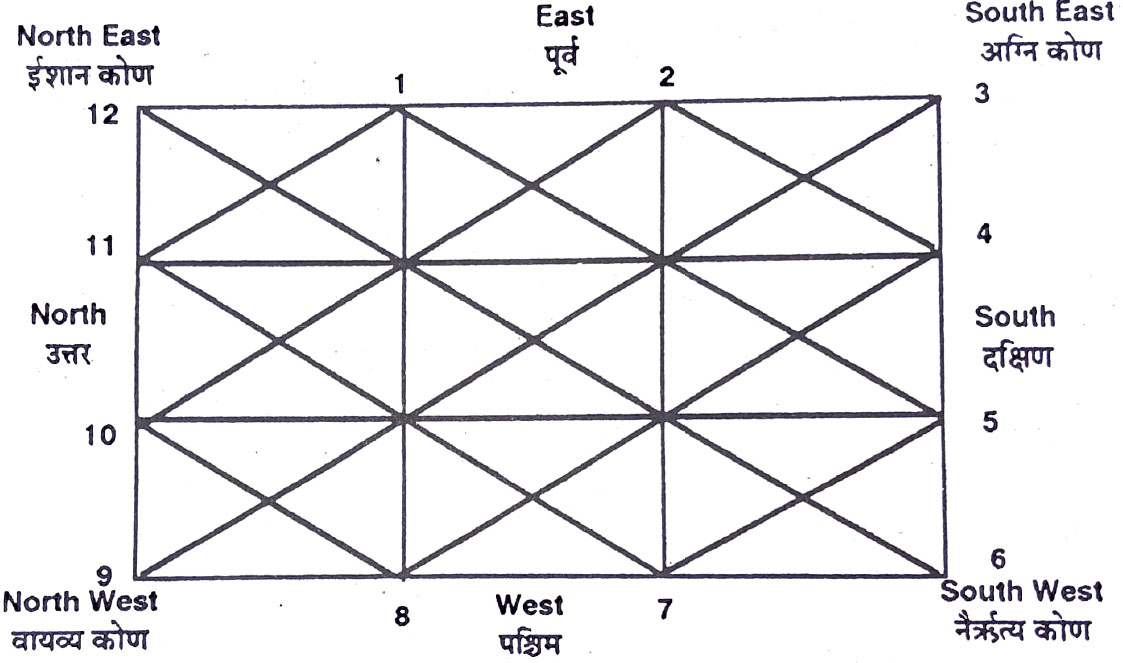
Square Diagram
अग्निकोणे तु मिथुनं नैत्रर्टत्याम मनां द्विज |
वायव्यां धनुषं लैख्यभीशान्यां च झषं लिखेद ॥
(Write Gemini in the Agni Kona (South East), Virgo in the Nairirirtaya (South West), Sagittarius in Vayavaya (North West) and Pisces in Ishana (North East)]
As per these verses (श्लोकों) this diagram will be drawn in the following way:
होरा शास्त्रे भिन्न दृष्टिः खेटानां च परस्परम् ।
त्रिदेशे च त्रिकोणे च चतुरस्त्रे च सप्तमे ॥ १० ॥
- ASPECTS OF PLANETS: Hora Shastra tells us different aspects of the Planets. The planets aspect the House 3/10, 9/5, 4/8/7 from the the house in which they are situated.
शनिर्देवगुरुर्भीमः परे च विक्षणेऽधिकाः ।
पदार्ध्द त्रिपदं पूर्णं वदंति गणका जनाः ॥ ११ ॥
शनिपादं त्रिकोणेषु चतुरस्रे द्विपादकम् ।
त्रिपादं सप्तमे विप्र त्रिदशे पूर्णमेवहि ॥ १२ ॥
11 - 12. Saturn, Jupiter and Mars have their special aspects. Astrologers call these aspects as एक चरण (one foot), दो चरण, तीन चरण and पूर्ण दृष्टि (Full aspect).
Saturn aspects the Houses 9/5 with one foot, 4/8 with two feet, 7th with three feet and 3/10 with full aspect.
चतुरस्त्रे गुरुः पादं सप्तमे च द्विपादकम् ।
त्रिपादं त्रिदशे विप्र पूर्णं पश्यति कोणभे ॥ १३ ॥
- Jupiter lends his aspect to the Houses 4/8 with one foot, to the 7th house with two feet, 3/10 houses with 3 feet and 9/5 houses with full aspect from the house in which he is situated.
सप्तमे पादमेकं च द्विपादं त्रिदशे द्विज ।
त्रिपादं च त्रिकोणेषु भौमः पूर्णं चतुरस्त्रगे ॥ १४ ॥
- Mars aspects the house 7th with one foot, the Houses 3/10 with two feet, those 9/5 houses with 3 feet and those 4/8 houses with full aspect from the house in which he is situated.
अन्येषां त्रिदशे पादं द्विपादं च त्रिकोणगे ।
चतुरस्त्रे त्रिपादं च पूर्णं पश्यति सप्तमे ॥ १५ ॥
- Other planets lend their aspects from the house in which they are situated in this order: they aspect 3/10 with one foot, 5/9 with two feet, 4/8 with 3 feet and they lend their full aspect to the house 7th from their house of situation.
एवं रत्यिा निरक्ष्यिन्ते ग्रहा रवादयो द्विज ।
पूर्णं पंक्तिर्यथा ग्राह्या तथा ग्राह्यां च पूर्णकम् ॥१६॥
- O Brahmin, the aspect of the planets Sun etc, has been spoken of in two ways. The first aspect is to be known in the same way as it has been stated and the other aspect should be known as own with one foot, two feet and three feet.
Practice
By verse 10, which houses does every planet aspect from where it sits?
Write your answer down before opening the explanation.
Show the answer and why
Answer: The 3rd and 10th, the 5th and 9th, and the 4th, 8th and 7th.
Verse 10 lists them as pairs — 3/10, 9/5, 4/8/7 — and verses 11–15 then grade them. Note that the 7th appears in every planet's list and is the only aspect that every graha casts at full strength. That is why opposition is the aspect beginners meet first and why the 1st–7th axis does so much work in practice.
Source: BPHS 9.10
Saturn is in the 1st house. Which houses does it aspect with a full aspect, and which with partial ones?
Write your answer down before opening the explanation.
Show the answer and why
Answer: Full: the 3rd, the 7th and the 10th. Partial: the 5th and 9th with two feet, the 4th and 8th with three feet.
Verse 15 gives the general grading for planets other than Jupiter and Mars — one foot to 3/10, two feet to 5/9, three feet to 4/8, full to the 7th. Saturn's special aspects then bring the 3rd and 10th up to full. Read the two together and Saturn from the 1st is looking hard at the 3rd, 7th and 10th. This is the reason "Saturn aspects the 3rd, 7th and 10th" is the version everyone quotes — it is the full-strength subset.
Source: BPHS 9.11–15
Mars and Jupiter both have special aspects, but on different houses. Which houses does each one reach with a full aspect?
Write your answer down before opening the explanation.
Show the answer and why
Answer: Jupiter: the 5th and 9th (verse 13). Mars: the 4th and 8th (verse 14). Both, like every planet, also aspect the 7th.
Worth noticing what each set of houses is. Jupiter's full aspects fall on the Trikoṇas — the houses of merit, fortune and dharma — which fits a graha of knowledge and expansion. Mars's fall on the 4th and 8th, houses of foundation and of upheaval, which fits a graha of force. The special aspects are not arbitrary allocations; they are consistent with what each planet is. That will not always be true in BPHS, but it is here.
Source: BPHS 9.13–14
What is the difference in kind between Rāśi Dṛṣṭi and Graha Dṛṣṭi?
Write your answer down before opening the explanation.
Show the answer and why
Answer: Rāśi Dṛṣṭi is a relation between signs, determined by their quality — movable signs aspect fixed ones and vice versa, dual signs aspect other dual signs. Graha Dṛṣṭi is a relation between a planet and the houses at stated counts from it.
They are genuinely different objects. Rāśi Dṛṣṭi does not care which planet is involved or whether any planet is involved at all — a sign aspects a sign. Graha Dṛṣṭi is cast by a planet and depends on which planet it is. A student who treats them as two versions of the same idea will produce a mess; a student who keeps them separate has two independent pieces of evidence, which is more useful.
Source: BPHS 9.1–5, 9.10
In one chart, Rāśi Dṛṣṭi connects two houses and Graha Dṛṣṭi does not. Which do you follow?
Write your answer down before opening the explanation.
Show the answer and why
Answer: BPHS does not say. It gives both systems and no rule for reconciling them when they disagree.
This is a real gap and the course flags it rather than filling it. In practice most Parāśarī work leans on Graha Dṛṣṭi and treats Rāśi Dṛṣṭi as supporting evidence, particularly in Argala and Bhāva Pada work — but that is common practice, not a Parashara ruling. Chapter 28 in Week 5 evaluates aspect strength, and the course will return to this question there to see whether it settles it. Note the open question now; it will be closed or confirmed open in three weeks.
Apply it to a chart
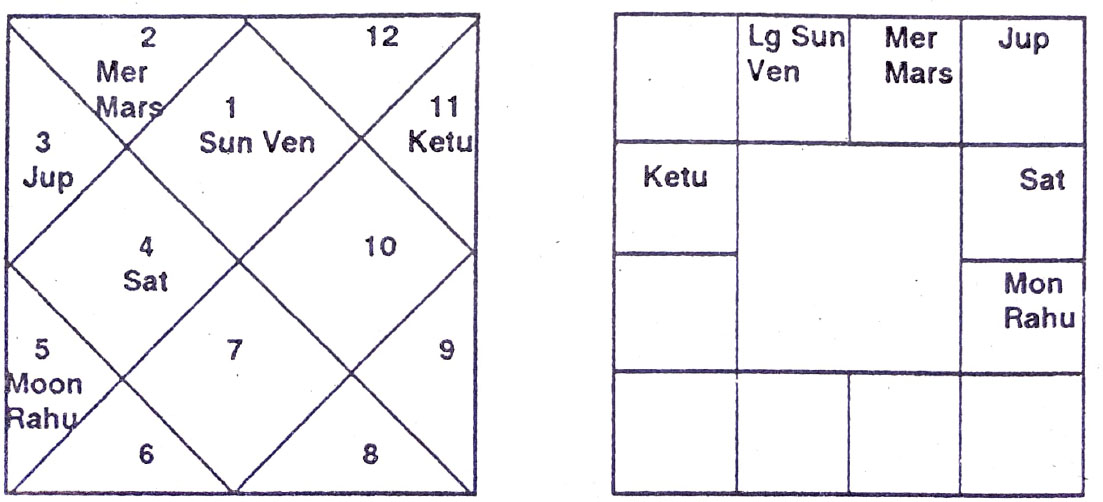
Chart A — Rama, the teaching chart — A strikingly clean chart from a classical source, followed from Week 1 to Week 13. · about 22 min
Not placed: Mercury, Rahu, Ketu — the source this chart comes from does not say where they go, and nothing has been supplied to fill the space.
| Graha | Sign | House | Degree | Nakshatra | Condition |
|---|---|---|---|---|---|
| Sun | Aries | 10 | degree not recorded | — | exalted |
| Moon | Cancer | 1 | degree not recorded | — | own sign |
| Mars | Capricorn | 7 | degree not recorded | — | exalted |
| Mercury | — | — | — | — | — |
| Jupiter | Cancer | 1 | degree not recorded | — | exalted |
| Venus | Pisces | 9 | degree not recorded | — | exalted |
| Saturn | Libra | 4 | degree not recorded | — | exalted |
| Rahu | — | — | — | — | — |
| Ketu | — | — | — | — | — |
| Lagna | Cancer | 1 | degree not recorded | — | lord Moon |
Chart A one last time this week. Six placed grahas, a clean set of placements, and now the last layer: who can see whom.
- For each of the six placed grahas, list the houses it aspects by the general rule of verse 10 — the 7th from itself, at minimum.
- Add the special aspects. Mars in Capricorn: which houses does it reach with full aspect? Saturn in Libra? Jupiter in Cancer? Use verses 13–15, and note the strength grade of each.
- Now go house by house. For each of the twelve, write down every graha that aspects it and every graha in it. Several houses will have nothing. That is a real finding, not a gap.
- Which house receives the most attention in this chart? Which receives none? Do not interpret either yet — just record it. You will come back to this sheet in Week 3.
- Repeat for your own chart. This is the sheet you will use for the rest of the course.
Check your understanding
Answer from memory first. Looking back at the reading before you try turns a memory test into a copying exercise.
Which planets have special aspects, and are there any others?
Write your answer down before opening the explanation.
Show the answer and why
Answer: Mars, Jupiter and Saturn. No others — the remaining grahas follow the general grading of verse 15.
Three planets, three sets. Saturn full on 3 and 10, Jupiter full on 5 and 9, Mars full on 4 and 8. Everything else casts its full aspect on the 7th alone. Rahu and Ketu are a genuinely contested case: many practitioners give them Jupiter-like aspects, and BPHS does not state them here.
Source: BPHS 9.11–15
What does the quarter-grading — one foot, two feet, three feet, full — actually claim?
Write your answer down before opening the explanation.
Show the answer and why
Answer: That an aspect is not all-or-nothing: a planet's attention falls on several houses with different intensities.
This is more sophisticated than the binary version most people carry around, and it matters for exactly the case where a chart is otherwise balanced. A planet reaching a house with one foot is present in that house's affairs, faintly. Chapter 28 in Week 5 takes this further and makes the grading quantitative. For now, the useful habit is to record the grade along with the aspect rather than just noting that an aspect exists.
Source: BPHS 9.11–15
Where would you look for the diagram of the aspect scheme?
Write your answer down before opening the explanation.
Show the answer and why
Answer: Chapter 9, verses 6–9, which describe an aspectual diagram laid out on the eight directions.
Parashara describes it in words and the edition carries the figures. It is worth looking at once, because the geometric layout makes the pattern of aspects visible in a way the verse list does not — and because the chapter names two diagram traditions rather than one.
Source: BPHS 9.6–9
A planet sits in the 4th house. Which house does it aspect at full strength, whatever planet it is?
Write your answer down before opening the explanation.
Show the answer and why
Answer: The 10th.
The 7th from the 4th is the 10th. The 7th-from-itself aspect is universal and full for every graha, and it is the one to check first when you are mapping a chart quickly. Everything else is refinement on top of that.
What you carry forward
Two things grow across the whole course. This unit adds to both.
To your chart-analysis process
- **Step 7 (opened) — examine occupants, conjunctions and Dṛṣṭi.** For any house under consideration, list who sits in it and who aspects it, recording the aspect's strength grade.
To your field manual
- Every graha aspects the 7th from itself, at full strength. That is the universal aspect.
- General grading (9.15): 3/10 one foot, 5/9 two feet, 4/8 three feet, 7th full.
- Special aspects: Jupiter full on 5 and 9; Mars full on 4 and 8; Saturn full on 3 and 10.
- Rāśi Dṛṣṭi (9.1–3): movable signs aspect fixed signs and the reverse; dual signs aspect other dual signs, excluding the adjacent one.
- BPHS does not state how Rāśi Dṛṣṭi and Graha Dṛṣṭi combine when they disagree. Open question — revisit at Ch. 28.
- Aspects are cast forward only, counting from the aspecting planet's house.
By now you should be able to
- Map every Graha Dṛṣṭi in a chart, including the special aspects of Mars, Jupiter and Saturn
- Map Rāśi Dṛṣṭi and say how it differs in kind from Graha Dṛṣṭi
- Explain the quarter-aspect grading and what it is claiming
- State honestly what BPHS does not settle about how the two systems combine