Week 12 · Unit 2 · Specialized Horoscopy, Remedies and Completion
Milestone 2 of 5: Female horoscopy, and what the body shows
Female Horoscopy
Chapter 82 — Parashara's own framing of what is general and what is specific, read accurately and in context.
Assumes you have done: The general method — which is, on Parashara's own statement, most of what applies here
Why this matters
This chapter is often either skipped or presented without comment, and neither serves a reader well. Parashara opens it by stating something important: that everything already given applies equally, and what follows is what he adds. That framing is the honest way to teach it. Much of the content is located in a particular society at a particular time, and saying so plainly is neither apology nor endorsement — it is accuracy.
Learn
Two chapters that are usually either skipped or presented without comment. Neither serves a reader.
Parashara’s own framing
Maitreya asks how to ascertain results for a female native. Parashara’s answer, in verses 2 to 4, is the most important thing in the chapter:
What all results relating to the male horoscopy which have been narrated so far, be also considered for the female horoscopy. However, what are specific…
Read that carefully.
The general method applies unchanged. Houses, lords, kārakas, dignity, strength, functional nature, yogas, Aṣṭakavarga, Viṁśottarī — all of it, without modification.
What follows is an addendum.
Reading the rest accurately
The chapter contains two kinds of material and they need different handling.
Technique. A verse that states a chart configuration and what it indicates is doing the same work as any other verse in the book. It transfers.
Period-located description. A verse that describes an outcome framed in terms of particular marriage customs, household structures or social standing is describing a specific world.
The second kind is not therefore worthless, and it is not therefore usable as written. What it requires is an extra step: ask what the underlying indication is, and what it would look like in a different social arrangement.
That step is an interpretation you are making, and — as with the renunciation material in the last unit and the “royal association” material in Week 7 — it should be visible as one rather than presented as a reading.
Why the course reads it in full
The same reasoning that applied to the Ariṣṭa material in Week 3 and the longevity material in Week 7.
Erasure is not neutrality. A curated version of BPHS produces a reader with an inaccurate picture of what the book contains and no defence against someone who has read the whole thing badly.
Endorsement is not accuracy either. Presenting period-located social description as timeless doctrine misrepresents the text just as thoroughly, in the opposite direction.
The position that respects both the source and the reader is to read it accurately, say what it is, and say what it is located in.
Chapter 83
Descriptive material on physical characteristics, and Reference in this course.
The usage test: nothing else in BPHS depends on it, and nothing in the Master Process uses it. You read it, you know what it is, you know where to find it, and it is not in your working method.
That is the same judgment the course made about Niṣeka Lagna, Varṇada Daśā, Viṁśopaka Bala, the Śayanādi Avasthās and planetary rays — applied by usage rather than by preference, and stated rather than left implicit.
Next: a single short chapter, and then the doctrinal heart of the week.
Read BPHS
This is the source itself. The teaching above prepares you for it; it does not replace it.
Show the full passage — 30 verses, 8 diagrams
बहुधा भवता प्रोक्तं तज्जातकफलं मुने ! ।
तन्नारीणां कथं ज्ञेयमिति मे कथयाऽधुना ॥ १ ॥
1 : Maitreya enquired - O Maharishi ! You have narrated various kinds of results connected with the native. Kindly now explain as to how to ascertain the results for the female native.
साधु पृष्टं त्वया विप्र ! तदपि प्रवदाम्यहम् ।
स्त्रीणां पुंभिः समं ज्ञेयं फलमुक्तं विपश्चिता ॥ २ ॥
विशेषस्तत्र यो दृष्ट: संक्षेपात् कथयामि तत् ।
लग्ने देहफलं तस्याः पञ्चमे प्रसवस्तथा ॥ ३ ॥
सप्तमे पतिसौभाग्यं वैधव्यं निधने द्विज; ।
स्त्रीणामसम्भवं यद्यत् तत्फलं तत्पतौ वदेत् ॥ ४ ॥
2-4 : Maharishi Parasara replied - O Vipra ! You have posed a very good question. I will explain the same as well. What all results relating to the male horoscopy which have been narrated so far, be also considered for the female horoscopy. However, what are special to the female horoscopy, the same are briefly, being described over here. The attributes related to her Deha (देह-physical traits, body etc.) should be reckoned from the 1st house (Ascendant), the birth from the 5th house, husband from the 7th house and widowhood be ascertained from the 8th house. Those results which are not possible to occur for a female, the same be stated for her husband.
Notes: The fortune (सौभाग्य) of the husband and widowhood of a woman should be analysed from the 7th and 8th houses respectively from her nativity. This is what, Maharishi has indicated in the above Shlokas. The 7th house denotes the husband. This house is reckoned as the Ascendant for the husband. Besides, the Ascendant not only signifies the body as expounded in these Shlokas but also stands for general happiness, sorrows, knowledge (prudence), place of birth, fame, strength, glory, honour, kingship, politeness, longevity, solace, general appearance, prestige, behaviour, sound health, vocation, childhood, adulthood, old age etc. The learned Astrologers have also reckoned the other Karkatwas of the Ascendant as to forsake things (त्याग), character of the native, shortcomings, various Avasthas (dignity of planets) etc.
Therefore, from the 7th house in the woman's nativity (taken as the Ascendant for her husband), it is quite appropriate to analyse the characteristics of the husband of the native. Positioning of benefic planets in the 7th house, makes the woman as most fortunate.
In the birth chart of a woman, if the dignified Sun is posited in the 7th house, and it (the Sun) does not form any kind of connections with the malefic planets like Rahu, Saturn etc., such female native gets married in a high class family.
In Chapter-1 of the Shloka 14 of Phaldeepika, it is stated that the Sobhagya (सौभाग्य) of the woman (husband's fortune), whether he is alive or not, should be delineated from the 8th house. Further, in accordance to the Shlokas 5 and 6 of Jataka Parijata (Chapter XVI), the longevity of the husband of a woman should be judged from the 8th house only. Therefore, to analyse the widowhood of a female from the 8th house is rather more appropriate. This is the only place where the position of Mars causes obstacles in the happiness and comforts of the husband. Placement of Mars in the 8th house denotes that the native is Manglika (मंगली). The 8th place from the 7th house is the 2nd house. This 2nd house is considered as the house of longevity or death of the husband. If the 8th house of a female holds two or more than two malefic planets, the 2nd house of such nativity will have the aspect of these malefic planets and that will indicate an adverse situation for the longevity of the husband of the native. In the 28th and 47th Shlokas of this very Chapter have stated that the position of Mars in the 8th house makes the native responsible for the husband's death. Here are two illustrations to affirm this contention.
Example : 103
Data : Date of birth, 3-3-1968; Time of birth, 18-06 hrs. (IST); Latitude 25°-34'N; Longitude 84°-01'E.
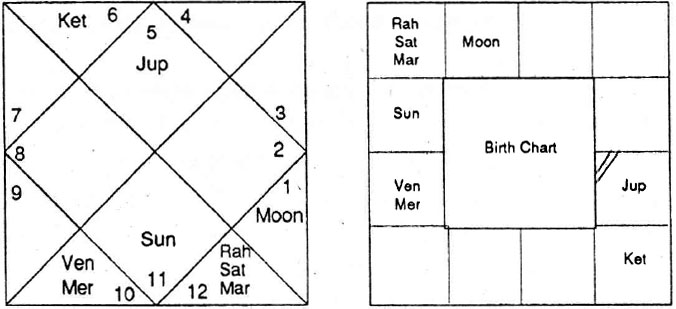
The husband of this native died due to throat disease after one and half years of the marriage. In the birth chart, Rahu, Saturn and Mars are posited in the 8th house forming a direct aspect over the 2nd house. This 2nd house is owned by Mercury. The signs belonging to Mercury always react swiftly. Therefore, in a short time after the marriage, this tragedy took place. The placement of malefic planets in the 8th house are therefore, not welcomed especially in context with the happenings of the life.
Example: 104
Data : Date of birth, 19-11-1951; Time of birth, 13-20 hrs (IST); Latitude, 27°-13'(N); Longitude 77°-29°(E).
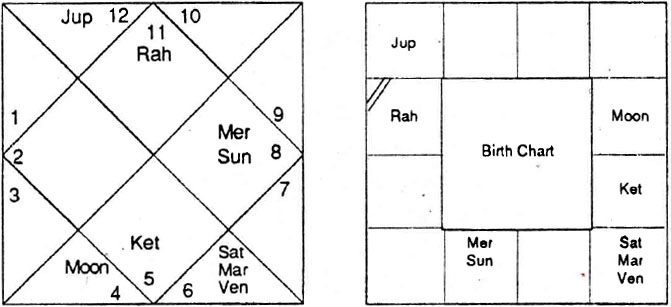
In the instant horoscope, the 8th house is harbouring. Saturn, Mars and Venus of which first two are first rated malefic planets. In the 2nd house, Jupiter is posited in its own sign. The lord of the house of longevity of the house, Karaka of the husband and the Bhava Karaka (2nd house) all the three factors related to the husband, are being represented by Jupiter. The 2nd house is also badly afflicted. Therefore, the husband died after 7 years of the marriage. Besides, this woman never experienced the lascivious comforts of the marriage. The reason being that firstly, the Karaka for such traits of life is Venus which is in the sign of debilitation and is also badly afflicted through the conjunction of two malefic planets and secondly, the lord of the spouse house (7th) Sun is receiving a malefic aspect of Saturn. Therefore, her husband, most of the time in this space of 7 years, remained sick and the obvious reason was the aspect of the Saturn over the Sun. This maleficence became prominent due to the fact that Saturn is the lord of the 12th house which is 6th (house of disease) from the 7th (house of husband) and when ever any connection between the Ascendant (body) and the 6th house is formed, the body contracts some disease. Both these horoscopes demonstrate the ill effects of the positioning of the malefic planets in the 8th house which resulted in the shortening the life of the husbands.
लग्नेन्दू समभे यस्याः सा नारी प्रकृतिस्थिता ।
कन्योचितगुणोपेता सुशीला शुभलक्षणा ॥ ५ ॥
शुभेक्षितौ सुरूपा च सदा देहसुखान्विता ।
Verse 5½5-5½ : If the sign of the Ascendant and the sign in which the Moon is posited, are even signs, that woman will be conjoined with the feminine characteristics and will have the feminish qualities. She will be submissive and possessed with auspicious attributes. Should there be aspects of the benefic planets, she will be exceedingly beautiful and will have sound health and bodily comforts.
Venus exclusively is the Karaka for beauty. It is said in the Deva Keralam "शुक्रो शुभ बल रूप राज्योगवरसप्रिय" that is in a female nativity if Venus is posited in an even sign and the Ascendant is neither occupied or aspected by the malefic signs, that woman will possess calm, composed and quite nature and will also be adorned with delicate womanish qualities. If the sign of the Moon also happenes to be of an even sign and is bereft of malefic aspect and also occupied by the malefic planets, such female qualities will get more pronounced.
Sage Mantreshwara in his treatise has affirmed this aspect in Shloka which runs as under :
"उदयहिमघरौ द्वौ युग्मगौ सौम्यदृष्ठी सुवनयपति भूषासंपदुत्कृष्ठ शीला ।"
It means that if a woman's horoscope have both Ascendant and the Moon in the even signs and are aspected by the benefic planets that woman will have a good son and husband and imbued with calmness and adorn plenty of ornaments.
Sage Varaha Mihira has stated in his Brihat Jataka some thing like this:
"पुग्मेष लग्नशशिनो प्रकृतिस्थिता स्त्री सच्छील भूषणयुता शुभदृष्ठयोद्धा ।"
It states that if the Ascendant and the Moon both are in the even signs, that woman will bear feminine nature. In other words, such women will have glowing lustre and will possess submissive, blushing and innocent looks. If these Ascendants are aspected by the auspicious planets, that woman will have decent behaviour and adorn elegant clothes and ornaments.
Saravali contains the following Shloka in this context:
"प्रकृतिस्था लग्नेन्द्रोः समभे सच्छीलरुपादया ।
भवणगुणैरूपेता शुभवीक्तियों श्रचयुवतिः स्थात ॥"
It says that if the Ascendant and the Moon be in the even sign in a woman's nativity, that woman will be faithful to her husband, beautiful and will possess a pleasant nature. If these Ascendants are aspected by the benefic planets, such woman will have long beautiful hair and imbued with many qualities.
An idol of beauty and carved in accordance to the descriptions expounded by the sages, for the body and behaviour of a woman, an appropriate horoscope of a woman is illustrated over here.
Example 105
Data : Date of birth, 17-2-1964; Time of birth, 20-59 hrs.
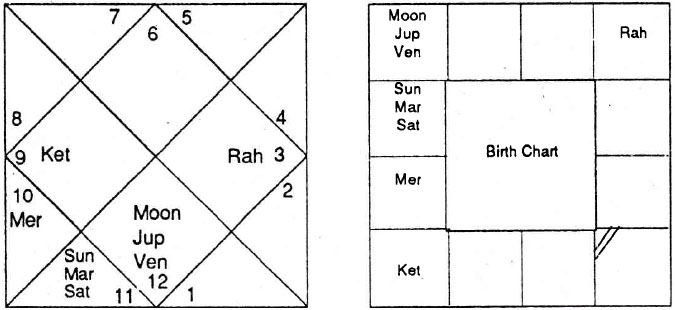
(IST); Latitude, 23°-09'(N); Longitude 79°-57'(E).
In this horoscope, the Ascendant is of Virgo sign while the Moon is in the Pisces sign (Ascendant of the Moon) and hence both are of even signs. The Karaka of beauty Venus is also in the sign. of exaltation and that too is in an even sign. Again, Venus owns the 2nd house in the nativity which signifies the 'face' and as such it gains further importance. The Ascendant is receiving the direct aspects. from the most auspicious planets, Jupiter, Venus and the Moon. Besides, the Ascendant is owned by a benefic planet Mercury. No doubt, the Ascendant is also being aspected (8th aspect) by Mars, but with so many other benefic factors in favour, this malefic aspect will not have much bearing over the auspiciousness.
The features of this woman are very much akin to these exceptionaly auspicious combinations, like she is fair in complexion, possesses a well proportionate body. She is soft spoken, polite, well behaved and adorns a pleasant smile. Her face is imbued with freshness and possessed with the quality of understanding. She is having a most comfortable married life.
विषमे पुरुषाकारा दुःशीला पापवीक्षितौ ॥ ६ ॥
पापाढ्यौ च गुणैर्हीना मिश्रे मिश्रफलं वदेत् ।
लग्नेन्द्रोर्यो बली तस्य फलं तत्र विशेषतः ॥ ७ ॥
6-7 : If the Ascendant and the Moon are in odd signs, that woman will possess manly attributes (both in shape and bearings) and will have bad temperament. If these (the Ascendant and the Moon) are being influenced by the malefic planets, she will be bereft of good qualities. If they receive a mixed (auspicious and inauspicious) influences, the mixed results be predicted. Amongst the Ascendant and the Moon whosoever is the stronger, its results will be pronounced.
अशुभसहितदृष्टौ चोजगो पुस्वंभावा ।
कुटिल मतिरवश्या भर्तुषमा परिद्रा ॥
It means that when the Ascendant and the Moon both are in the odd signs and are aspected by or conjoined with malefic planets and the female possessing such dispositions in her birth chart will be of a fraudulent mind, haughty and behaves with her husband in, furious and impolite manner. She will have manly traits, will not remain under the control and will face poverty.
Saravali also speaks in the tone of Phaldeepika and the matching renderings are as follows:
पुरुषाकृतिशीलता दुःशीला दुःखिता विषमराशौ ।
क्रूरैवीक्षितयुतयोः पापा स्त्री स्याद्गुणैर्हीना ॥
It says that if; in the horoscope of a female, the Ascendant and the Moon are in the odd signs, that woman will have the manly appearance, and behaviour and will possess maleficent nature and undergo miseries. If the odd sign of the Ascendant and the sign housing the Moon are conjoined with or aspected by the malefic planets, she will be sinful, wretched and bereft of good qualities.
According to Brihat Jataka :
ओज: स्थयोश्च मनुजाकृतिशीलयुक्ता ।
पापा च पापयुतवीक्षित योर्गुणोना ॥
It states that if odd signs herbour the Ascendant and the Moon in the female nativity, she will possess masculine features and behaviour. Should the Ascendant and the Moon receive malefic aspects and conjunction, she will perform sinful act and devoid of good qualities. If the Ascendant in the even and the Moon in the odd signs or if it is in other way round, she will posses the combination of the mixed qualities.
लग्नेन्द्रोर्यो बली विप्र ! त्रिंशांशैस्तदधिष्ठितैः ।
ग्रहराशिवशाद् वाच्यं फलं स्त्रीणां विशेषतः ॥ ८ ॥
8 : O Vipra! The stronger between the two i.e. the Ascendant and the Moon, will give specific results in its sign (Rashi) and Trimsamsa in the female horoscopy.
कन्यैवारगृहे दृष्टा भौमत्रिंशांशके भवेत् ।
कुंचरित्रा तथा शोक्रे, समाया बोधने स्मृता ॥ ९ ॥
जैवे साध्वी, शनौ दासी, ज्ञर्क्षे कौजे छलान्विता ।
शौक्रे प्रकीर्णकामा सा बौर्धेऽशे च गुणान्विता ॥ १० ॥
क्लीबाऽऽर्क्यंशे, सती जैवे, कौजै शौके दुष्टा सितर्क्षके ।
शौक्रे ख्यातगुणा. बौधे कलासु निपुणा भवेत् ॥ ११ ॥
जैवे गुणवती, मान्दे पुनर्भूश्चन्द्रभे ततः ।
स्वतन्त्रा कुजात्रिंशांशे शौक्रे च कुलपांसना ॥ १२ ॥
बौधे शिल्पकलाऽभिज्ञा जैवे बहुगुणा, शनौ ।
पतिघ्नी, चार्कभे कौजे वाचाला भार्गवे सती ॥ १३ ॥
बौधे पुंश्चेष्टिता जैवे राज्ञी मान्दे कुलच्युता ।
कौजे बहुगुणाऽऽर्यर्क्षे शौक्रे चाप्यसती मता ॥ १४ ॥
बौधे विज्ञानसंयुक्ता जेवैऽनेकगुणान्विता ।
मान्दे चाल्परतिः प्रोक्ता, दासी कौजे, तथाऽऽर्किझे ॥ १५ ॥
सुप्रज्ञा च भवेच्छौक्रे बौघे दुःस्था तथा खला ।
जैवे पतिव्रता प्रोक्ता मान्दे नीचजनानुगा ॥ १६ ॥
9-16 : The stronger between the Ascendant and the Moon (the lord of the Ascendant and the sign of the Moon) if is posited in the signs of Mars and in the Trimsamsa of Mars of a woman nativity, that woman will have sexual union with a male before her marriage. If it is in the Trimsamsa of Venus, she will be an adulterous woman even after her marriage. Should it be in the Trimsamsa of Mercury, that woman will be involved in conjuration and incantation (occultism). If it being in the Trimsamsa of Jupiter, she will be a saintly and virtuous woman. In case, it is in the Trimsamsa of Saturn, she will be a maid servant or a mistress.
If the Ascendant or the Moon as the case may be, is posited in the signs of Mercury and had gone in the Trimsamsa of Mars, she will be a cunning and guileful woman. If in the Venus Trimsamsa, she will be of lascivious character; if in the Trimsamsa of Mercury, a virtuous woman; in case, it is in the Trimsamsa of Saturn, she will be hermaphrodite and if in Jupiter's Trimsamsa, she will be a chaste woman.
If the Ascendant or the Moon as the case may be, is posited in the signs of Venus and gets located in the Trimsamsa of Mars, the female native will be of a wicked nature; if in its own Trimsamsa (Venus), she will become popular on account of her good qualities; if in the Trimsamsa of Mercury, she will distinguish herself in various kinds of arts (having an artistic flair); should it be in the Trimsamsa of Jupiter, she will be full of qualities and in case of Saturn's Trimsamsa, she will marry for the second time.
If the Moon being in the sign of Cancer (own sign) in the nativity and get located in the Trimsamsa of Mars, she will be of an independent nature; if it is in the Trimsamsa of Venus, she will be characterless; in Mercury's Trimsamsa, she be an expert in sculpture art; in the Trimsamsa of Jupiter, she will be endowed with many qualities and should it be in the Trimamsa of Saturn, she will attain widowhood.
If the Ascendant or the Moon as the case may be, is posited in the Leo sign in the birth chart and is situated in the Trimsamsa of Mars, she will be of a talkative nature; if in Venus's Trimsamsa, she will immolate herself (Sati-सती); if in the Trimsamsa of Mercury, she will behave like a man (possessing manly qualities and nature); if in the Jupiter's Trimsamsa, she will be a queen and if in the Trimsamsa of Saturn, she will go astray (or go against) from her family's traditions and customs.
If the Ascendant or the Moon as the case may be, is placed in the signs of Jupiter in the nativity and then has gone in the signs of Mars in the Trimsamsa, she will possess many qualities; if in the Trimsamsa of Venus, she will be deviating from a good conduct; if in Mercury's Trimsamsa, she will be acquainted with sciences; in the Trimsamsa of Jupiter, she will be conjoined with many qualities and if it is in the Trimsamsa of Saturn, she will be averse to an intense sexual relationship.
If the Ascendant or the Moon as the case may be is posited in the signs of Saturn in a female horoscopy, and get placed in the Trimsamsa of signs of Mars, that woman will be a maidservant; if in the Trimsamsa of Venus, she will be a learned; if it being in the Trimsamsa of Mercury, she will be of a low moral values; in case of the Trimsamsa of Jupiter, she will be devoted to her husband and should it be in the Trimsamsa of Saturn, she will be involved in the adultry with the low caste persons.
If the stronger Ascendant is in the sign of Aries and Scorpio, barring the Trainsamsa of the Jupiter, the results will not be of a good quality. This is what Maharishi has revealed. The reason being, if it is in the Timsamsa of Mars, the woman enjoys the sexual union even before her marriage. The reason for this is quite obvious because Mars is also the lord of the Ascendant and owns the Trimsamsa of the Ascendant which is imbued with the qualities of independent nature and to act in ones own will. It also gives rise to passion and to control over the passion is rather difficult, especially by the one who possesses such a nature. Phatdeepika, and Saravali used the word 'दुष्टा' (sinful) and in Jataka Parijata called it as दूराचारिणी (ill tempered) for such combinations. These connotations lend full support and confirm the statement of Brihat Jataka.
With the Trimsamsa of Venus, the woman is also stated to be of ill tempered but in this situation she maintains sexual union with the other persons even after the marriage. Venus is the significator of the marriage. This kind of disposition does form some kind of connection between Mars and Venus. While Mars denotes passion, Venus attributes sex. This combination tends the native to cross the limits of wedlock, customs and sensitivity of the precious relations.
If it is in the Trimsamsa of Mercury, she will pursue occutlism. This is also stated by the savants Varaha Mehira, Kalyana Varma, and Mantreswara apart from Maharishi Parasara. Such women are the great believer of occultism (मायाविनी) and incantation. Even though they acquire good education and have modren out look, this particular quality will be deep seated in them. Jataka Parijata contains "सौम्यांशे मलिना" instead of 'मायाविनी' which connotes that in the event of Mercury's Trimsamsa, the woman will be of dirty nature. It is also experienced that in such a situation, the woman will be lethargic and lives in an apathetic state.
In case of Jupiter's Trimsamsa, the intensity of the passion of Mars is checked by Jupiter. As such the woman of such nativity will be sober and moderate. The Trimsamsa of Saturn will give rise to subservientence to the native because the nature of Saturn (service) influences Mars to give such results.
The Ascendant or the Moon (Ascendant) who so ever is stronger, if is in the sign of Mercury and in the Trimamsa of Mars in a female horoscopy, she will be a cunning woman, according to Maharishi Parasara. Here an important principle takes birth that the combination of the Ascendant and the Trimsamsa takes priority because Maharishi has stated earlier that if the Ascendant being Mars falls in the Trimsamsa of Mercury then only the woman will believe in occultism. Here, if the Ascendant that of Mercury is in the Trimsamsa Mars, the native will be a cunning women.
In the event of Venus trimsamsa, she will be hard working type. Saravali also states some thing like this "शौक्रे प्रकीर्णकामा" which means that she will believe in working hard thereby lending full support to Maharishi. Varaha Mihira in Brihat Jataka expounded the same aphorism while Jataka Parijata gives a different version. According to which, if there be the Ascendant or Moon (Ascendant) of Mercury and Mercury be in the Trinsamsa of Venus, she will adorn beautiful clothes and ornaments and also be the keeper of many cows and female buffaloes besides being wealthy and reputed. The concerned Shloka runs as follows:
"शौक्रे चारुतराम्बराभरणगोविन्त प्रसिद्धा भवेत ॥"
The version of Phaleepika is all together different which states such woman will be an important woman. As a matter of fact, the results depicted by Phaldeepika and Jataka Parijata appear to be more relevant in this context. The basis of this statement, in addition to the experience, are some technical reasons which are as follows:
(i)Mercury signifies handicraft especially work of minute nature such as making ornaments etc.
(ii)Venus, on the other hand, is fond of ornaments and finances are also controlled by it
(iii)Mercury is considered as hermaphrodite planet
(iv)In a natural horoscope, Venus owns the 2nd house which denotes apart from other things, mouth and due to this fact, the eatables like food, milk products etc., also being signified by it
(v)Here, Mercury being a hermaphrodite planet and Venus being a planet of passion and lust, it will not give less indulgence in sex because this combination carries conflict within itself. It is here, Maharishi has stated, that if there be Trimsamsa of Saturn, the native will be hermaphrodite which is quite true because both the planets involved in creating this situation in the Vargas are hermaphrodite planets.
In the Mercury's Ascendant and also in the Trimsamsa of Mercury in the birth chart of a female, she will possess many qualities. Infact, these qualities are related to the sculptural trait. Such woman is also good in house holds. She would be expert in all kinds of works and carries out her duties most diligently.
In the event of Ascendant or Moon, whatever is the case, is in the sign of Venus and in the Trimsamsa of Mars, she will be an unchaste woman. This expression is in line with the Shloka 9 ibid.
Should it be in the Trimsamsa of Venus, she will possess great qualities. Infact, such a woman will be highly civilised, having a sweet voice and loves music. Her work will have an artishic touch. She organises herself well and keeps a perfect equilibrium in every sphere of her work. According to Phaldeepika, such female is a reputed woman. In this context, Saravali has this much to say: "शौक्रे ख्यातगुण-------।" meaning the same thing. However, Jataka Parijata have the different connotation. It says:
"शुक्रंशे बहावल्लभा च सुभगा लोकप्रिया जायते"
It implies that with such a combination, she will be the wife of a learned person (पंडित), will be good looking and reputed.
In the Trimamsa of Mercury, she will be expert in arts. These renderings are rather quite appropriate. However, here some kind of distinction could be drawn between the two signs of the Venus viz., Taurus Libra. If the Ascendant being Taurus and Trimsamsa of Mercury, it will give subtle and intellegent touch to her art and even the finer details would not escape her notice. In case of Libra Ascendant and Mercury is the Trimsamsa, her art will be infused with a special quality and her reputation will spread beyond the frontiers of the country.
In the Jupiter's Trimsamsa, the woman will be possessed with many qualities. This is also contended in Brihat Jataka and Saravali but Jataka Parijata states:
"साध्वी पुत्रवती पुरन्दर गुरोरंशे ।"
That is, such a woman is like an epithet of Lord Indra, loyal to her husband, bestowed with children and saturated with many good qualities.
The Trimsamsa of Saturn will cause remarriage for the native. If such Saturn is the lord of the 7th house or posited therein, the remarriage may take place at an old age.
If the sign of the Moon is in the Ascendant and be in Trimsamsa of Mars, she will be of an independent nature. Infact, this state of nature is confined upto the age of adolescent. Thereafter, the mental excitements and anger will come up in a great measure.
In the event of Venus Trimsamsa, she will be an unchaste woman and her conduct will be contrary to her family's traditions. It should also be termed as characterless. This contention of Maharishi will probably, in the state of fall of the Moon and Venus because with the loss of strength of the Moon, the level of the native goes down (in respect of family, society and education) and in the grip of her intense feelings, the Karkatwa of Venus takes over and its related attributes bring diminuation in her behaviour, character etc. If both the planets are strong, the expression contained in Phaladeepika in this respect, be kept in mind, which states that in the Cancer Ascendant and Venus Trimsamsa, she will possess a good conduct.
In the Trimsamsa of Mercury and Jupiter, the results will take place in according to the said priciple. With regerd to Saturns' Trimsamsa, she will attain widowhood. This effect is noticed primarily in those horoscopes in which there is an exchange between the Moon and Saturn.
If the Ascendant being of Leo sign with the Trimamsa of Mars, the native will be talkative and loquacious as stated by Maharishi. However, Phaladeepika contended that with such a combination, she will act as wicked wife. According to Srihat Jataka, she will be of manly nature. Jataka Parijata has this to say:
"नारी पुम्प्रकृतिस्थिता च कुलटा:"
That is, such a woman will have qualities befitting to a man and unchaste in character. However, the contention of Saravali falls in line with Maharishi.
Infact, woman with this combination would be of aggresive nature, loud mouthed, commanding voice and of a dominating kind. The other results may be read in this context.
If the Ascendant is in the sign of Jupiter and Trimsamsal of Mars, she will have many qualities. If the 5th house of the nativity of such woman is well fortified, she will undertake research work on some topic. She will be commended for her work at least once in her life time and her reputation will be acclaimed by the world. The results of the Trimsamsas of Mercury, Jupiter and Saturn will take effect in the same manner. However, in the Trimsamsa of Venus, bad charater is stated. This possibility will be in the event of Venus being in the sign of debilitation.
When the Ascendant is in the sign of Saturn or the Moon is also in the Saturn's sign and in the Trimsamsa of Mercury, the stated results that such woman is cruel and will be involved in adultry with the low caste persons, needs to be analysed alongwith other expositions on the subject which would be useful.
According to Jataka Parjata;
"सर्वज्ञा कुलटा बुधांशजनिता"
which means that such woman is omniscient and her sharp intallect will have many facets but those will be of unchate nature.
Phaldeepika, Brihat Jataka and Saravali used the connotation of characterless, sinful, evil respectively. It may, therefore, be seen that except Jataka Parijata, the point of views of all others are identical. It has also been observed through experience that such a woman undertakes decieitful and cunning works for the financial gains. This is also possible, in the event of planets lending support to such an act.
मन्दे शून्ये शुभादृष्टे पतिः कापुरुषो भवेत् ।
चरभे च प्रवासी स्यात् क्लीवस्तत्र ज्ञमन्दयोः ॥ १७ ॥
सूर्येऽस्तभे पतित्यक्ता बाल्ये च विधवा कुजे ।
शनावशुभसन्दृष्टे याति कन्यैव वृद्धताम् ॥ १८ ॥
विधवास्तगतैः पापैः सौम्यैस्तु सधवा सती ।
मिश्रखेटै: पूनर्भूः सा ज्ञेया मित्रफलान्विता ॥ १९ ॥
मिथोंऽशस्थौ सितारौ चेदन्यासक्ता तदांऽगना ।
सप्तमे च स्थिते चन्द्रे तदा भर्तुरनुज्ञया ॥ २० ॥
शुक्रभे शनिभे वाऽपि सेन्दुशुक्रे च लग्नगे ।
मात्रा सह तदा नारी बन्धकी भवति ध्रुवम् ॥ २१ ॥
17-21 : If the 7th house is devoid of any planet and also without any benefic aspect, she will have a coward husband. If the sign of the 7th house being a moveable sign, the husband will be out of the house for most of the times. If Saturn or Mercury is posited in the 7th house, the husband of the native will be impotent. In the event of the Sun getting posited in the 7th house, she will be deserted by her husband. With the position of Mars in the 7th house, that woman will become widow at childhood or she dies immediately after the marriage. If Saturn is posited in the 7th house duly aspected by the malefic planets, she will remain unmarried right upto her old age. If the 7th house contains malefic planets, she will attain widowhood and if the planets being benefic she will devoted to her husband who will live long. Should there be planets of mixed category, she may remarry and will have mixed results (about her married life).
If the Moon duly conjoined with Venus is posited in the Ascendant or in the signs of Venus or Saturn, such woman will certainly be a mistress alongwith her mother.
कुजर्क्षे वा तदंशेऽस्ते स्त्रीलोलः क्रोधनः पतिः ।
बौधर्क्षशे तथा विद्वान् कलासु निपुण: सुधीः ॥ २२ ॥
जैवे सर्वगुणोपेतः पतिरस्ते जितेन्द्रियः ।
शौक्रे सौभाग्यसंयुक्तः कान्तः स्त्रीजनवल्लभः ॥ २३ ॥
सौरर्क्षे वाऽथ सौरांशे वृद्धो मूर्खश्च सप्तमे ।
अतीवामृदुरर्काशे तदृक्षेवाऽतिकर्मकृत् ॥ २४ ॥
अस्ते कर्के तदंशे वा कान्तः कामी मृदुः पतिः ।
मिश्रे मिश्रफलं वाच्यं भांशयोश्च बलक्रमात् ॥ २५ ॥
22-25 : If the sign of the 7th house and also the Navamsa, be of Mars, her husband will flirt with other women and will be an angryman. If it be in the sign and the Navamsa of Mercury, her husband will be intelligent, skilled and a well composed person. If it be in the sign and Navamsa of Jupiter, her husband will be virtuous and will be able to exercise control over his sensing organs. If it be in the sign and Navamsa of Venus, her husband will be fortunate, handsome and loved by the women. If the 7th house be in the sign and Navamsa of Saturn, her husband will be old (much older than his wife) and stupid. If it be in the sign and Navamsa of the Sun, the husband will be a stone hearted and hard working type. If it be in the sign and Navamsa of the Moon, her husband will be handsome, libidinous and delicate. If there be different signs and different Navamsas of the 7th house, the result will also be mixed one and it should be so stated.
सूर्येऽष्टमगते जाता दुःखदारिद्र्यसंयुता ।
क्षतांगी खेदयुक्ता च भवेद्धर्मपराङ्मुखी ॥ २६ ॥
चन्द्रेऽष्टमगते नारी कुभगा कुस्तनी कुट्टग् ।
वस्त्राभरणहीना च रोगिणी चातिगर्हिता ॥ २७ ॥
कुजेऽष्टमगते बाला कृशांगी रोगसंयुता ।
विधवा कान्तिहीना च शोकसन्तापदुःखिता ॥ २८ ॥
बुधेष्टमगते जाता धर्महीना भयातुरा ।
अभिमानधनैर्हीना निर्गुणा कलहप्रिया ॥ २९ ॥
26-29 : If the Sun be, posited in the 8th house in the horoscope of a female, the woman remains in distress and faces poverty. She will have a deformed limb (or suffers from ulcer) and irreligious. If the Moon be in the 8th house, she will have defective vagina, deformed breasts and repulsive eyes. She will be bereft of clothes (decent) and ornaments, will be diseased and criticised by others. If Mars is posited in the 8th house, that woman will be of weak physique, sickly, widow, not beautiful and will face destitution and distress. The position of Mercury, in the 8th house, she will be irreligious, remain frightful, deprived of wealth, pride, good qualities and will be quarrelsome.
गुरावष्टमगे बाला विशीला स्वल्पसन्ततिः ।
पृथुपादकरा पत्या त्यक्ता बह्वशना भवेत् ॥ ३० ॥
शुक्रेऽष्टमगते जाता प्रमत्ता धनवर्जिता ।
निर्दया धर्महीना च मलिना कपटान्विता ॥ ३१ ॥
शनावष्टमगे जाता दुःस्वभावा मलिम्लुचा ।
प्रवंचनपरा नारी भवेत् पतिसुखोज्झिता ॥ ३२ ॥
राहावष्टमभावस्थे कुरूपा पतिवर्जिता ।
कठोरहृदय रोगैर्युक्ता च व्यभिचारिणी ॥ ३३ ॥
30-33 : The position of Jupiter in the 8th house will make the woman shameless, of less children, with thick.hands and feet, deserts her husband and a voracious eater. If Venus be in the 8th house, she will be lethargic, bereft of wealth, irreligious, cruel, filthy and cunning. If Saturn is situated in the 8th house, she will be ill mannered, remain filthy and deprived of her husband's affection. Rahu's being in the 8th house, she will be repulsive (ugly), without a husband, stone hearted, sickly and of a bad conduct.
शशिशुक्रौ यदा लग्ने मन्दाराभ्यां युतौ तदा ।
बन्ध्या भवति सा नारी सुतभे पापट्टग्युते ॥ ३४ ॥
34 : If the Moon and Venus are posited in the Ascendant and get conjoined with Saturn or Rahu and the 5th house is occupied or aspected by the malefic in the female nativity, that woman will be barren.
"शिवस्मपनतो विष्णुकीर्न्तनाद्व ससन्ततिः ।"
Meaning thereby that one begets a child by performing Rurdra Abhisheka and singing (कीर्तन) of sacred hymns in devotion to Lord Vishnu.
When the Moon and Venus duly conjoined with Saturn or Mars are posited in the Ascendant, they will certainly get deeply afflicted. The out come of the affliction of Venus in a female birth chart would be that the productive parts of the woman would get greatly diseased. Some kind of disorder in the generating organs will set in. Added to it, if the Moon is also in a state of distress, the effect will in a greater degree.
Besides, formation of any adverse Yoga or malefic aspects over the 5th house in female nativity would mean a straight assault on the capability of giving birth to a child because, this house signifies wombs which is directly connencted with the progeniture and such a woman is considered as barren (बन्ध्या). Therefore, such disposition of the planets will naturally get affected with Bandhya Yoga (combinations of barreness). In support of this aphorism of causing Bandhya Yoga of Maharishi, two practical examples are illustrated over here:
Example: 106
Data : Date of birth, 10.4.1921: Time of birth 5-40 hrs (IST): Latitude, 26-27'(N); Longitude, 79°-02'(E).
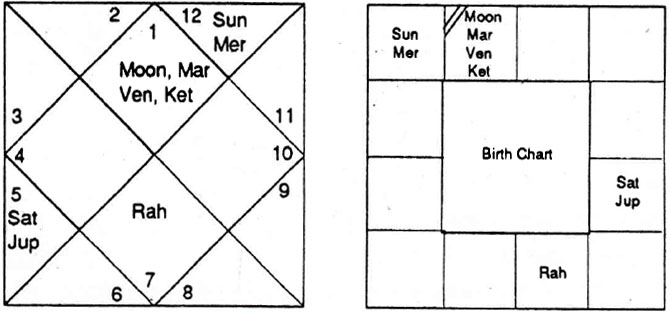
In the instant horoscope of Aries Ascendant, the Moon, Venus duly conjoined with Mars are posited therein. Further, the 5th house is occupied by Saturn. As such, all the conditions of the preceding aphorism are getting satisfied. This woman could never bear a child. Besides, the occupation of the 7th house by Rahu, Karaka of offspring Jupiter is having association with Saturn (retrograde), the Sun the lord of the 5th house conjoining with Mercury lord of the 6th house (disease) and getting posited in the 12th house (Dushtha Sthana), are such important and nagetive factors that lend active support in causing barrenness conclusively.
Example: 107
Data : Date of birth, 2.10.1902; Time of birth 6-30 hrs (IST); Latitude, 26°-55'(N); Longitude, 75°-49'(N).
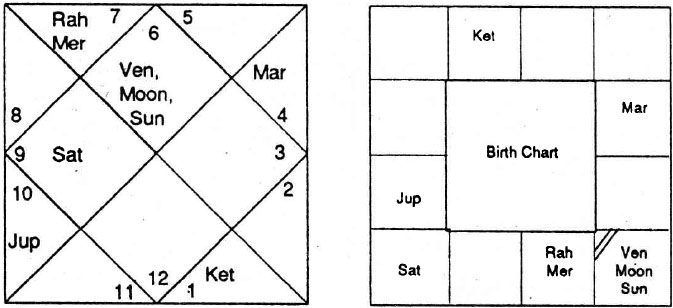
This horoscope of a female of Virgo Ascendant holds Venus and the Moon in it and receiving a malefic aspect from Saturn which is also the lord of the 6th house (disease). The 5th house is under the direct aspect of Mars and the Karaka for progeny (Jupiter) is also getting engulfed by this malefic aspect. Besides, Jupiter is weak being in the sign of debilitation and this has also weaken.the 7th house owned by Jupiter. In this nativity, the Moon is totally weak. This woman, accordingly, was never blessed with a child.
In the Shloka in question, there is close involvement of the Ascendant. When ever any discease giving planet gets affected in the Ascendant, the effect of such affliction causes great miseries. This is a distinctive principle which has great bearing in delivering the adverse results and is a very important angle of the whole gamut.
कुजांशेऽस्तगते सौरि- दृष्टे नारी सरुग्भगा ।
शुभांशे सप्तमे ज्ञेया सुभगा पतिवल्लभा ॥ ३५ ॥
35 : If the 7th house be in the Navamsa of Mars and is aspected by the Saturn in the female horoscopy, that man will be unfortunate (she will possess diseased vagina). In the 7th house, if there is Navamsa of an auspicious planet, such woman will be fortunate and is loved by her husband.
बुधभे लग्नगे सूतौ चन्द्रशुक्रयुते द्विज ! ।
ज्ञेया पितृगृहे नारी सा सर्वसुखसंयुता ॥ ३६ ॥
36 : If the Ascendant contains the sign of Mercury, and it is occupied by the Moon and Venus in the female nativity, she beholds abundant comforts of her father's house.
लग्ने चन्द्रज्ञशुक्रेषु बहुसौख्यगुणान्विता ।
जीवे तत्रातिसम्पन्ना पुत्रवित्तसुखान्विता ॥ ३७ ॥
37 : If the Moon, Mercury and Venus are posited in the Ascendant in the horoscope of a woman, she is endowed with many qualities. If Jupiter happens to be in the Ascendant, she will be bestowed with great satisfaction, children, wealth and happiness.
Notes: This Shloka is very important because in this, Mars and Saturn are also implicated in causing affliction to the Ascendant. In a nativity of Aries Ascendant, the lord and the Bhava Karaka of the 4th house is the Moon. As it is stated earlier that the sensibility of motherhood is infused in the Moon. Here, the position of Venus in the Ascendant is as a lord of the 7th house. In the event of progeniture, this house plays an important role. Therefore, placement of the Moon and Venus in the Ascendant becomes exceedingly important in connection with the motherhood.
Secondly, in the Capricorn Ascendant, the Moon and Venus acquire due importance related to progeny because in such a nativity, they own the 5th and the 7th houses respectively. It could be stated that amongst the four Ascendants of Mars and Saturn, Aries and Capricorn are the only two Ascendents in which if the Moon and Venus get afflicted, they will become responsible for the denial of progeny. The other two Ascendants are of different level. Between them, Scorpio Ascendant is again important than the Aquarious Ascendant in which Venus get the ownership of 7th house and the Moon takes over the 9th house. Incidentally, the 9th house is also connected with the progeny.
In Aquarious Ascendant, the lord of the 9th house is Venus and the same planet own the 2nd house as well. Therefore, Venus has an edge over the Moon in this case. In fact the conjunction of the Moon and Venus in the Ascendant will produce an opposite effect because the Moon being the lord of the 6th house will acquire malice prepense through disease. Therefore, the positionof the Moon in the Ascendant with Venus will not only be harmful for the Venus but also for the Ascendant.
The Yoga of barrenness (बन्ध्या) is also formed in other Ascendants but the combination of Venus and the Moon in these Ascendants is not that important. The other planets also perform the similar function but it is also true that these planets are not capable of producing such damaging affects as in the Ascendants of Mars and Saturn while harbouring the Moon and Venus. The following planets will be the source of causing barrenness in different Ascendants :
| Sign of Ascendant | Planets of Barrenness | |
| 1. | Taurus | Mercury, Mars |
| 2. | Gemini | Venus, Jupiter |
| 3. | Cancer | Mars, Saturn |
| 4. | Leo | Jupiter, Saturn |
| 5. | Virgo | Saturn, Jupiter |
| 6. | Libra | Saturn, Mars |
| 7. | Sagittarious | Mars, Mercury |
| 8. | Pisces | Moon, Mercury. |
In these Ascendants, the lord of the 5th and the 7th houses are taken as the basis. Besides, the lord of the 9th house and Jupiter also play an important role because, as stated earlier that 9th house is also, in a way, connected with the progeny and Jupiter is the significator (Karaka) for the progeny. Here are a few horoscopes to demonstrate the effect of the combinations of the barrenness.
Example: 108
Data : Date of birth, 17-5-1939; Time of birth 4-30 hrs (IST); Latitude 29°-27'(N); Longitude 77°-19'(N).
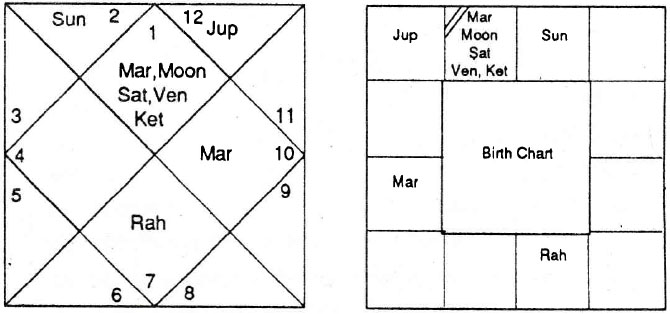
In the horoscope of Aries Ascendant, Venus, the Moon, Saturn, Ketu are posited therin and are afflicted through the aspect of Mars from the 10th house. Besides, the planet which is greatly malefic in the Aries Ascendant is Mercury and it is also occupying the Ascandant. Therefore, the Moon and Venus are deeply afflicted. Further, here Mercury is the lord of the 6th house which has also aggrevated the situation of barrenness. The aspect of Mars over the 5th house (progeny) has also diminished the chances of motherhood. Owning to these adverse factors, this woman inspite of performing so many propitiatory measures and undertaking series of treatments, remained barren.
Example: 109
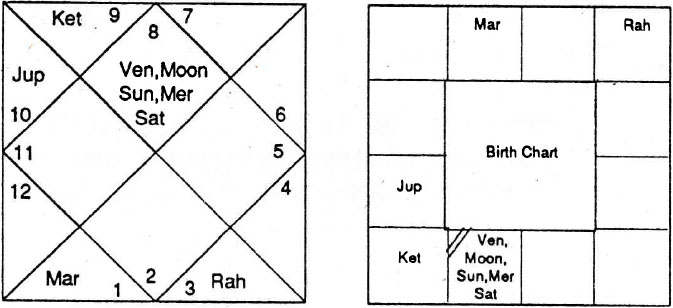
Data : Date of birth, 5-12-1926; Time of birth, 7-30 hrs (IST); Lalitude, 28°-39'(N); Longitude, 77°-13'(E).
In the Ascendant, the Moon and Venus are conjoined with Saturn. Mars is in the 6th house and causing aspect over the Ascendant. Mercury being the lord of 8th and the 11th house will be considered as a malefic planet over here. The Karaka of progey Jupiter is in the sign of debilitation. Therefore, this woman could not be blessed with a child in her entire life due to heavy affliction on the Moon and Venus and with so many other adverse factors. All her attempts to bear a child turned futile and she remained barren.
Example : 110
Here is an example of Capricorn Ascendant of Saturn:
Data : Date of birth, 26-1-1914; Time of birth, 6-00 hrs (IST); Lalitude, 29°-01 '(N); Longitude, 77°-45'(E).
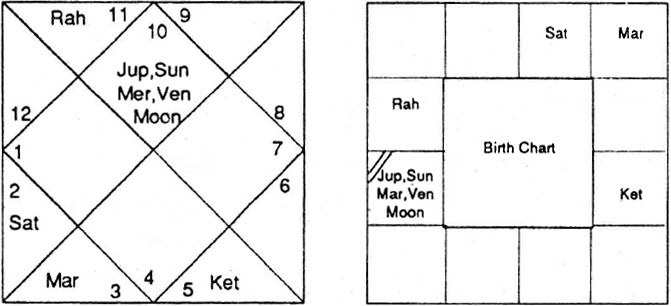
In this horoscope of Capricorn Ascendant, Venus, the Moon and the lord of the 6th house Mercury are posited there in and they will cause disease in the nativity. The debilitated position of Jupiter in the Ascendant will also prove no less harmful. Again, Mars having posited in the 6th house, causing aspects over the Ascendant. Further, the position of Saturn which is Karaka for scarcity in the 5th house is also harmful. The Sun occupying the Ascendant also very damaging as it is making Venus combust and the Moon is getting powerless and afflicted and thus becomes malefic. All these nagetive attributes agánist progeny in the horoscope kept the native childless.
लग्नादष्टमगौ स्यातां चन्द्रार्कौ स्वर्क्षगौ तदा ।
बन्ध्याऽथ काकबन्ध्या चेदेवं चन्द्रबुधौ यदा ॥ ३८ ॥
38: If the Sun or the Moon be in their own sign in the 8th house in the female nativity, she will be barren (बन्धा). If the 8th house have the signs of Gemini, Vigro or Cancer and Mercury or the Moon is posited over there, the woman will have only one child (काकबन्धा)
शनिमंगलभे लग्ने चन्द्र भार्गवसंयुते ।
पापदृष्टे च सा नारी बन्ध्या भवति निश्चयात् ॥ ३९ ॥
39 : If Saturn is posited in the Ascendant or the Moon and Venus are posited in the sign of Mars and are aspected by the malefic planets in the female horoscopy, she will certainly be a barren woman.
स- राहौ सप्तमे सूर्ये पञ्चमे पापसंयुते ।
शुक्रेज्यराहवो मृत्यौ मृतापत्या च सा भवेत् ॥ ४० ॥
40 : If the Sun is posited in the 7th house duly conjoined with Rahu or Jupiter conjuncts with Venus or Rahu and gets posited in the 8th house, and the 5th house contains malefic planets, that woman will give birth to a still born child.
शुक्रेज्यावष्टमे सारौ सप्तमे वा कुजो भवेत् ।
शनिना दृग्युतो नारी गलद्गर्भा प्रकीर्तिता ॥ ४१ ॥
41 : Should Jupiter or Venus conjoin with Mars or Mars in the 7th house is conjoined with or aspected by Saturn in the birth chart of a woman, such woman will get abortion after the conception.
पापकर्तरिके लग्ने चन्द्रे जाता च कन्यका ।
समस्तं पितृवंशं च पतिवंशं निहन्ति सा ॥ ४२ ॥
42: The woman whose Ascendant and the Moon (Lagna) in the birth chart contain Papa Kartari (पापकतरि) Yoga (hemmed between malefic planets), that woman will cause destruction to her father's and husband's families.
ससर्पाग्निजलेशर्क्षे भानुमन्दारवासरे ।
भद्रातिथौ जनुर्यस्याः सा विषाख्या कुमारिका ॥ ४३ ॥
43 : A woman who takes birth in the combination of (i) the Nakshatra of Aslesha, Kritika and Shatabisha, (ii) on the week days of Sunday, Saturday and Tuesday and (iii) in the Bhadra Tithis (2nd, 7th, 12th), that woman is called Visha-Kanya.
सपापश्च शुभो लग्ने द्वौ पापौ शत्रुभस्थितौ ।
यस्या जनुषि सा कन्या विषाख्या परिकीर्तिता ॥ ४४ ॥
44 : At the time of birth, the woman who has one benefic and one malefic planet in the Ascendant and two malefic planets are posited in the inimical signs, she will also be reckoned as Visha Kanya.
विषयोगे समुत्पन्ना मृतवत्सा च दुर्भगा ।
वस्त्राभरणहीना च शोकसन्तप्तमानसा ॥ ४५ ॥
45: A birth of a female Visha Kanya Yoga, still born (मृतवत्सा) and in unfortunate Yogas, she will be distressed and bereft of clothes and ornaments.
सप्तमेश: शुभो वाऽपि सप्तमे लग्नतोऽथवा ।
चन्द्रतो वा विषं योगं विनिहन्ति न संशयः ॥ ४६ ॥
46 : If the lord of the 7th house from the Ascendant or the sign of the Moon is an auspicious planet and if auspicious planets are posited in the 7th house, it will, certainly destroy the Visha-Kanya Yoga.
लग्ने व्यये सुखे वाऽपि सप्तमे वाऽष्टमे कुजे ।
शुभदृग्योगहीने च पतिं हन्ति न संशयः ॥ ४७ ॥
47 : If Mars is bereft of the aspect or conjunction of the auspicious planets and is posited in the Ascendant, in the 12th house, the 4th house, the 7th house or the 8th house, (in the nativity of a woman), the husband of such woman will certainly have an early death.
यस्मिन् योगे समुत्पन्ना पतिं हन्ति कुमारिका ।
तस्मिन् योगे समुतपन्नो पत्नीं हन्ति नरोऽपि च ॥ ४८ ॥
स्त्रीहन्त्रा परिणीता चेत् पतिहन्त्री कुमारिका ।
तदा वैधव्ययोगस्य भंगो भवति निश्चयात् ॥ ४९ ॥
48-49 : The Yoga in which when a woman takes birth and attains widowhood, with the similar yoga, if a male takes birth will also become widower. If a woman with the Yoga of widowhood, marries a man with the similar Yoga in his nativity, it will cause cancellation of such yoga.
मिथोंsशस्यौ मिथो दृष्टौ सितार्की वा सितर्क्षके ।
घटांशे लग्नगे नारी प्रदीप्तं मदनानलम् ॥ ५० ॥
संशान्ति नयति स्त्रीभिः सखीभिर्मदनातुरा ।
पराभिः पुरुषाकारस्थिताभिर्द्विजसत्तम ! ॥ ५१ ॥
50-51: In the nativity of a woman, if Saturn and Venus are in the Navamsa of each other, both are also aspecting each other or in the Ascendant of Taurus or Libra, if there is Navamsas of Capricorn, that woman will be of lascivious passion. Duly aroused with excessive desire of sexual union, she gets her lustful passion satisfied through another female companion acting as male (lesbianism is like homosexuality in women).
कुजज्ञगुरुशुक्रैश्च बलिभिः समभे तनौ ।
कुशलाऽनेकशास्त्रेषु सा नारी ब्रह्मवादिनी ॥ ५२ ॥
52 : If the Ascendant of an even sign and in which Mars, Mercury, Jupiter and Venus are powerful in the horoscopy of a woman, that woman will be learned in many 'shashtras' and will give renderings on Vedanta.
क्रूरे सप्तमगे कश्चित् खेचरो नवमे यदि ।
सा प्रव्रज्यां तदाप्नोति पापखेचरसंभवाम् ॥ ५३ ॥
53 : In the birth chart of woman, if there are malefic planets in the 7th house and the 9th house is devoid of any planet, she will embrace asceticism. This will be caused when there is influence of the malefic planets. (i.e. during the operation of the Antardasa of the malefic planets).
विलग्नादष्टमे सौम्ये पापदृग्योगवर्जिते ।
मृत्युः प्रागेव विज्ञेयस्तस्या मृत्युर्न संशयः ॥ ५४ ॥
54: If there is an auspicious planet in the 8th house from the Ascendant and is bereft of any malefic conjunction or aspect, in the nativity of a woman, she will die before the death of her husband.
अष्टमे शुभपापौ चेत् स्यातां तुल्यबलौ यदा ।
सह भर्त्रा तदा मृत्युं प्राप्त्वा स्वर्याति निश्चयात् ॥ ५५ ॥
55 : At birth (horoscope) of a female, if benefic and malefic planets of identical strength are posited in the 8th house, that woman will certainly die alongwith her husband.
Show the full passage — 61 verses
बहुधा भवता प्रोक्तं जन्मकालात् शुभाशुभम् ।
श्रोतुमिच्छामि नारीणामंगचिहै: फल मुने ! ॥ १ ॥
शृणु विप्र ! प्रवक्ष्यामि नारीणामङलक्षणम् ।
फलं यथाऽऽह पार्वत्यै भगवान् शंकरस्तथा ॥ २ ॥
1-2 : Maitreya said - Hey Maharishi ! You have perorated various types of auspicious and inauspicious results (of woman) from the birth time (Ascendant), now I beseech the results on the basis of the characteristics of the various parts of the woman's body.
Maharishi Parasara replied - O Brahmin! In the manner the results of the characteristics of the parts of the woman's body propounded by Lord Shiva to Goddess Parvati, I will unfold the same before you. Please listen.
स्निग्धं पादतलं स्त्रीणां मृदुलं मांसलं समम् ।
रक्तमस्वेदमुष्णं च बहुभोग-प्रदायकम् ॥ ३ ॥
विवर्णं परुषं रूक्षं खण्डितं विषमं तथा ।
सूर्पाकारच शुष्कं च दुःखदौर्भाग्यदायकम् ॥ ४ ॥
3-4 : A woman whose soles are slick, delicate, fleshy, even, reddish in colour, non sweating that woman will enjoy plenty of comforts. A woman whose soles are pale in colour, hard, dry, chilblains, crooked, having mesh like marks (सूप) and skinny, such woman suffers miseries and is unfortunate.
शंख - स्वस्तिक - चक्राऽब्ज-ध्वज - मीनाऽऽतपत्रवत् ।
यस्याः पादतले चिहं सा ज्ञेया क्षितिपांगना ॥ ५ ॥
भवेत् समस्तभोगाय तथा दीर्घोर्ध्वरेखिका ।
रेखाः सर्पाऽऽखु-काकाभा दुःखदारिद्र्यसूचिकाः ॥ ६ ॥
5-6 : A woman whose sole contains marks like conch, Swastika, Chakra, lotus, flag, fish, umbrella and having long raised lines, such woman enjoys copious happiness and comforts and is like a queen. If the marks like serpent, mouse, crow are apparent on the sole of a woman that woman is the indicator of misery, poverty and destitute.
रक्ता: समुन्नता: स्निग्धा वृत्ताः पादनखा: शुभाः ।
स्फुटिता: कृष्णवर्णाश्च ज्ञेया अशुभसूचकाः ॥ ७ ॥
7 : The one beholds nails of the toes of reddish colour, well developed, slick and roundish is bestowed with happiness and comforts while short, blackish in colour and torn nails, indicate discomfort and unhappiness.
उन्नतो मांसलोऽङ्गुष्ठो वर्तुलोऽतुलभोगदः ।
वक्रो इस्वश्च चिपिटो दुःखदारिद्र्यसूचकः ॥ ८ ॥
8 : A well developed, fleshy and roundish thumb of the feet manifests enjoyment and crooked, short and flat indicates misery rand misfortune.
मृदवोऽङ्गुलयः शस्ता घना वृत्ताश्च मांसलाः ।
दीर्घाङ्गुलीभिः कुलटा कृशाभिर्धनवर्जिता ॥ ९ ॥
9 : If the toes are soft, filled, roundish and well formed are auspicious and a woman who possesses longish toes is considered to have loose moral and the one with lean (bony) toes will be poor and destitute.
भवेद्ध्रस्वाभिरल्पायुर्विषमाभिश्च कुट्टनी ।
चिपटाभिर्भवेद्दासी विरलाभिश्च निर्धना ॥ १० ॥
यस्या मिथः समारूढाः पादाङ्गुल्यो भवन्ति हि ।
बहूनपि पतीन् हत्वा परप्रेष्या च सा भवेत् ॥ ११ ॥
10-11 : A woman who possesses short toes will have short life; toes being short and long, she will be procuress and deceitful. If toes are flat, she will be a maid and the toes being unevenly spaced, she will be poor. Should the toes be of uneven size, she will be a widow and live on others.
यस्याः पथि चलन्त्याश्च रजो भूमेः समुच्छलेत् ।
सा पांसुला भवेन्नारी कुलत्रयविघातिनी ॥ १२ ॥
यस्याः कनिष्ठिका भूमिं गच्छन्त्या न परिस्पृशेत् ।
सा हि पूर्वपतिं हत्वा द्वितीयं कुरुते पतिम् ॥ १३ ॥
12-13: A woman while walking raises the dust, such woman will bring disrepute and stigma to father, mother and husband's family. While walking, if the small toe does not touch the ground, such woman marries again after the death of her first husband.
मध्यमाऽनामिका चापि यस्या भूमिं न संस्पृशेत् ।
पतिहीना च सा नारी विज्ञेया द्विजसत्तम ! ॥ १४ ॥
प्रदेशिनी भवेद्यस्या अंगुष्ठाद् व्यतिरेकिणी ।
कन्यैव दूषिता सा स्यात् कुलटा च तदग्रतः ॥ १५ ॥
उन्नतं पादपृष्ठं चेत् तदा राज्ञी भवेद् ध्रुवम् ।
अस्वेदमशिराढ्यञ्च मांसलं मसृणं मृदु ॥ १६ ॥
14-16 : O Great Brahmin ! A woman whose middle and its adjescent toes (अनामिका) also do not touch the ground, she will attain widowhood. The toe next to the great toe is longer than the great toe (अंगुठा) such woman will have illicit relation with a man before marriage and continues to have such relation's even after the marriage and is an unchaste woman.
अन्यथा धनहीना च शिरालं चेत्तदाऽध्वगा ।
रोमाढ्यं चेद् भवेद्दासी निर्मांसं यदि दुर्भगा ॥ १७ ॥
17 : A woman whose back (top) of the feet is well developed, does not sweat, slick and fleshy, such woman equates with a queen. If having opposite features, she will be a poor woman. If this portion of the feet is full of veins, she will be a keen traveller. If it is hairy, she will be a maid and in the event of skinny (bony), she will be unfortunate.
सुभगा समपार्ष्णिः स्त्री पृथुपार्ष्णिश्च दुर्भगा ।
कुलटोन्नतपार्ष्णिश्च दीर्घपाणिश्च दुःखिता ॥ १८ ॥
18: If the heels being even, she will have the pleasure of the love of her husband and if thickly padded, she will be unfortunate. Raised heels will denote unchaste woman and if heels being long, she will face sufferings.
अरोमे च समे स्निग्धे यस्या जंघ सुवर्तुले ।
विसिरे च सुरम्ये सा राजपत्नी भवेद् ध्रुवम् ॥ १९ ॥
19 : A woman if having hairless, even, smooth, roundish, invisible veins and elegant legs, will in all certainity, be the wife of the king.
वर्तुलं मांसलं स्निग्धं जानुयुग्मं शुभप्रदम् ।
निर्मांसं स्वैरचारिण्या निर्धनायाश्च विश्लथम् ॥ २० ॥
20 : If both the knees are round, full of flesh and smooth, it will manifest happiness. If the knees are bony, she will dictate her own terms, while loose knees will cause poverty.
घनौ करिकराकारौ वर्तुलौ मृदुलौ शुभौ ।
यस्या ऊरू शिराहीनौ सा राज्ञी भवति ध्रुवम् ॥ २१ ॥
21 : If both the thighs are fleshy and of round shape analogous to the trunk of an elephant, delicate, beautiful and hairless such a woman will be certainly a queen. The possessor of flat and hairy thighs will be a widow and an unfortunate woman.
चिपिटौ रोमशौ यस्या विधवा दुर्भगा च सा ।
चतुर्भिर्विंशतियुतैरंगुलैश्च समा कटि: ।
समुन्नतनितम्बाढ्या प्रशस्ता स्यात् मृगीदृशाम् ॥ २२ ॥
22 : A Waist of 24 Angula (अंगुल), evenly shaped with well formed hips is appreciable and auspicious.
विनता चिपिटा दीर्घा निर्मासा संकटा कटि: ।
इस्वा रोमैः समायुक्ता दुःखवैधव्यसूचिका ॥ २३ ॥
23 : An uneven, flat, long, skinny, hairy waist indicates. widowhood and inauspiciousness.
नितम्बः शुभदः स्त्रीणामुन्नतो मांसलः पृथुः ।
सुखसौभाग्यदः प्रोक्तो ज्ञेयो दुःखप्रदोऽन्यथा ॥ २४ ॥
24 : Ita woman possesses beautiful, well formed (shaped), fleshy and well spread hips, she will be bestowed with comforts and have love and warmth of her husband (सौभागम्). The contrary features of the hips produces unhappiness and distress.
स्त्रीणां गूढमणिस्तुंगो रक्ताभो मृदुरोमकः ।
भगः कमठपृष्ठाभ: शुभोऽश्वत्यदलाकृतिः ॥ २५ ॥
25: If clitoris remains concealed, having pinkish lustre, duly covered with tender hairs and curved like the back of a tortoise, shape analogous to the leaf of Pipal (पीपल) and smooth, produces auspiciousness.
कुरंगखुररूपो यश्चुल्लिकोदरसंनिभः ।
रोमशो दृश्यनासश्च विवृतास्योऽशुभप्रदः ॥ २६ ॥
26: If the shape of the sexual organ corresponds to deer's feet (सुर) having cavity like hearth (चुल्हा), thick haired, spread like open mouth, coarse hair, with protruding clitoris is considered as inauspicious.
वामोन्नतस्तु कन्याजः पुत्रजो दक्षिणोन्नतः ।
शंखावर्तो भगो यस्याः सा विगर्भांऽगना मता ॥ २७ ॥
27 : If the left side of the female organ is raised one, she will give birth to female children and if the right side is raised, she will be blessed with male children. If the sexual organ is shaped like conch, she will be unable to produce children.
मृद्वी वस्तिः प्रशस्ता स्याद् विपुलाल्पसमुन्नता ।
रोमाढ्या च शिराला च रेखांका न शुभप्रदा ॥ २८ ॥
28 : If the portion below the navel is well spread, tender and slightly raised is considered auspicious. If the same portion is hairy with visible veins and containing lines (wrinkles etc.), it will indicate inauspiciousness.
गम्भीरा दक्षिणावर्ता नाभिः सर्वसुखप्रदा ।
व्यक्तग्रन्थिः समुत्ताना वामावर्ता न शोभना ॥ २९ ॥
29 : A navel having a depth, turning towards south will manifest auspiciousness and a raised navel, titled towards right, lumpy will bring inauspiciousness.
पृथुकुक्षि : शुभा: नारी सूते सा च बहून् सुतान् ।
भूपतिं जनयेत् पुत्रं मण्डूकाभेन कुक्षिणा ॥ ३० ॥
30 : A well spread womb will have healthy sexual organ and produce many children and will also manifest happiness and if it similar to a frog, it will be capable of giving birth to a king.
उन्नतेन, वलीभाजा, सावर्तेन च कुक्षिणा ।
वन्ध्या संन्यासिनी, दासी जायते क्रमशोऽबला ॥ ३१ ॥
31 : A woman with raised, wrinkled, whirled type of womb is signified as barren, ascetic and maid respectively.
समे समांशे मृदुले पार्श्वे स्त्रीणां शुभप्रदे ।
उन्नते रोमसंयुक्ते शिराले चाऽशुभप्रदे ॥ ३२ ॥
32 : If the area over the ribs is even, well developed and tender, it will be propitious. If this portion is raised, hairy and with many visible veins, it will be inauspicious.
निर्लोमं हृदयं स्त्रीणां समं सर्वसुखप्रदम् ।
विस्तीर्णं च सलोमं च विज्ञेयमशुभप्रदम् ॥ ३३ ॥
33 : If the portion over the heart (chest) of a woman is devoid of hairs and even, it will manifest happiness but a well spread and hairy chest is considered inauspicious.
समौ पीनौ घनौ वृत्तौ दृढौ शस्तो पयोधरौ ।
स्थूलाग्रौ विरलौ शुष्कौ स्त्रीणां नैव शुभप्रद्रौ ॥ ३४ ॥
34 : The breasts of a woman are equal in size, fleshy, fully developed (well inflated) roundish and firm are appreciable. If these are thick in front and both are distant to each other, skinny, it will not be considered propitious.
दक्षिणोन्नतवक्षोजा नारी पुत्रवती मता ।
वामोन्नतस्तनी कन्याप्रजा प्रोक्ता पुरातनैः ॥ ३५ ॥
35 : A woman who has raised right breast, will bear male child and who has raised left breast, will have female child as described by the ancient savants of the Astrology.
नारीणां चूचुके शस्ते श्यामवर्णे सुवर्तुले ।
अन्तर्भग्ने च दीर्घे च कृशे चापि न शोभने ॥ ३६ ॥
36 : If the teats of a woman is roundish and of brownish (tawny) colour, it is considered as good. The depressed, long and weak teats are not reckoned as propitious.
स्त्रीणां स्कन्धौ समौ पुष्टौ गूढ़सन्धी शुभप्रदौ ।
रोमाढ्यावुन्नतौ वक्रौ निर्मांसावशुभौ स्मृतौ ॥ ३७ ॥
37 : Even, strong with concealed joints type of shoulders of a woman are propitious and hairy, raised, crooked, bony shoulder are not considered as auspicious.
सुसूक्ष्मरोमे नारीणां पुष्टे स्निग्धे शुभप्रदे ।
कक्षे शिराले गम्भीरे न शुभे स्वेदमेदुरे ॥ ३८ ॥
38 : A woman who has fine and delicate hair under the armpits which are strong and smooth is propitious. The armpits which are fleshy, deep and sweating type are considered inauspicious.
गूढास्थी कोमलग्रन्थी विशिरौ च विरोमकौ ।
सरलौ सुवर्तुलौ चैव भुजौ शस्तौ मृगीदृशाम् ॥ ३९ ॥
निर्मांसौ स्थूलरोमाणौ हस्वौ चैव शिराततौ ।
वक्री भुजौ च नारीणां क्लेशाय परिकीर्तितौ ॥ ४० ॥
39-40 : A woman who possesses arms which are not bony, having fine joints, hairless and with no visible veins, straight and elegantly round, that woman is adorable. A woman with bony arms with coarse hairs, short, full of veins and crooked, that woman will give distress and miseries.
सरोजमुकुलाकारौ करांगुष्ठौ मृगीदृशाम् ।
सर्वसौख्यप्रदौ प्रोक्तौ कृशौ वक्रौ च दुःखदौ ॥ ४१ ॥
41 : If the thumb of the hand is like a lotus' bud, that woman will render comforts while a woman with a crooked thumb without much flesh on it, that woman will produce distress and unhappiness.
स्त्रीणां करतलं रक्तं मध्योन्नतमरन्ध्रकम् ।
मृदुलं चाल्परेखाढ्यं ज्ञेयं सर्वसुखप्रदम् ॥ ४२ ॥
विधवा बहुरेखेण रेखाहीनेन निर्धना ।
भिक्षुका च शिरोढ्येन नारी करतलेन हि ॥ ४३॥
42-43 : A woman having palms with pinkish lustre, raised in the middle, showing no perforation between them while joining the fingers, delicate with scanty lines, such woman always enjoys happiness and comforts. A woman having palm with plenty of lines attains widowhood and a palm without line leads to poverty and a palm with visible veins makes a woman Bhikshuka (one who subsists entirely on alms)
पाणिपृष्ठं शुभं स्त्रीणां पुष्टं मृदु विरोमकम् ।
शिरालं रोमशं निम्नं दुःख- दारिद्र्य-सूचकम् ॥ ४४ ॥
44 : If the back of the hands of a woman is well formed delicate, hairless, it is propitious, while if it shows veins prominently, hairy and depressed, it will indicate distress and poverty.
यस्याः करतले रेखा व्यक्ता रक्ता च वर्तुला ।
स्निग्धा पूर्णा च गम्भीय सा सर्वसुखभागिनी ॥ ४५ ॥
मत्स्येन सुभगा ज्ञेया स्वस्तिकेन धनान्विता ।
राजपत्नी सरोजेन जननी पृथिवीपतेः ॥ ४६ ॥
सार्वभौमप्रिया पाणौ नद्यावर्ते प्रदक्षिणे ।
शंखातपत्रकमठैर्भूपस्य जननी भवेत् ॥ ४७ ॥
45-47 : A woman whose palm shows clear lines which are pink in colour, circular, smooth, complete (without cuts) and deep, such woman enjoys all comforts. If the lines of the palm indicating marks like a fish, she will have good luck and Sawbhaya (will have pleasure of the love of her husband). If the lines showing marks like a swaslika, that woman will be wealthy; if like lotus, she becomes wife of a king. If palm contains a sign of whirl traversing from right to left, she will be the queen of the king of the kings. If a woman's palm possesses sign (mark) of couch, umbrella, tortoise, she will be the mother of the king.
रेखा तुलाकृति: पाणौ यस्याः सा हि वणिग्वधूः ।
गजवाजिवृषाभा वा करे वामे मृगीदृशः ॥ ४८ ॥
48 : If the palm of a woman contains' sign (mark) analogous to balance, elephant, horse or bull, she will be the wife of a business man.
रेखा प्रसादवज्राभा सूते तीर्थकरं सुतम् ।
कृषीवलस्य पत्नी स्याच्छकटेन युगेन वा ॥ ४९ ॥
चामराङ्कुश-चापैश्च राजपत्नी पतिव्रता ।
त्रिशूलाऽसिगदाशक्तिंदुन्दुभ्याकृतिरेखया ॥ ५० ॥
49-50: If palm is having a mark (sign) indicating a house, Weapon (वज्र) that woman will give birth to a son who will be learned of Shashtras (scriptures). Marks of indicating the signs of Chamar (चामर -awhisk of hairs with staff), Ankush (अकुंश), bow, trident, sword, mace, shakti (trumpet), small drum kind (दुन्दुभि) are prominent, she will be the wife of the emperor.
अङ्गुष्ठमूलान्निर्गत्य रेखा याति कनिष्ठिकाम् ।
सा नारी पतिहन्त्री स्याद् दूरतस्तां परित्यजेत् ॥ ५१ ॥
काक-मण्डूक-जम्बूक- वृक- वृश्चिक- भोगिनः ।
रासभोष्ट्र - विडालाभा रेखा दुःखप्रदाः स्त्रियाः ॥ ५२ ॥
51-52 : If lines on the palm commencing from the root of the thumb and run upto the base of the little fingure, a woman possessing such palm will be the cause for the death of her husband. Such women shall be discarded even before the marriage. The lines showing the shapes of crow, frog, jackal, wolf, scorpion, snake, donkey, camel and cat that woman will suffer miseries.
मृदुलाश्च सुपर्वाणो दीर्घा वृत्ता: क्रमात् कृशाः ।
अरोमकाः शुभाः स्त्रीणामङ्गुल्यः परिकीर्तिताः ॥ ५३ ॥
अतिइस्वाः कृशा वक्रा विरला रोमसंयुताः ।
बहुपर्वयुता वाऽपि पर्वहीनाश्च दुःखदाः ॥ ५४ ॥
53-54 : If fingers of the hand of a woman are delicate with elegant phalanges, thin and tapering towards the end, hairless, such figures are propitious. If the fingers are short, skinny, crooked, showing space in a closing form, hairy, having several phlanges or without any phlange, such woman will cause distress and bring miseries.
रक्तवर्णा नखास्तुंगा सशिखाश्च शुभप्रदाः ।
निम्ना विवर्णा पीता वा पुष्पिता दुःखदायकाः ॥ ५५ ॥
55 : Nails of the fingers being redish in colour, raised and pointed are propitious. Depressed, colurless, pale or with white spots are considered as inauspicious.
अन्तर्निमग्नवंशास्थि पृष्ठं स्यान्मांसलं शुभम् ।
स- शिरं रोमयुक्तं वा वक्रं चाऽशुभदायकम् ॥ ५६ ॥
56 : A woman having back where bones are not visible, well shaped and filled with flesh is propitious and a back with visible veins, hairy and crooked is considered inauspicious.
स्त्रीणां कण्ठस्त्रिरेखांकस्त्वव्यक्तास्थिश्च वर्तुलः ।
मांसलो मृदुलश्चैव प्रशस्तफलदायकः ॥ ५७ ॥
स्थूलग्रीवः च विधवा वक्रग्रीवा च किंकरी ।
बन्ध्या च चिपिटग्रीवा लघुग्रीवा च निःसुता ॥ ५८ ॥
57-58 : If the neck of a woman contains three lines (strips) and bones are not visible, roundish, well formed and delicate is appreciably beneficial. A thick necked woman attain widowhood; a woman with uneven neck becomes maid; a woman with flat neck will be barren and with short neck remains childless.
श्रेष्ठा कृकाटिका ऋज्वी समांसा च समुन्नता ।
शुष्का शिराला रोमाढ्या विशाला कुटिलाऽशुभा ॥ ५९ ॥
59 : If throat being straight, fully developed and well. raised is considered the best. Skinny, showing veins, hairy, long and uneven type of throat is proved to be inauspicious.
अरुणं मृदुलं पुष्टं प्रशस्तं चिबुकं स्त्रियाः ।
आयतं रोमशं स्थूलं द्विधाभक्तमशोभनम् ॥ ६० ॥
60 : The chin of a woman, if is of reddish colour, delicate and well nourished is admirable and if the chin is broad, hairy, thick, splitting type is considered inauspicious.
कपोलावुन्नतौ स्त्रीणां पीनौ वृत्तौ शुभप्रदौ ।
रोमशो परुषौ निम्नौ निर्मासौ चाऽशुभप्रदौ ॥ ६१ ॥
61 : If a woman is having inflated, fleshy and round cheeks will give happiness. Hairy, hard and under nourished cheeks manifest unhappiness.
स्त्रीणां मुखं समं पृष्ठं वर्तुलं च सुगन्धिमत् ।
सुस्निग्धं च मनोहारि सुख-सौभाग्यसूचकम् ॥ ६२ ॥
62 : A mouth neither broad nor small, well nourished, roundish, emitting fragrance, charming and elegant, indicates comforts and good luck.
वर्तुल: पाटल: स्निग्धा रेखाभूषितमध्यभूः ।
मनोहरोऽधरो यस्याः सा भवेद् राजवल्लभा ॥ ६३ ॥
निर्मास: स्फुटितो लम्बो रूक्षो श्यामवर्णकः ।
स्थूलोऽधरश्च नारीणां वैधव्यक्लेशसूचकः ॥ ६४ ॥
63-64: A woman who has lower lip as round, of pinkish lustre, glossy, having parting line in the middle and elegant looking, she will be a queen. If it is without much flesh, cracked, longish, dry, thick and dark colured, that lip indicates widowhood and miseries.
रक्तोत्पलनिभः स्निग्ध उत्तरोष्ठो मृगीदृशाम् ।
किञ्चिन्मध्यौन्नतोऽरोमा सुखसौभाग्यदो भवेत् ॥ ६५ ॥
65 : If the upper lip is reddish in colour with middle similar to lotus, lustrous and smooth, having a trifle protrusion in the middle, hairless, it will manifest comforts and good luck.
स्निग्धा दुग्धनिभाः स्त्रीणां द्वात्रिंशद्दशनाः शुभाः ।
अधस्तादुपरिष्ठाच्च समाः स्तोकसमुन्नता: ॥ ६६ ॥
अधस्तादधिकाः पीता: श्यामा दीर्घा द्विपङ्क्तयः ।
विकटा विरलाश्चापि दशना न शुभाः स्मृताः ॥ ६७ ॥
66-67 : If the teeth of a woman are glossy, having milky lustre, of 32 in number, slightly raised but even, it will be propitious. If the lower teeth are more in number, pale, blackish, long, in pair of twos, broken and cracked, over spaced are considered inauspicious.
शोणा मृद्धी शुभा जिह्वा स्त्रीणामतुलभोगदा ।
दुःखदा मध्यसंकीर्णा पुरोभागेऽतिविस्तरा ॥ ६८ ॥
सितया मरणं तोये श्यामया कलहप्रिया ।
मांसलया धनेहींना लम्बयाऽभक्ष्यभक्षिणी ॥ ६९ ॥
प्रमादसहिता नारी जिहया च विशालया।
68-69½ : If a woman has tongue of reddish in colour and soft, it will manifest auspiciousness and render a great comforts. If it is depressed in the middle and spreaded at the front portion, it will cause distress. Tongue being of white colour will indicate death; of darkish colour will create quarrel; a thick tongue will produce poverty; woman with longish tongue will be an omnivorous. A broad tongue indicates lethargy and carelessness.
सुस्निग्धं पाटलं स्त्रीणां कोमलं तालुशोभनम् ॥ ७० ॥
श्वेते तालुनि वैधव्यं पीते प्रव्रजिता भवेत् ।
कृष्णे सन्ततिहीना स्याद् रूक्षे भूरिकुटुम्बिनी ॥ ७१ ॥
70-71 : If a woman has well smooth, pinkish in colour, soft palate, it will be propitious. A white palate denotes widowhood; a pale palate indicates asceticism; a blackish coloured palate manifests barrenness; a dry palate is the indicative of a large family.
अलक्षितरदं स्त्रीणां किञ्चित्फुल्लकपोलकम् ।
स्मितं शुभप्रदं ज्ञेयमन्यथा त्वशुभप्रदम् ॥ ७२ ॥
72 : A laughter of a woman which does not show her teeth and her cheeks are seen being mildly inflated, she will be propitious otherwise it will be inauspicious.
समवृत्तपुटा नासा लघुच्छिद्रा शुभप्रदा ।
स्थूलाग्रा मध्यनिम्ना वा न प्रशस्ता मृगीदृशाम् ॥ ७३ ॥
रक्ताग्राऽऽकुञ्चिताग्रा वा नासा वैधव्यकारिणी ।
दासी सा चिपिटा यस्या हस्वा दीर्घा कलहप्रिया ॥ ७४ ॥
73-74 : If a woman has evenly round noise with small nostrils, it is considered propitious. In the event of nose being thick in its front portion and middle part is flat, it is not admirable.
If the front portion of the nose is reddish in colour or shrunken, it indicates widowhood. If nose being flat, she will work as maid and if nose happens to be too small or too long, she will be quarrelsome.
शुभे विलोचने स्त्रीणां रक्तान्ते कृष्णतारके ।
गोक्षीरवर्णे विशदे सुस्निग्धे कृष्णपक्ष्मणी ॥ ७५ ॥
उन्नताक्षी न दीर्घायुर्वृत्ताक्षी कुलटा भवेत् ।
रमणी मधुपिंगाक्षी सुखसौभाग्यभागिनी ॥ ७६ ॥
पुंश्चली वामकाणाक्षी वन्ध्या दक्षिणकाणिका ।
पारावताक्षी दुःशीला गजाक्षी नैव शोभना ॥ ७७ ॥
75-77: If the eyes of a woman are reddish in its corners with black pupils, eye balls are white like cow's milk, longish and smooth eye lashes, it will be auspicious.
A woman with raised eyes will have short life and with round eyes will indicate loose morals. Honey kind reddish - brown colour eyes denote good-luck and happiness. A woman being blind from her left eye will have bad conduct and being blind from her right eye will be a barren woman. A woman with pigeon like eyes will be of a vicious and sinful character and if a woman has eyes analogous to elephant eyes, she will be unfortunate.
मृदुभिः पक्ष्मभिः कृष्णैर्घनैः सूक्ष्मैः सुभाग्ययुक् ।
विरलैः कपिलैः स्थूलैर्भामिनी दुखभागिनी ॥ ७८ ॥
78 : A silky soft, black, compact, subtle eye lashes denote good-luck. A woman with scanty, reddish brown coloured or thick eye lashes suffers miseries.
वर्तुलौ कार्मुकाकारी स्निग्धे कृष्णे असंहते ।
सुभ्रुवौ मृदुरोमाणौ सुभ्रुवां सुखकीर्तिदौ ॥ ७९ ॥
79 : A woman who has eye brows as round, curved like bow, smooth, black in colour, disjointed and with silky hair, is bestowed with happiness and fame.
कर्णौ दीर्घौ शुभावर्तौ सुतसौभाग्यदायकौ ।
शष्कुलीरहितौ निन्द्यौ शिरालौ कुटिलौ कृशौ ॥ ८० ॥
80 : Long and elegantly moulded ears of a woman is lucky and she is bestowed with a son. A woman with compact, visible veins, crooked and thin ears, will be misreputed.
शिराविरहितो भालः निर्लोमाऽर्धशशिप्रभः ।
अनिम्नस्त्रयङ्गुलस्त्रीणां सुतसौभाग्यसौख्यदः ॥ ८१ ॥
स्पष्टस्वस्तिकचिहश्च भालो राज्यप्रदः स्त्रियाः ।
प्रलम्बो रोमशश्चैव प्रांशुश्च दुःखदः स्मृतः ॥ ८२ ॥
81-82 : A woman who has forehead not showing veins, hairless, shaped as half Moon, undepressed, of three Angula (बगुल- figures) width, she will be blessed with a son and good-luck. If forehead bears a clear Swastik sign, its possessor will be a queen. An over larged, hairy and abnormally raised forehead manifests miseries.
उन्नतो गजकुम्भाभो वृत्तो मूर्धा शुभः स्त्रियाः ।
स्थूलो दीर्घाऽथवा वक्रो दुःखदौर्भाग्यसूचकः ॥ ८३ ॥
83: A woman who has head developed similar to that of elephant, round is bestowed with good-luck. If the head being of large sized, long, crooked, it will indicate miseries and misfortune.
कुन्तला: कोमला: कृष्णा: सूक्ष्मा दीर्घाश्चशोभना ।
पिङला: परुषा रूक्षा विरला लघवोऽशुभाः ॥ ८४ ॥
पिङला गौरवर्णया श्यामाया: श्यामला: शुभाः ।
नारीलक्षणतश्चैवं नराणामपि चिन्तयेत् ॥ ८५ ॥
84-85 : Soft (silky), black, thin and long hair brings auspiciousness. Hairs of reddish-brown colour, hard, dry, scanty and short are inauspicious.
However, a woman possessing golden-yellow coloured (honey) or black coloured hairs is propitious.
In the manner the characteristics of the parts of the body of the woman are enunciated in this chapter, these (characteristics) as well, be applied to delineate the features of the man's body.
Practice
What does Parashara say in verses 2 to 4 about the scope of this chapter?
Write your answer down before opening the explanation.
Show the answer and why
Answer: That all the results already given for the native apply equally, and that what follows is what is specific in addition.
That is a significant statement and it is easy to read past. The general method — houses, lords, kārakas, dignity, strength, yogas, timing — is not replaced or modified. Ninety-nine per cent of what you have learned applies unchanged. This chapter is an addendum, and Parashara says so in his opening verses.
Source: BPHS 82.2–4
Within Chapter 82, how would you distinguish technique from period-located description?
Write your answer down before opening the explanation.
Show the answer and why
Answer: Technique states a chart configuration and what it indicates. Period-located description states an outcome framed in terms of a particular social arrangement — marriage customs, household structure, social standing.
Both are present and they need different handling. A verse saying a configuration indicates difficulty in partnership is doing the same kind of work as any other verse in the book. A verse describing a woman's standing within a household of a particular kind is describing a social world. The first transfers; the second requires you to ask what the underlying indication is and what it would look like now.
Why does this course read the chapter in full rather than selecting from it?
Write your answer down before opening the explanation.
Show the answer and why
Answer: Because presenting a curated version would misrepresent the text, and because a reader who has not seen the material cannot evaluate claims made from it.
The same reasoning applied to the Ariṣṭa material in Week 3 and the longevity material in Week 7. Erasure is not neutrality — it produces a reader who has an inaccurate picture of what BPHS contains and no defence against someone who has read the whole thing badly. Reading it accurately, with its context stated, is the position that respects both the source and the reader.
A verse describes an outcome you would not say to anyone. What do you do with it?
Write your answer down before opening the explanation.
Show the answer and why
Answer: Read it, understand what configuration it describes, and decline to deliver it as stated — while being able to say what it says if asked.
There is a real distinction between what a text says and what a practitioner says. Knowing the doctrine and choosing what to communicate are two different acts, and conflating them produces either a practitioner who repeats everything or one who knows nothing. The three tests from Week 7 apply here as they do everywhere: is it true, does it stay within the evidence, does it leave the person better off.
Chapter 83 describes physical characteristics. Why is it Reference here while Chapter 82 is Working?
Write your answer down before opening the explanation.
Show the answer and why
Answer: Because Chapter 82 contains technique that transfers, and Chapter 83 is almost entirely period-located descriptive material with no downstream dependency.
The usage test again. Nothing else in BPHS depends on Chapter 83, and nothing in the Master Process uses it. You read it, you know what it is, you know where it is, and it is not in your working method. That is the complete Reference outcome and it applies here on the same grounds as it applied to Niṣeka Lagna and planetary rays.
Check your understanding
Answer from memory first. Looking back at the reading before you try turns a memory test into a copying exercise.
Where in BPHS is female horoscopy, and what does the chapter before it cover?
Write your answer down before opening the explanation.
Show the answer and why
Answer: Chapter 82. The chapter before, 81, covers the yogas causing asceticism.
The placement is not thematic — Chapters 78 to 84 are a sequence of specialised topics rather than a developed argument. Knowing that helps: it means you should not look for a connecting logic that is not there.
What is the single most important thing to carry from this chapter?
Write your answer down before opening the explanation.
Show the answer and why
Answer: Parashara's own statement that the general results apply equally, and that this chapter adds specifics.
Because it settles the question of scope. This is not a separate system of astrology for half the population; it is an addendum to one method. A practitioner who understood only that sentence and none of the rest of the chapter would still be in a reasonable position.
Source: BPHS 82.2–4
How would you answer someone who asks whether BPHS treats women's charts differently?
Write your answer down before opening the explanation.
Show the answer and why
Answer: That Parashara states the general results apply equally and adds a chapter of specifics, most of which are located in the social arrangements of his period.
Accurate, brief, and it neither defends nor attacks the text. It also happens to be the answer that gives the questioner the most useful information, which is generally a good test of whether you have described something well.
What you carry forward
Two things grow across the whole course. This unit adds to both.
To your chart-analysis process
- **No new step.** Parashara's own statement is that the general method applies. Use it.
To your field manual
- Ch. 82 verses 2–4: Parashara states that all previously given results apply equally, and that this chapter adds what is specific. The general method is not replaced.
- Within Ch. 82, distinguish technique (a configuration and what it indicates) from period-located description (an outcome framed by particular social arrangements).
- Ch. 83 is Reference: descriptive, period-located, and nothing downstream depends on it.
- Knowing what a text says and choosing what to communicate are different acts. The Week 7 tests apply: true, within the evidence, leaves the person better off.
By now you should be able to
- State Parashara's own framing of what female horoscopy adds
- Distinguish technique from period-located description within the chapter
- Read the chapter accurately without either endorsing or erasing it
- Say how the material is and is not usable in a modern reading