Week 3 · Unit 1 · Reading the Bhavas
Milestone 1 of 3: What the chart says about the birth itself
What the Chart Says About the Birth Itself
Three chapters on birth circumstances, Ariṣṭa, and its antidotes — read honestly, in their own context.
Assumes you have done: Module 1 complete — you need dignity, house classification and aspects to follow these verses at all
Why this matters
These three chapters are the ones a modern course is most tempted to skip, and skipping them would tell you something false about the book. Parashara thinks the chart records the room you were born in, the lamp that was lit, and the people who were present — and then he spends forty-five verses on combinations for early death, followed immediately by nine verses on what cancels them. Read together they show you how this system actually thinks about misfortune, which is not how a modern reader expects.
Learn
Three chapters that a lot of modern teaching quietly drops. This course reads them, and the reason is not completeness for its own sake.
Chapter 10, and what the system thinks it is doing
Chapter 10 tells you what the chart says about the room.
Whether the lamp was flickering, and where in the house it stood. How many people were present at the delivery, and how many were inside the room versus outside. Which way the door faced. Whether the child emerged head first. Whether the father was away. Where the moles on the body will be.
The natural first reaction is that this is a strange thing for an astrological text to spend thirty-two verses on. Sit with it a moment longer and it becomes the clearest statement in the early chapters of what the whole system claims.
Nobody is suggesting the Sun’s position lights a lamp. The claim is that a moment has a character, and that everything belonging to that moment expresses it — the sky, the room, the people, the child. The chart is a readout of the moment, not a cause of it.
That is worth having explicit, because it is exactly the same claim being made when Chapter 17 says the 4th house shows the mother. If you accept the one you have already accepted the other, and if you reject the one you should know that you are rejecting the whole.
Chapter 11, in its own world
Then forty-five verses of Ariṣṭa — combinations indicating early death. Death of the child within a week, within six months, within eight years. Death of the mother. Death of the father. The child that will not survive, nursed by two mothers.
It is difficult reading, and it should be read anyway.
Two things make it possible to read well.
The first is context. This is a text from a world in which a large fraction of children died before the age of five, in which that was the ordinary background of every family, and in which a system claiming to read a life had no honest way to avoid the subject. Chapter 11 is not morbid by the standards of its own setting. It is addressing the most common event in the life of a household.
The second is that Chapter 11 does not stand alone, and Parashara made sure of that by putting Chapter 12 immediately after it.
Chapter 12, which changes everything before it
Nine verses. And they are not a footnote.
If even one among Mercury, Jupiter and Venus happens to be placed in a Kendra, the combination destroys all the evils, as darkness is eliminated by the rising of the Sun.
A single but strong Jupiter in the Lagna has the ability to destroy all evils.
The lord of the Lagna, strongly placed in a Kendra, has the capability of destroying all evils.
Stop and consider how often those conditions are met. A benefic in one of the four angles is not an unusual configuration — it is present in a large fraction of all charts ever cast. Parashara has constructed a structure in which the alarming chapter is routinely cancelled by the following one, and has placed them adjacent so that no honest reader can take the first without the second.
The general lesson, which outlasts these chapters
The pattern you have just seen — a rule, then the conditions under which the rule does not apply — is how BPHS works throughout, and it is the single most common thing readers get wrong about it.
Week 6 gives you the Yoga Kārakas, and immediately gives you the conditions under which a Yoga Kāraka is blocked. Week 7 gives longevity systems and then the rules for choosing between them when they disagree. In every case the qualification is in the text and in every case it is the part people drop.
Get in the habit now, on material where the stakes are obvious: when BPHS gives you a rule, look for what cancels it before you use it.
How to hold this material
You have read all three chapters. You know what they claim, why Parashara included them, and where they sit. This course does not train you to apply Chapter 11’s combinations, and the reason is worth stating plainly rather than leaving implied.
It is not squeamishness. It is that these are the highest-stakes judgments in the book, they were written for a medical reality that no longer holds in most of the world, they are cancelled by conditions that are extremely common, and the cost of getting one wrong and saying it out loud to a parent is not recoverable. Week 7 takes up longevity properly, with the same care and rather more method, and there is a standing statement that runs from here to the end of the course: this course does not train you to announce death dates.
What Chapters 10 to 12 have given you is something else, and it is worth having — a clear view of how this system understands the relationship between a chart and a life, and a working habit of looking for the cancellation before using the rule.
Next is the chapter that most of the rest of BPHS is an elaboration of.
Read BPHS
This is the source itself. The teaching above prepares you for it; it does not replace it.
पराशर उवाच —
अथाहं सूतिकाध्यायं वक्ष्यामि श्रृणु सुव्रत ! ।
पुरा प्रसङ्गवशतो ब्रह्मणा कथितं यथा ॥ १ ॥
यन्त्रैः स्पष्टतरो वेद्यो जन्मकालस्तथा पुनः ।
साध्या:स्पष्टखगाचैवं लग्नं साध्यं यथोदितम् ॥ २ ॥
लग्नद्वादशभावेषु ग्रहाः स्थाप्या दिवाजनौ ।
सूर्याे रात्रौ सूर्यपुत्रो जनकौ परिकीर्तितौ ॥ ३ ॥
तथैव सितचन्द्रौ तु विज्ञेयौ मातृसंज्ञितौ ।
तयोर्मध्ये बली यः स्यात्तस्य गेहे जनिर्भवेत् ॥ ४ ॥
1 - 4 Parasara said: "O Suvrata Maitreya (Suvrata: one who has taken a religious vow) now I tell of the surroundings at the time of birth. Lord Brahma told it to me by way of telling Astrological matters. First of all with the help of instruments (as we have watch, people in those days had some device of knowing time: this was the yantra) the Astrologer should have the exact knowledge of the time of birth. Then he should know in the birth chart the Ascendant and the planets at the time of birth and the planets should be placed in the Ascendant and the other Houses. If the birth occurs in the day time then the Sun, if it does during night, then Saturn is to be regarded as the father. Similarly Venus and the Moon will represent the mother respectively during day and night time. The birth of the child has taken place in the house of that parent whose representative planet is stronger.
नीचराशिगताः सौम्या ग्रहदृष्टिविविर्जिताः ।
चन्द्रो यदि भवेल्लग्ने पथि जन्म विनिर्दिशेत् ॥ ५ ॥
- If the benefics are situated in their signs of debilitation and are not aspected by any planet and the Moon is placed in the Ascendant, then the birth is to be told as occurring on the way.
सबलो भौमदृष्ट्य स्वक्षेत्रादिषु संस्थितः ।
सूर्यो यद तदा ज्ञेयं बहुदीपान्वितं गृहम् ॥ ६ ॥
जलभांशगतश्चचन्द्रश्चतुर्थे भवने भवेत् ।
युक्तो मन्देन वा दृष्टोऽन्धकारे जायते जनिः ॥ ७ ॥
6-7. When being in his own sign the Sun is strong and is aspected by Mars, it should be known that the birth chamber was lit with many earthen lamps. If the Moon being in a watery sign has been placed in the 4th house and is in conjunction with or is aspected by Saturn, the birth of the child should be predicted as occurring in darkness.
यस्मिन् भागे भवेत्सूर्यस्तत्र दीपं वदेत् सुधीः ।
लग्नादवर्त्तिस्तथा चन्द्रात्तैलं वाच्यं मनीषिभिः ॥ ८ ॥
चरेऽके चंचलो दीपः स्थिर तु स्थिरो भवेत् ।
द्विभे स्थितिर्द्वयोर्जया सूर्यर्क्षवशतो बुधैः ॥ ९ ॥
8-9 The situation of the earthen lamp is to be told in that part of the house where in the birth Chart the Sun is situated. The learned astrologer should know of the Wick from the Ascendant and the oil from the Moon. If at the time of birth the Sun be in a movable sign, the lamp will be flickering, if he be in a fixed sign, it will remain fixed and, if he be in a dual sign, it should be told as sometimes stable and sometimes flickering.
शीषाच्छीर्षोदये वाच्यः पादात् पृष्ठोदये मतः ।
करात्तदुभये ज्ञेयः प्रसवः सर्वदेहिनाम् ॥ १० ॥
- If at the time of birth the Ascendant is a sign rising with its head, then the birth of the child should be told as emerging out with its head, if it is a sign rising with its back, then it emerged with its feet and, if it is a sign rising with both its head and back, then it emerged with its hand.
केन्द्रस्थग्रहयोगाद्वा लग्नर्क्षद्वा बलाधिकात् ।
द्वारं वाच्यं तु गेहस्य दिशीशक्रमतः सदा ॥ ११ ॥
- The direction of the door of the delivery room is to be known from the planets situated in an angle according to their strength or from the sign in the Ascendant House. These are respectively the lords of the directions.
लग्नचन्द्रान्तरालस्थग्रहै: स्युरुपसूतिकाः ।
दृश्यादृश्यविभागाम्यां बहिरन्तश्च ताः स्मृताः ॥ १२ ॥
स्वर्शादौ द्विगुणा ज्ञेया वक्रोच्चे त्रिगुणा मताः ।
यत्रोभयस्य सम्प्राप्तिस्त्रैगुण्यं तत्र वै सकृत ॥ १३ ॥
पापैस्तु विधवा ज्ञेया: शोभनैः सधवाः स्मृताः ।
12-13.1/2 The number of nurses/mid wives (women present with the child giving mother at the time of the delivery) is equal to the number of planets between the Ascendant and the sign in which the Moon is situated. The nurses attending outside and inside the delivery room are according to the visible and the invisible half of the Horoscope. The number of nurses should be understood by multiplying the number of the planets in their own sign by two, by three if they are in their exaltation signs or are in their retrogression. If there is the situation of both (multiplied by 2 and 3) then multiply it by three only once. Equal to the number of the malefic planets between the Ascendant and the Moon was the number of widows and equal to the number of benefic planets there was the number of women having their husbands alive.
कालाङ्गे यत्र भौमार्कों तत्र ज्ञेयं तिलादिकम् ॥ १४ ॥
शनिराहू स्थितौ यत्र तत्र श्यामलमादिशेत् ।
लग्ने चन्द्रारशुक्रश्चेत्चिह्नं शिरसि संस्थितम् ॥ १५ ॥
शुक्रेऽस्ते निधनेराहुः वामकर्णेऽथ मस्तके |
गुरु शुक्रोऽथवा भौमो यदि द्यूने व्यवस्थितः ॥ १६ ॥
तदा चिह्नं भवेन्मूर्ध्नि ग्रहवर्णाऽनुसारतः ।
चन्द्रो वा क्षितिजो लग्नेऽथवा शुक्रो भवेद्यदि ॥ १७ ॥
द्वादशाब्दे तदा चिह्नं शीर्षे स्यान्नात्र संशयः ।
त्रिकोणास्थाकिंभौमाभ्यां गुदे लिंगेऽपि वा दिशेत् ॥ १८ ॥
सुखे लग्नेऽथवा मन्दस्त्रिकोणे भार्गवो यदि ।
मृत्युस्थौ बुधदेवेज्यौ जठरो तत् समादिशेत् ॥ १९ ॥
शुक्रार्कराहवश्चेत् स्युः सुखे लग्नेऽथवा कुजे ।
तदा चिह्नं भवेन्नूनं वामपादे विशेषतः ॥ २० ॥
शुक्रो लग्नेऽष्टमे राहुश्चिन्हं वामश्रुतौ शिशोः ।
जीवो लग्ने मदे राहुस्तदा वामभुजे वदेत ॥ २१ ॥
अष्टमे रजनीनाथो-व्ययस्थौ गुरुभार्गवौ ।
मदस्थौ मन्दमाहेयौ तदा चिह्नं भुजद्वये ॥ २२ ॥
शुक्रो घनेऽथ कर्मस्थौ सैहिकेयशनैश्चरौ ।
अष्टमे दिवसाधीशो नाभौ चिह्नं तदा दिशेत् ॥ २३ ॥
शुक्रभौमौ तृतीयस्थौ द्वितीये रजनीपतिः ।
दशमे भवने मन्दचिह्नं कटिगतं भवेत् ॥ २४ ॥
त्रिषडाये यदा सौम्यो व्यये व वाचस्पतिर्भवेत् ।
सहजे च भवेत् काव्यस्तदा चिह्नं हृदि स्थितम् ॥ २५ ॥
14-25. The organ of the body of the Kalpurusha (Time Personified) on which Mars and the Sun are situated should have a mole on it and where Saturn and Rahu are situated a black spot is to be indicated there. If the Moon, Mars and Venus occupy the Ascendant, the spot will be on the head. In case Venus is there in the 7th House and Rahu in the 8th House there will be spot in the left ear or on the forehead; if Jupiter, Venus and Mars are situated in the 7th House there should be spot in the forehead according to the colour of the planets; If there are the Moon, Mars or Venus in the Ascendant, there should be no doubt in it that there will be a spot in the forehead in the 12th year. In case Saturn and Mars are in a trine the spot should be indicated in the Anus or in the sexual organ. When Saturn is there in the Ascendant and Venus occupies a trine and Mercury and Jupiter are situated in the 8th House, it should be indicated that there is a spot on the belly; If Venus, the Sun and Rahu are in the 4th House or Mars is in the Ascendant, it should be specially predicted that there will be spot on the left leg. Should there be Venus in the Ascendant and Rahu in the 8th House, there will be spot in the left ear of the child. In case Jupiter is in the Ascendant and Rahu in the 7th House the spot should be told on the left arm: If there is the Moon in the 8th house, Jupiter and Venus in the 12th House and Saturn and Mars in the 7th House, there should be a spot on both the arms. When there is Venus in the 2nd House, Rahu and Saturn in the 10th House and the Sun is there in the 8th House, there should be a spot on the navel. If Venus and Mars are situated in the 3rd House, the Moon occupies the 2nd House and Saturn the 10th House, the spot is to be predicted on the back. In the event of Mercury falling in the 3rd 6th or 11th House, Jupiter in the 12th House and Venus in the 3rd House, the spot should be told on the chest.
लग्ने मन्दो मदे भौमश्चन्द्रो लग्नं च पश्यति ।
बुधशुक्रान्तरे चन्द्रः परोक्षे स्याञ्जनिः पितुः ॥ २६ ॥
अष्टमे नवमे वापि चरभे यदि भास्करः ।
परोक्षे जन्म जातस्य पितुः स्यान्नात्र संशयः ॥ २७ ॥
कर्मभावं विना दृश्ये चरभे यदि भास्करः ।
लग्नं चन्द्रो न पश्येश्चेद् दूरसंस्थः शिशो:पिता ॥ २८ ॥
26-28 If Saturn occupies the Ascendant, Mars the 7th House and the Moon does not aspect the Ascendant and she is situated between Mercury and Venus, then the birth of the child should be told as occurring in the absence of the father (the father being some where far away from his home,). When the Sun is situated in the 8th or the 9th House in a movable sign, then also the birth of the child will certainly occur in the absence of the father. Again, if the. Sun is situated in any other house of the visible half of the birth chart, except the 10th House, and the Moon does not aspect the Ascendant, even then the birth will occur in the absence of the father.
रात्रौ जन्म यदा यस्य, भौमयुक्तः शनैश्वरः ।
चरस्थ: परदेशे तु तातस्य निधनं वदेत् ॥ २९ ॥
अष्टमे वा व्यये पापा लग्नेशो बलसंयुतः ।
सुखेऽथ नवमे वापि रोगयुक्तस्तदा पिता ॥ ३० ॥
लग्नस्थं सबलं सूर्यं शनिभौमौ प्रपश्यतः ।
जन्मकाले तदा तस्य रोगयुक्तः पिता भवेत् ॥ ३१ ॥
चतुर्थे दशमे वापि शनिभौमार्कखेचराः ।
शुभसम्बन्धहीनश्चेत्तदा पितृसुखं नहि ॥ ३२ ॥
29-32. If in the horoscope of a child born during night time, Saturn in conjunction with Mars, is placed in a movable sign, the death of the father should be predicted in foreign lands. If the 8th or the 12th House is occupied by malefic planets and the strong Ascendant lord occupies either the 4th or the 9th House, the native's father gets illness. In case the Sun is strong and occupies the Ascendant and is aspected by Saturn and Mars, the native's father should be ill at the birth of the child. If Saturn, Mars and the Sun are placed in the 4th or the 10th House and they are bereft of any benefic influence, the native is deprived of the happiness of having his father.
Show the full passage — 36 verses, 3 diagrams
आदौ जन्माङ्गतो विप्र ! रिष्टाऽरिष्टं विचारयेत् ।
ततस्तन्वादिभावानां जातकस्य फलं वदेत् ॥ १ ॥
- O Brahmin, first of all the astrologer should take into consideration from the Ascendant the evils and the antidotes for those evils of the native, and then should be told the effects of the 12 houses like Tanu etc.
चतुर्विशतिवर्षाणि यावद् गच्छन्ति जन्मतः ।
जन्मारिष्टं तु तावत् स्यादायुर्दायं न चिन्तयेत् ॥२ ॥
- The 24 years which pass from the birth of the native have the Balarishta or Janamarishta in them. Therefore upto that period the age of the native should not be assessed.
षष्ठाष्टरिष्फगश्चन्द्रः क्रूरैः खेटैश्च वीक्षितः ।
जातस्य मृत्युदः सद्यस्त्वष्टर्षेः शुभेक्षितः ॥ ३ ॥
शशिवन्मृत्युदाः सौम्याश्चेद्वक्राः क्रूरवीक्षिताः ।
शिशोर्जातस्य मासेन लग्ने सौम्यविवर्जिते ॥ ४ ॥
यस्य जन्मनि धीस्था: स्युः सूर्याकन्दुकुजाभिधाः ।
तस्य त्वाशु जनित्री च भ्राता च निधनं व्रजेत् ॥ ५ ॥
पापेक्षितो तो भौम लग्नगो न शुभेक्षितः ।
मृत्युदस्त्वष्टमस्थोऽपि सौरेणार्कण वा युतः ॥ ६ ॥
3-6 If the Moon is in 6th, or 8th or 12th Houses (Trik Houses) from the Ascendant and is aspected by malefic planets, then the native's death will occur soon. It will occur in the 8th year if aspected by benefic planets. Even the retrograde benefic planets are death-giving like the Moon, when they are aspected by malefic planets. If the Ascendant does not have the aspect of a benefic planet upon itself then the child will die within a month from the birth. Should the 5th House from the Ascendant is occupied by Saturn, Mars, the Sun and the Moon, soon his mother and brother would die. If Mars is placed in the Ascendant and is in conjunction with the Sun or Saturn and is not aspected by benefics, it will cause death of the native immediately. It will also prove an immediate source of death, when Mars is placed in the 8th House in conjunction with Saturn and the Sun.
चन्द्रसूर्यग्रहे राहुश्चन्द्रसूर्ययुतो यदि ।
सौरिभौमेक्षितं लग्नं पक्षमेकं स जीवति ॥ ७ ॥
कर्मस्थाने स्थितः सौरिः शत्रुस्थाने कलानिधिः ।
क्षितिज: सप्तमस्थाने सह मात्रा विपद्यते ॥ ८ ॥
लग्ने भास्करपुत्रश्च निधने चन्द्रमा यदि ।
तृतीयस्थो यदा जीव: स याति यममन्दिरम् ॥ ९ ॥
हरायां नवमे सूर्यः सप्तमस्यः शनैश्वरः ।
एकादशे गुरु शुक्रो मासमेकं स जीवति ॥ १० ॥
व्यये सर्वे ग्रहा नेष्टाः सूर्यशुक्रेन्दुराहवः ।
विशेषान्नाशंकर्तारो दृष्टय्या वा भङ्गकारिणः ॥ ११ ॥
7-11. In the House of the Moon or of the Sun, the presence of Rahu in conjunction with the Sun and the Moon, and the aspect of Mars and Saturn on the Lagna (Ascendant) in such combinations the child does not live even for a week. The child dies along with its mother if Saturn is placed in the House of Karma' or the 10th House, the Moon in the 6th House and Mars in the Seventh House. The native in whose Lagna (Ascendant) is situated the son of the Sun (Saturn), in the 8th house the Moon and in the 3rd House Jupiter, will soon go to the abode of Yama. If there is the Sun in the Lagna (Ascendant) or in the Ninth House, Saturn in the 7th House and Jupiter and Venus in the 11th house, the native will live only for a month. In the 12th House from the Lagna (Ascendant) all the planets are source of evil, but the Sun, the Moon, Venus and Rahu are specially destroyers (of life). But the aspect of these on the 12th house will counteract the evil.
पापान्वितः शशी धर्मे द्यूनलग्नगतो यदि ।
शुभैरवेक्षितयुतस्तदा मृत्युप्रदः शिशोः ॥ १२ ॥
- If the Moon is with a malefic in the 9th, 7th, or in the Ascendant and she does not have the aspect or conjunction of any benefic planets then she becomes the source of death.
सन्ध्यायां चन्द्रहोरायां गण्डान्ते निधनाय वै ।
प्रत्येकं चन्द्रपापैश्च केन्द्रगैः स्याद्विनाशनम् ॥ १३ ॥
- If there is a birth in a Sandhya (morning or evening) or in a Hora ruled by the Moon, or in gandanta, and if in every condition the Moon and the malefic planets are placed in Kendra, the combination will bring destruction (or death).
रवेस्तु मण्डलार्द्धास्तात् सायं संध्या त्रिनाडिका ।
तथैवार्ध्दोदयात् पूर्व प्रातः संध्या त्रिनाडिका ॥ १४ ॥
- DEFINITION OF SANDHYA : Three ghatis after the half setting of the Sun's disc is called the Saayam Sandhya (or the Evening twilight) and three ghatis after the half rising of the Sun's disc is called Pratah; Sandhya (the morning twilight).
चक्रपूर्वापरार्द्धेषु क्रूरसौम्येषु कीटभे ।
लग्नगे निधनं याति नाऽत्र कार्या विचारणा ॥ १५ ॥
- If all the malefics are in the oriental (Eastern) half while all the benefics are in the occidental (western) half and the Lagna or Ascendant is Scorpio, it will cause the death of the native; there is no need of any rethinking in this respect.
Some Commentators have interpreted the word af in this verse as referring to the sign Cancer (कर्क राशि). But in our view the meaning of कीट राशि should be the वृश्चिक राशि (the sign Scorpio). This meaning of occurs in **Jataka Parijata** in the Verse which refers to the synonyms of वृश्चिक राशि (the sign Scorpio) " अल्पषट्मं वृश्चिक कौर्पिकीटा: "that is अलि अष्टम कौर्पि, कीट (Ali, Ashtama, Kaurpi and Keeta) are the other names of a Rashi or the Sign of Scorpio.
व्ययशत्रुगतैः क्रूरैर्मृत्युद्रव्यगतैरपि ।
पापमध्यगते लग्ने सत्यमेव मृतिं वदेत् ॥ १६ ॥
- When the malefics are situated in the 12th and 6th Houses (व्यय and शत्रु Houses) or in the 8th and 2nd Houses (मृत्यु and द्रव्य Houses) and the Ascendant also falls between malefics the death of the native will certainly occur. The Astrologer may predict it.
लग्नसप्तमगौ पापौ चन्द्रोऽपि क्रूरसंयुतः ।
यदा नावेक्षितः सौम्यैः शीघ्रान्मृत्युर्भवेत्तदा ॥ १७ ॥
- If malefics are placed in the Ascendant and in the Seventh House and the Moon is also in conjunction with a malefic and these do not receive the aspect of benefics, then the death of the native will occur soon.
क्षीणे शशिनि लग्नस्थे पापैः केन्द्राष्टसंस्थितैः ।
यो जातो मृत्युमाप्नोति स विप्रेश ! न संशयः ॥ १८ ॥
- In the case of the decreasing Moon falling in the Ascendant and the malefics occupying the Kendra (Angles) and the 8th House, the native will have immediate death. O Brahmin, there is no doubt about that.
पापयोर्मध्यगश्चन्द्रो लग्नाष्टान्तिमसप्तमः ।
अचिरान्मृत्युमाप्नोति यो जात: स शिशुस्तदा ॥ १९ ॥
- The child who is born when the Moon falls between two malefics in the Ascendant, the 8th, the 12th or the 7th Houses is subjected to an early death.
पापद्वयमध्यगते चन्द्रे लग्नसमाश्रिते ।
सप्ताष्टमेन पापेन मात्रा सह मृतः शिशुः ॥ २० ॥
- If the Moon hemmed between two malefics is placed in the Ascendant and the 7th and 8th Houses are also inflicted by malefics the child will face immediate death along with its mother.
शनैश्चरार्कभौमेषु रिष्फधर्माष्टमेषु च ।
शुभैरवीक्ष्यमाणेषु यो जातो निधनं गतः ॥ २१ ॥
- Saturn, the Sun and Mars being in the 12th, the 9th and the 8th Houses and having no aspect from benefics will subject the native to immediate death.
यद् र्देष्काणे च यामित्रे यस्य स्याद्दारुणो ग्रहः ।
क्षीणचन्द्रो विलग्नस्थ: सद्यो हरति जीवितम् ॥ २२ ॥
- In whose birth chart there is a malefic in the rising Drekkana (Decanate) and in the 7th House (from the Ascendant) and the decreasing Moon is there in the Ascendant, the life of such native will be taken away soon.
आपोक्लिमस्थिताः सर्वे ग्रहा बलविवर्जिताः ।
षण्मासं वा द्विमासं वा तस्यायुः समुदाहृतम् ॥ २३ ॥
- If all the planets devoid of strength are situated in Apoklima Houses (3rd, 6th, 9th and 12th Houses) the life span of the Child has been said to be of 6 months or 2 months duration.
त्रिभिः पापग्रहै: सूतौ चन्द्रमा यदि दृश्यते ।
मातृनाशो भवेत्तस्य शुभैर्दृष्टे शुभं वदेत् ॥ २४ ॥
- EVILS TO MOTHER: If the Moon is aspected by 3 malefic planets at birth there will be the destruction of the native's mother. The aspect of benefic planets on her should be predicted as auspicious to the mother.
धने राहुर्बुधः शुक्रःसौरिः सूर्यो यदा स्थितः ।
तस्य मातुर्भवेन्मृत्युमृते पितरि जायते ॥ २५ ॥
- When Rahu, Mercury, Venus, Saturn and the Sun are placed in the Second House, the combination will cause the death of native's mother and the child will be born posthumously (after his father's death).
पापात्सप्तमरन्ध्रस्थे चन्द्रे पापसमन्विते ।
बलिभिः पापकैर्दृष्टे जातो भवति मातृहा ॥ २६ ॥
- The native will be the destroyer of his mother if the Moon is situated in the 7th or 8th House from a malefic and is herself with a malefic and is aspected by strong malefics.
उच्चस्थो वाऽथ नीचस्थ: सप्तमस्थो यदा रविः ।
पानहीनो भवेद् बाल अजाक्षीण जीवति ॥ २७ ॥
- The child will be deprived of the mother's milk and will live on the milk of a She goat when the Sun is exalted or debilitated in the 7th House.
चन्द्राच्चतुर्थग: पापो रिपुक्षेत्रे यदा भवेत् ।
तदा मातृवधं कुर्यात् केन्द्रे यदि शुभो न चेत् ॥ २८ ॥
- A malefic planet falling in the 4th House from the Moon in an inimical sign and an angle having no benefic in it, this combination will cause the death of the native's mother.
द्वादशे रिपुभावे च यदा पापग्रहो भवेत् ।
तदा मातुर्भयं विद्याच्चतुर्थे दशमे पितुः ॥ २९ ॥
- If there are malefics in the 12th and the 6th Houses then fear of death should be known to the mother, and in the case of malefics being in the 4th and the 10th Houses, to the father.
लग्ने क्रूरो व्यये कूरो धने सौम्यस्तथैव च ।
सप्तमे भवने क्रूरः परिवारक्षयंकरः ॥ ३० ॥
- The placement of malefics in the Ascendant, the 7th House and the 12th House and that of Mercury in the second House (the House of Wealth) this combination is the destroyer of the family.
“सौम्यस्तारातनय बुध विद्वोधनाश्वेन्दुपुत्रः”
That is the various names of "बुध" Mercury are: सौम्य (Saumaya) तारातनय (Taratanaya), 'वित्त' (Vitta), 'बोधन' (Bodhana) and इन्दुपुत्र (Indu Putra). Mercury is a barren planet. Therefore, it is a barren planet that should be opposite to the jeeva or living being and not a benefic planet. Thus, it is Mercury who can be an obstacle in the growth of the family. Here is a rare example in this context:
Date of Birth 23/24-2-1929 A.D. I.S.T. 3.15 a.m., Latitude: 29° - 01', Longitude of 77°-45'.
Here in this Birth Chart the Lagna is Sagittarius and Saturn is situated in it; in the 7th House is placed Mars, in the 12th Ketu. Therefore 1/7/12 Houses are occupied by Malefics. The second House is occupied by Mercury. This combination therefore applies here completely. The horoscope is that of a Chemical Engineer. This native passed his child- hood at the house of his maternal uncle as all the members of his family had been swallowed by Death in his very child-hood. He himself had no issue; his wife died 11 years after his marriage; he married the second time, but the second wife also
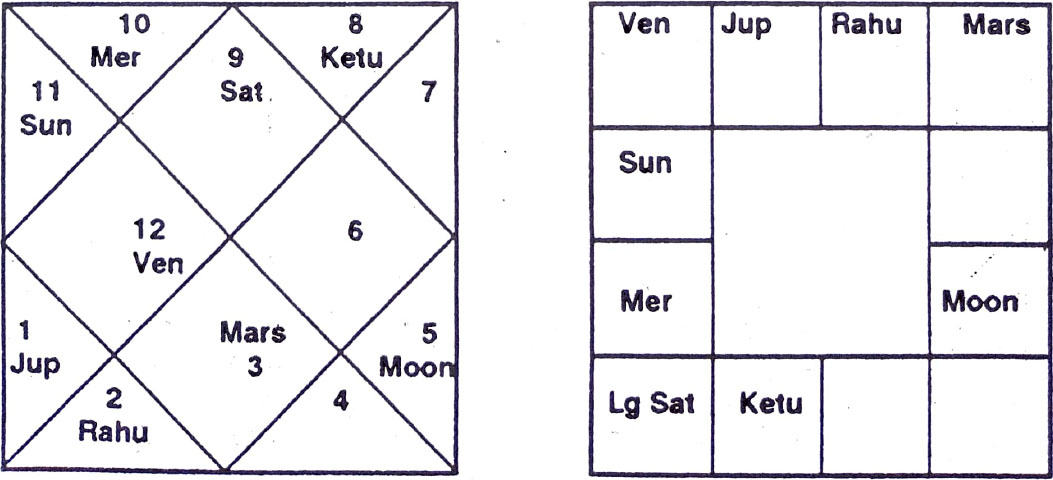
lived only for three years after marriage. He did not marry thrice. Now he is all alone and has become an ascetic in Vivekananda Matha (Monastery). I have seen the fruitation of this combination without fail in my 20 years' experience.
लग्नस्थे च गुरौ सौरौ धने राहौ तृतीयगे ।
इति चेञ्जन्मकाले स्यान्माता तस्य न जीवति ॥ ३१ ॥
- If at the time of birth Jupiter is in the Ascendant and Saturn is situated in the 2nd House and Rahu in the 3rd House, the native's mother does not remain alive.
क्षीणचन्द्रात्त्रिकोणस्थैः पापैः सौम्यविवर्जितैः ।
माता परित्यजेद्वालं षण्मासाच्च न संशय ॥ ३२ ॥
- There is no doubt in it that the mother will leave the child in six months when the trines (the 5th and the 9th Houses) counted from the decreasing Moon are occupied by malefics and these malefics are not together with benefics.
एकांशकस्थौ मन्दारौ यत्र कुत्रस्थितौ यदा ।
शशिकेन्द्रगतौ तौ वा द्विमातृभ्यां न जीवति ॥ ३३ ॥
- When in a horoscope Saturn and Mars remain at 1° from each other in any Rashi or Sign and they fall in a Kendra (angle) from the Moon, the child will not remain alive though it will be nursed by two mothers.
Some learned writers interpret "एकांशकस्थौ" as "in the same Navamamsha". In Aries or Libra, if Saturn and Mars are in one amsha (degree) or in one Navamamsha and the Lagna or Ascendant is Capricorn, this combination has been seen happening in 100% cases. There is no experience as to whether it is 100% true or not in other Ascendants. Given below is a horoscope which proves the truth of this combi-nation.
In this horoscope Saturn and Mars are in the same degrees and the same Navamamsha. The native's mother died just after the delivery. After her death the native was brought up by the grandmother but the native himself died on 13.5.1984.
लग्ने मन्दो मदे भौमः षष्ठस्थाने च चन्द्रमाः ।
इति चेज्जन्मकाले स्यात् पिता तस्य न जीवति ॥ ३४ ॥
- EVILS TO FATHER : In the case of a Saturn occupying the Lagna or Ascendant, Mars the Seventh House, the Moon the Sixth House the native's father doesnot remain alive.
लग्ने जीवो धने मन्दरविभौमबुधास्तथा ।
विवाहसमये तस्य बालस्य प्रियते पिता ॥ ३५ ॥
- When the Ascendant is occupied by Jupiter, the House of Wealth (the 2nd House) by Saturn, the Sun, Mars and Mercury, the native's father dies at the time of his (native's) marriage.
सूर्यः पापेन संयुक्तो ह्मथवा पापमध्यगः |
सूर्यात् सप्तमगः पापस्तदा पितृवधो भवेत् ॥ ३६ ॥
- If the Sun is with a malefic or is hemmed between malefics and the 7th House from the Sun is occupied by a malefic, the native's father is killed.
सप्तमे भवने सूर्यः कर्मस्थो भूमिनन्दनः ।
राहुर्व्यये च यस्यैव पिता कष्टेन जीवति ॥ ३७ ॥
- The native's father will hardly live if there is the Sun in the 7th House, Mars in the 10th and Rahu in the 12th.
दशमस्थो यदा भौम: शत्रुक्षेत्रसमाश्रितः ।
प्रियते तस्य जातस्य पिता शीघ्रं न संशयः ॥ ३८ ॥
- There is no doubt about it that the native's father dies soon when Mars is situated in the 10th House identical with his enemy's sign.
रिपुस्थाने यदा चन्द्रो लग्नस्थाने शनैश्वरः ।
कुजश्च सप्तमे स्थाने पिता तस्य न जीवति ॥ ३९ ॥
- When the Moon is in the 6th House (the House of Enemy), Saturn in the Lagna or Ascendant, Mars in the 7th House, the Inative's father does not remain alive.
भौमांशकस्थिते भानौ शनिना च निरीक्षिते ।
प्राग्जन्मनो निवृत्तिः स्यान्मृत्युर्वाऽपि शिशोः पितुः ॥ ४० ॥
- The native's father would have given up his family and become an ascetic or would have died before his (native's) birth if the Sun is situated in the Mar's Navamamsha (the Navamamsha in the birth chart is in Aries or in Scorpio) and is aspected by Saturn.
चतुर्थे दशमे षापौ द्वादशे च यदा स्थितौ ।
पितरं मातरं हत्वा देशाद्देशान्तरं व्रजेत् ॥ ४९ ॥
- When the malefics are placed in the 4th, 10th and 12th Houses, the native having killed his parents (both father and mother) wanders in foreign lands from one place to another.
राहु-जीवौ रिपुक्षेत्रे लग्ने वाऽथ चतुर्थके ।
त्रयोविंशतिमे वर्षे पुत्रस्तातं न पश्यति ॥ ४२ ॥
- If Rahu and Jupiter be in the 6th House or the Lagna or Ascendant or the 4th House the son does not see his father in the 23rd year.
भानुः पिता च जन्तूनां चन्द्रो माता तथैव च ।
पापदृष्टियुतो भानुः पापमध्यगतोऽपि वा ॥ ४३ ॥
पित्ररिष्टं विजानीयाच्छिशोर्जातस्य निश्चितम् ।
भानोः षष्ठाष्टमर्क्षस्यैः पापैः सौम्यविवर्जितैः ।
सुखभावगतैर्वाऽपि पित्ररिष्टं विनिर्दिशेत् ॥ ४४ ॥
एवं चन्द्रात् स्थितैः पापैर्मातुः कंष्टं विचारयेत् ।
बलाऽबलविवेकेन कष्टं वा मृत्युमादिशेत् ॥ ४५ ॥
43 - 45. The Sun is the father of all beings and the Moon is the mother. If the Sun, at the time of the native's birth, is aspected by or is situated with malefics or is hemmed between two malefics, it should be known that the combination will certainly cause evil to the native's father. Also, evil to the native's father is to be predicted if the 6th, 8th or 4th House are occupied by malefics and these donot have the aspect or conjunction of the benefics Similarly, evil to the native's mother is to be considered if malefics are situated in these Houses from the Moon and trouble or death should be predicted according as the strength or weakness of the occupants concerned.
इत्यारिष्टं मया प्रोक्तं तद्भङ्गश्चापि कथ्यते ।
यत् समालोक्यं जातानां रिष्टाऽरिष्टं वदेद् बुधः ॥ १ ॥
- (Parasara said to Maitreya) I have described to you the evils at birth, now I narrate the antidotes to such evils as well by considering which the learned astrologer should speak of the native's auspicious and inauspicious effects.
एकोऽपि ज्ञार्यशुक्राणां लग्नात् केन्द्रगतो यदि ।
अरिष्टं निखिलं हन्ति तिमिरं भास्करो यथा ॥ २ ॥
- If even one among Mercury, Jupiter and Venus happens to be placed in a Kendra House (1, 4, 7, 10 are Kendra houses) the combination destroys all the evils as darkness is eliminated only by the rising of the Sun.
एक एव बली जीवो लग्नस्थो रिष्टसंचयम् ।
हन्ति पापक्षयं भक्त्या प्रणाम इव शूलिनः ॥ ३ ॥
- A single but strong Jupiter in the Lagna or Ascendant has the ability to destroy all evils just as a single reverential obeisance to Lord Shiva can destroy all sins.
एक एव विलग्नेश: केन्द्रसंस्थ बलान्वितः ।
अरिष्टं निखिलं हन्ति पिनाकी त्रिपुरं यथा ॥ ४ ॥
- Just as Lord Shiva, the holder of bow destroyed the demon Tripur, the Lord of the Lagna or Ascendant has the capability of destroying all evils provided that he is strongly placed in Kendra (1/4/7/10).
Notes: From the Lagna or Ascendant is known the native's physical strength and capacity, his stamina etc. the excess or lack of these. Therefore if the Ascendant Lord himself is strongly placed in a Kendra House, the longevity of the native is a certainty.
शुक्लपक्षे क्षपाजन्म लग्ने सौम्यनिरीक्षिते ।
विपरीतं कृष्णपक्षे तथारिष्टविनाशनं ॥ ५ ॥
- If the birth time falls in the Shukla Paksha (the bright half of the month) during night and the Ascendant is aspected by benefics, it causes the destruction of all evils and similar effect is produced if the birth time falls in the Krishna Paksha (the dark half of the month) during day time and the Lagna or Ascendant is aspected by benefics.
Notes : The meaning of the 2nd half of this sloka श्लोक (verse) has not been rightly understood by some learned writers. In the first line of the (verse) there is the word 'शुक्लपक्षेक्षपाजनम्' which means 'if the birth occurs in shuklapaksha (the bright half of the month). Exactly in the same context there is in the second line the opposite word कृष्णपक्षे (Krishnapaksha or the dark half of the month). Here the whole of the first line cannot be reversely interpreted. Therefore its meaning should be in this way: "If the birth takes place in the Krishnapaksha during the day time and the Ascendant is aspected by a benefic planet, it destroys all evils"; but some learned writers have interpreted it thus: "If the birth takes place in the Krishnapaksha during day time and the Lagna or Ascendant has the aspect of a malefic planet it destroys all evils".
व्ययस्थाने यदा सूर्यस्तुलालग्ने तु जायते ।
जीवेत् स शतवर्षाणि दीर्घायुर्बालको भवेत् ॥ ६ ॥
- If the Child is born in the Libra Ascendant and the Sun is placed in the Vyaya Sthan (i.e. the 12th House) it will have long life and will live for 100 years.
गुरु-भौमौ यदा युक्तौ गुरुदृष्टोऽथवा कुजः ।
हत्वाऽरिष्टमशेषं च जनन्या: शुभकृद्भवेत् ॥ ७ ॥
- When Mars and Jupiter are placed together or Mars has the aspect of Jupiter, the combination proves auspicious for the native's mother after destroying all the evils.
चतुर्थदशमे पाप: सौम्यमध्ये यदा भवेत् ।
पितुः सौख्यकरो योगः शुभैः केन्द्रत्रिकोणगैः ॥ ८ ॥
- When malefics situated in the 4th and the 10th Houses happen to be hemmed by benefics and benefics fall in the Kendra or angles (4-7-10) or in Trikona or trines, the combination is auspicious to the native's father.
सौम्यान्तरगतैः पापैः शुभैः केन्द्रत्रिकोणगैः ।
सद्यो नाशयतेऽरिष्टं तद्भावोत्थफलं न तत् ॥ ९ ॥
- In the case of malefics having been placed between benefics and benefics having gone in Kendras or Trikonas (angles or trines) the combination destroys the evils soon and the Bhava or House concerned also does not yield evil effects.
Practice
Chapter 10 says the lamp in the birth chamber corresponds to the Sun's position, the wick to the Lagna, and the oil to the Moon. What kind of claim is that?
Write your answer down before opening the explanation.
Show the answer and why
Answer: That the chart and the physical circumstances of the birth are two expressions of the same moment — not that one causes the other.
This is worth being precise about, because it is the clearest statement in the early chapters of how the whole system is supposed to work. Nobody is claiming the Sun's position lights a lamp. The claim is that the configuration of a moment shows up in everything belonging to that moment, the room included. Whether you find that plausible is your own business; what matters for reading BPHS is knowing that this is the claim, because it is the same claim being made when a chapter says the 4th house shows the mother.
Source: BPHS 10.8–9
Verse 2 of Chapter 11 says the first twenty-four years carry Bālāriṣṭa, and that longevity should not be assessed until that period has passed. What is Parashara doing there?
Write your answer down before opening the explanation.
Show the answer and why
Answer: Setting a limit on his own technique — declaring that the longevity methods given later cannot be applied to a young child.
A classical text placing an explicit boundary on when a method may be used is worth noticing, and it is easy to read past. It also tells you something about Chapter 11 itself: these are not longevity calculations, they are a separate class of judgment about early danger, and Parashara keeps them separate deliberately. Week 7's longevity systems are a different apparatus and this verse says so in advance.
Source: BPHS 11.2
Chapter 12's cancellations are strikingly easy to satisfy — one of Mercury, Jupiter or Venus in any Kendra destroys all the evils; a single strong Jupiter in the Lagna does the same; so does a strong Lagna lord in a Kendra. What does that tell you about how Chapter 11 is meant to be used?
Write your answer down before opening the explanation.
Show the answer and why
Answer: That the Ariṣṭa combinations are not verdicts. They are conditions that must be checked against a set of cancellations before any conclusion is drawn.
Run the numbers informally and this is more striking still. A benefic in a Kendra is not rare — it happens in a large fraction of all charts. Which means Parashara has built a structure where the alarming chapter is routinely defused by the reassuring one, and he has placed them adjacent so you cannot read one without the other. Anyone who quotes Chapter 11 without Chapter 12 is quoting half a sentence.
Source: BPHS 12.2–4
Chapter 11 verse 43 says the Sun is the father of all beings and the Moon the mother. How does that relate to the 9th and 4th houses?
Write your answer down before opening the explanation.
Show the answer and why
Answer: They are two independent routes to the same subject: the Sun and Moon as natural significators, the 9th and 4th as the houses. Both are used, and they can be checked against each other.
This is the first appearance of a principle that becomes structural in Week 5 — the kāraka, the natural significator. A subject in Jyotish typically has both a house and a planet standing for it, and agreement between them strengthens a reading while disagreement weakens it. You saw the same idea in Chapter 8's "the 9th from the Sun also shows the father". It is the same move.
Source: BPHS 11.43–45
Check your understanding
Answer from memory first. Looking back at the reading before you try turns a memory test into a copying exercise.
What is Bālāriṣṭa, and what period does Parashara assign to it?
Write your answer down before opening the explanation.
Show the answer and why
Answer: Danger to a young child. The first twenty-four years.
Also called Janmāriṣṭa. The twenty-four-year figure is longer than most readers expect and is worth holding, because it is also the period during which Parashara says longevity itself should not be judged.
Source: BPHS 11.2
Someone asks whether BPHS says anything about what cancels a difficult combination. Where do you send them, and what is the general shape of the answer?
Write your answer down before opening the explanation.
Show the answer and why
Answer: Chapter 12. The general shape: benefics in Kendras, a strong Jupiter in the Lagna, a strong Lagna lord in a Kendra, malefics hemmed between benefics, and benefics occupying Kendras or Trikoṇas.
This is one of the most practically useful pieces of navigation in the early book, and not only for Ariṣṭa. The same cancellation logic — strong benefics in strong houses relieve difficulty elsewhere — recurs throughout BPHS, and Chapter 12 is where it is stated most plainly.
Source: BPHS 12.2–9
Why does this course read all of Chapters 10 to 12 rather than summarising them?
Write your answer down before opening the explanation.
Show the answer and why
Answer: Because they are part of the text and because reading them changes what you understand about how Parashara reasons — but their specific combinations are not techniques this course trains you to apply.
There is a difference between skipping a chapter and placing it. You have read these, you know what they claim, you know where to find them, and you know why the course does not build on them. That is a complete outcome. It is not the same as a summary, and it is not the same as pretending they are not there.
What you carry forward
Two things grow across the whole course. This unit adds to both.
To your chart-analysis process
- **Step 4 (opened) — identify the relevant Bhāvas.** Before judging a house, note whether any of Parashara's cancellation conditions apply to the chart as a whole (Ch. 12): benefics in Kendras, strong Lagna lord, malefics hemmed by benefics.
To your field manual
- Bālāriṣṭa covers the first 24 years. BPHS says longevity should not be assessed within that period (11.2).
- Ch. 12 cancellations: any of Mercury, Jupiter or Venus in a Kendra; a strong Jupiter in the Lagna; a strong Lagna lord in a Kendra; malefics hemmed between benefics; benefics in Kendras or Trikoṇas.
- Never quote an Ariṣṭa combination without checking the Ch. 12 cancellations. The two chapters are a single argument.
- The Sun signifies the father and the Moon the mother, independently of the 9th and 4th houses. Where house and kāraka agree, a reading is stronger.
By now you should be able to
- Describe what kind of claim Chapters 10–12 are making about a chart
- State the general structure of Parashara's Ariṣṭa material and its cancellation
- Explain why Chapter 12 must be read together with Chapter 11
- Say how a responsible reader handles this material today