Week 3 · Unit 4 · Reading the Bhavas
Milestone 3 of 3: The first five houses, taught from their principles
Home and Mind, Children and Intelligence
Bhāvas 4 and 5 — the ground beneath a life, and what a person produces from within.
Assumes you have done: Unit 3 — the derivation method, which this unit assumes
Why this matters
These are the two houses most often reduced to keyword lists, and the two where the reduction costs most. "Mother, home, vehicle" for the 4th and "children, education" for the 5th will get you through a quiz and fail you the first time somebody asks a real question. Both houses have a wide organising idea underneath, and this is the unit where the method from the last one becomes something you can use on any house at all.
Learn
Two houses, and both of them are routinely flattened into three-word summaries that cost more than they save.
The 4th — the ground beneath a life
Chapter 13 gives it as conveyance, relatives, mother, happiness, treasure, lands and houses.
The usual teaching turns that into “mother, home, property, vehicles”. Which is accurate as far as it goes, and goes nowhere.
Here is the idea. The 4th house is what holds and shelters a life — the ground you stand on.
Mother is the first shelter any person has. A dwelling is the physical shelter. Land is the ground itself. A vehicle is what holds you while you move. Treasure is what you fall back on when other things fail. And happiness — in the specific sense Parashara uses, which is closer to settledness than to pleasure — is the inner correlate of all of it: the felt state of being held.
Read Chapter 17 with that in hand and its proportions stop being puzzling. The chapter spends far more of its length on contentment, ease of mind and domestic comfort than on real estate, because contentment is the subject and the property is one of the things that produces it.
There is a corollary that becomes structurally important in Week 13. If the 4th is what holds you, then its affliction is what makes leaving possible. A question about relocation, migration or foreign residence is not only a 12th house question — it is a question about whether the ground beneath this person holds them in place or lets them go. That reasoning is not available from a keyword list at all.
The 5th — what a person brings forth
Chapter 13 gives it as amulets, sacred mantras, learning, the splendour of the intellect, sons, the capacity to manage affairs, and falling from position.
The idea: what a person produces from within, and the merit that makes production possible.
Children are the most literal case — what you bring forth that outlives you. Learning is what you take in and make your own, which is a kind of internal production. Intelligence is the faculty itself. Mantras and amulets belong because the 5th is classically the house of pūrva puṇya, merit carried forward, and mantra is the technology by which merit is generated and transferred. “Capacity to manage affairs” is the same faculty applied practically. And falling from position belongs precisely because a fall is what happens when the merit runs out.
That last item is the test of whether you have the principle. On a keyword list, “falling from position” in the house of children and education makes no sense at all. On the principle it is the obvious complement: the house of accumulated merit is also the house of merit exhausted.
Two Trikoṇas, two kinds of merit
The 1st, 5th and 9th are the Trikoṇas, and two of them concern merit. It is worth having the distinction sharp before Week 6 builds Rāja Yoga on it.
The 5th is merit as it operates from you: what you generate, produce, earn and bring forth.
The 9th is merit as it comes to you: fortune, dharma, the teacher, the father, inheritance in the widest sense.
Generated and received. Both are merit; the direction is opposite. When a question involves both — as questions about education abroad or about a family business routinely do — knowing which side of the flow you are asking about is what keeps the reading coherent.
A standing caution, stated once and meant throughout
Chapter 18 contains material that appears to allow you to state how many children someone will have. Later chapters add to it, and the D7 is often used the same way.
This course does not train you to produce that number, and it is worth being explicit about the reasoning rather than just declining.
The classical material comes from a context in which the number of births and the number of surviving children were substantially different quantities, in which neither was much subject to choice, and in which the question was practically about lineage rather than about a person’s plans. None of that holds in the same way now. Modern reproductive circumstances — medical intervention, contraception, deliberate choice, adoption — make “how many children” a different question from the one the text is answering.
And the cost of being wrong is not symmetrical. Someone told confidently that they will have no children, or three, carries that. It is not a claim you can retract.
Where Week 3 leaves you
You can judge a house. You can find the idea underneath one rather than memorising its instances. You have done it on five houses with a method that works on the other seven.
Week 4 asks you to do exactly that — the remaining seven houses, considerably faster, because you already have the method. And then it does the thing that turns twelve separate judgments into a single connected reading.
Read BPHS
This is the source itself. The teaching above prepares you for it; it does not replace it.
उक्तं तृतीयभावस्य फलं संक्षेपतो मया ।
सुखभावफलं चाऽथ कथयामि द्विजोत्तम ! ॥ १ ॥
- O excellent Brahmin, I, explained to you shortly the effects of the Third House. Now I will speak of the effects of the Fourth House.
सुखेशे सुखभावस्थे लग्नेशे तद्गतेऽपि वा ।
शुभदृष्टे च जातस्य पूर्ण गृहसुखं वदेत् ॥ २ ॥
- The native will enjoy the full happiness of the house should the Lord of the Fourth House be in the 4th House and the Ascendant Lord be also there and be aspected by a benefic planet.
स्वगेहे स्वांशके स्वोच्चे सुखस्थानाधिपो यदि ।
भूमि-यान-गृहादीनां सुखं वाद्यभवं तथा ॥ ३ ॥
- If the Lord of the 4th House is placed in his own sign, in his own Navamamsha and in his sign of exaltation the native gets the comforts of having lands, conveyance, house and musical instruments.
कर्माधिपेन संयुक्ते केन्द्र कोणे गृहाधिपे ।
विचित्रसौधप्राकारैर्मण्डितं तद्ग्रहं वदेत् ॥ ४ ॥
- In the event of the Lord of the 10th House together with the Lord of the 4th House being placed in Kendra (angle) or a trikona (trine) the native's house should be spoken as being adorned with a boundary wall plastered with special material.
बन्धुस्थानेश्वरे सौम्ये शुभग्रहयुतेक्षिते ।
शशिजे लग्नसंयुक्ते बन्धुपूज्यो भवेन्नरः ॥ ५ ॥
- In the case of the Lord of the Fourth House being a benefic planet, is being aspected by a benefic planet and Mercury occupying the Lagna or Ascendant, the native is adored by his relatives.
मातुःस्थाने शुभयुते तदीशे स्वोच्चराशिगे ।
कारके बलसंयुक्ते मातुर्दीर्घायुरादिशेत् ॥ ६ ॥
- It is an indication of the long life of the mother, should there be a benefic planet in the fourth house and its Lord be in his sign of exaltation and, the significator planet of mother (the Moon) be endowed with strength.
सुखेशे केन्द्रभावस्थे तथा केन्द्रस्थितो भृगुः ।
शशिजे स्वोच्चराशिस्थे मातुः पूर्ण सुखं वदेत् ॥ ७ ॥
- If the Lord of the Fourth House and Venus are situated in a Kendra or angle and Mercury is in his exaltation sign there will be full happiness of the mother.
सुखे रविते मन्दे चन्द्रे भाग्यगते सति ।
लाभस्थानगतो भौमो गो-महिष्यादिलाभकृत् ॥ ८ ॥
- In the event of the Sun being placed in the 4th House, Saturn and the Moon in the 9th House and Mars in the House of Profit (the 11th House), the native gets the benefit of owning cows and buffaloes.
चरगेहसमायुक्ते सुखे तद्राशिनायके ।
षष्ठे व्यये स्थिते भौमे नरः प्राप्नोति मूकताम् ॥ ९ ॥
- The native get dumbness when there is a movable sign in the 4th House and the Lord of the 4th House and Mars are placed in the 6th or 12th House.
लग्नस्थानाधिपे सौम्ये सुखेशे नीचराशिगे।
कारके व्ययभावस्थे सुखेशे लाभसङ्गते ॥ १० ॥
द्वादशे वत्सरे प्राप्ते वाहनस्य सुखं वदेत् ।
वाहने सूर्यसंयुक्ते स्वोच्चे तद्भावनायके ॥ ११ ॥
शुक्रेण संयुते वर्षे द्वात्रिंशे वाहनं भवेत् ।
कर्मेशन युते बन्धुनाथे तुङ्गांशसंयुते ॥ १२ ॥
द्विचत्वारिंशके वर्षे नरो वाहनभाग् भवेत् ।
लाभेशे सुखराशिस्थे सुखेशे लाभसंयुते ॥ १३ ॥
द्वादशे वत्सरे प्राप्ते जातो वाहनभाग् भवेत् ।
शुभं शुभत्वे भावस्य पापत्वे फलमन्यथा ॥ १४ ॥
10-14. It should be predicted that the native will get the happiness of obtaining conveyance in the 12th year when the Ascendant Lord is a benefic planet, the Lord of the 4th House is in his debilitation sign, the significator of the 4th House is in the 12th House and the Lord of the 4th House is in the House of Profit (the 11th House). If the Sun is in the 4th House and the Lord of the 4th House is together with Venus in his exaltation sign, the native will obtain conveyance in the 32nd year. When the Lord of the 10th House is together with the Lord of the 4th House and is in his exalted Navamamsha, the native will obtain the happiness of obtaining conveyance in the 42nd year: And when the Lord of the House of Profit (the 11th House) is placed in the 4th House and the Lord of the 4th House in the 11th House, the native gets the benefit of conveyance in the 12th year. When the 4th House is under benefic influence the effects will be auspicious while these will be inauspicious if it (the 4th House) is under malefic influence.
Show the full passage — 22 verses, 2 diagrams
अथ पञ्चमभावस्य कथयामि फलं द्विज ! |
लग्नपे सुतभावस्थे सुतपे च सुते स्थिते ॥ १ ॥
केन्द्रत्रिकोणसंस्थे वा पूर्ण पुत्रसुखं वदेत् ।
षष्ठाष्टमव्ययस्थे तु सुताधीशे त्वपुत्रता ॥ २ ॥
सुतेशेऽस्तं गते वाऽपि पापाक्रान्ते च निर्बले ।
तदा न जायते पुत्रो जातो वा प्रियते ध्रुवम् ॥ ३ ॥
1-3 O Brahmin, Now I speak of the effects of the 5th House: The Ascendant Lord and the Fifth Lord being placed in the 5th House or in a kendra or Trikona, the native should be told of the thorough happiness of the son; the situation of the 5th Lord in the 6th or 8th or 12th House is to be predicted as the thorough lack of son. If the Fifth Lord is combust, is in conjunction with a malefic planet and is also weak, then no son will be born or if born his death is quite certain.
पष्ठस्थाने सुताधीशे लग्नेशे कुजसंयुते ।
प्रियते प्रथमापत्यं काकबन्ध्या च गेहिनी ॥ ४ ॥
- In case the 5th Lord being in the 6th House, and the Ascendant Lord in Conjunction with Mars, the native's first born child will die whereafter his wife will become sterile ("काकबन्ध्या" "Kakbandhya") (one who is incapable of conceiving after producing one child).
Here are two examples to prove this:
| Date of birth | Time of birth | Place of birth |
| 2-11-1955 | 9.50 P M IST | Meerut. |
This native has Gemini Ascendant. The 5th Lord is Venus who placed in the 6th House. The Ascendant Lord Mercury together
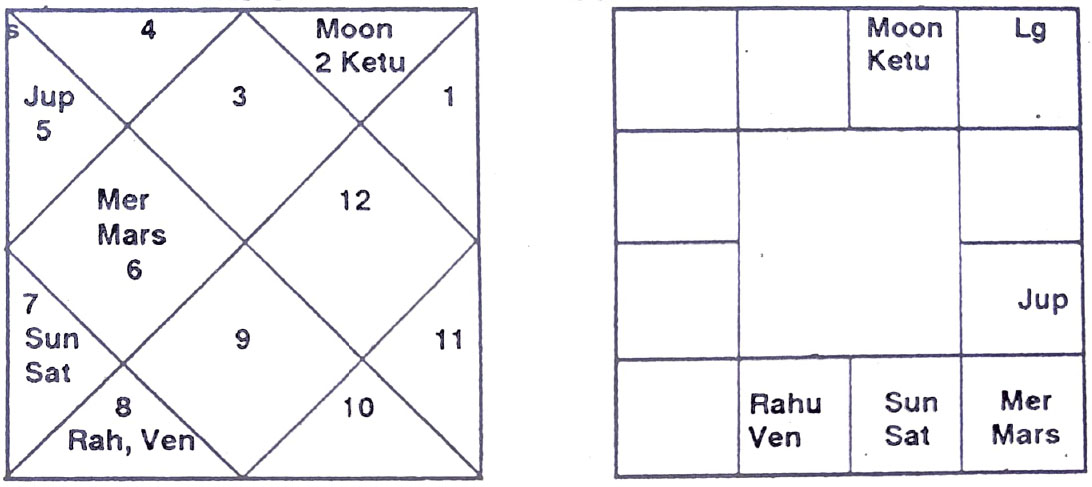
with Mars is in the 4th House. The native got a son two years after marriage. He (the son) died 1 1/2 years after by snakebite. The wife felt pain in the abdomen after sometime. During medical tests it was found that she had developed a lump of tissues on the mouth of her ovary which was operated. After operation she was incapacitated of conceiving and producing children as the ovary itself was removed in the operation.
The second example is that of an acquaintance of mine:
| Date of birth | Time of birth | Place of birth |
| 3-4-1942 | 11.15 PM. IST | Hapur |
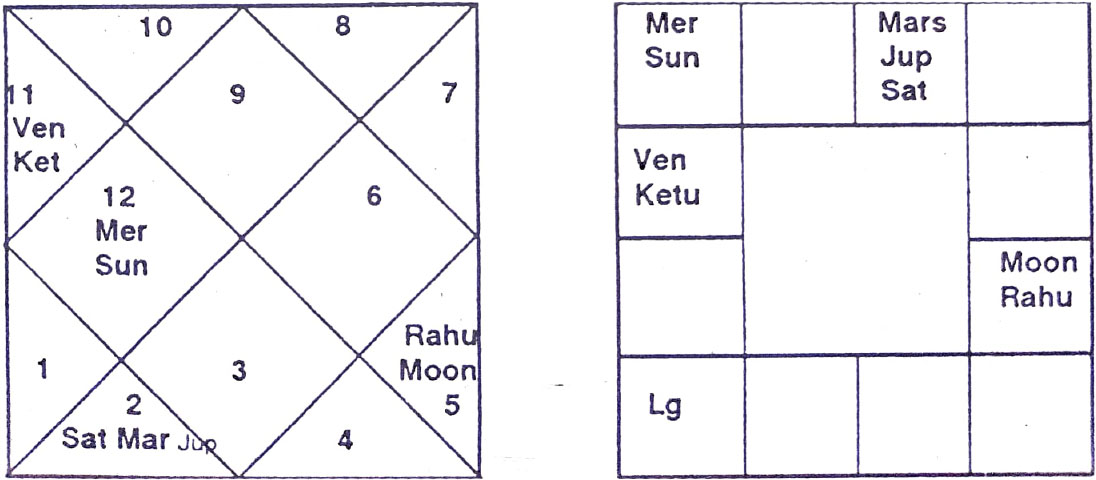
Here the Ascendant is Sagittarius. The fifth Lord is Mars who is placed in the 6th House. The Ascendant Lord Jupi ter is also together with Mars. Therefore, this combination brought the above said effect hundred percent.
सुताधीशो हि नीचस्थो व्ययषष्टाष्टमस्थितः ।
काकबन्ध्या भवेन्नारी सुते केतुबुधौ यदि ॥ ५ ॥
- If the debilitated Fifth Lord is situated in 12th, 6th or 8th house and Mercury in the 5th House, the native's wife will be Kakbandhya 'काकबन्ध्या (Sterile after giving birth to one child).
सुतेशो नीचगो यत्र सुतस्थानं न पश्यति ।
तत्र सौरिबुधो स्यातां काकबन्ध्यात्वमाप्नुयात् ॥ ६ ॥
- The native's wife will be sterile ("काकबन्ध्या" "Kakbandhya") if the Fifth Lord is in his debilitation or he does not aspect the Fifth House and Saturn and Mercury are situated there (in the fifth House).
भाग्येशो मूर्तिवर्ती चेत् सुतेशो नीचगो यदि ।
सुते केतु-बुधौ स्यातां सुतं कष्टाद् विनिर्दिशेत् ॥ ७ ॥
- If the 9th Lord is in the 5th House and the 5th Lord is debilitated and Mercury and Ketu are there in the 5th House, son will be obtained after great ordeal, the astrologer should predict so.
षडादित्रयसंस्थोऽपि नीचो वाऽप्यरिसंस्थितः ।।
पापाक्रान्ते सुतस्थाने पुत्रं कष्टाद्विनिर्दिशेत ॥ ८ ॥
- If the debilitated 5th Lord is situated in the 6th, 8th or 12th House or in an enemy sign, and the 5th House is occupied by malefic planets the son is got after great ordeal.
षष्ठाष्टमव्ययस्थो वा नीचो वा शत्रु राशिग: ।
सुतेशश्च सुते तस्य कष्टात् पुत्रं विनिर्दिशेत ॥
Which may be explained in this way: If the 5th Lord be in the 6th, 8th or 12th House or in his debilitation sign or in an enemy sign or in the 5th House, the getting of son will occur after great ordeal.
पुत्रभावे बुधक्षेत्रे मन्दक्षेत्रेऽथवा पुनः ।
मन्दे मान्दियुते दृष्टे तदा दत्तादय: सुताः ॥ ९ ॥
- Should there be the signs of Mercury or Saturn in the 5th House and should it (the 5th House) have the conjunction or aspect of Saturn and Mandi, the native will have adopted sons.
रवि-चन्द्रौ यदैकस्थावेकांशकसमन्वितौ ।
त्रिमातृथिरसौ यद्वा द्विपित्राऽपि च पोषितः ॥ १० ॥
- If the Sun and the Moon are placed in the same sign and in the same Navamamsha, then the native is brought up by three mothers or two fathers.
पञ्चमे षड्ग्रहैर्युक्ते तदीशे व्ययराशिगे ।
लग्नेशेन्दू बलाढयौ चेत् तदा दत्तसुतोद्भवः ॥ ११ ॥
- If the 5th House is occupied by 6 planets, its Lord is placed in the 12th House and the Ascendant Lord and the Moon are endowed with strength, in this combination also the native will have adopted son.
सुते ज्ञजीवशुक्रैश्च सबलैरवलोकिते ।
भवन्ति बहवः पुत्रा: सुतेशे हि बलान्विते ॥ १२ ॥
- The 5th House is aspected by strong Mercury, Jupiter and Venus and the 5th Lord is also endowed with strength, the combination will confer many children on the native.
सुतेशे चन्द्रसंयुक्ते तद्रेष्काणगतेऽपि वा ।
तदा हि कन्यकोत्पत्तिः प्रवदेद् दैवचिन्तकः ॥ १३ ॥
- If the 5th Lord is together with the Moon and is also in the Decanate of the Moon, the astrologers opine that the native will beget only daughters.
सुतेशे चरराशिस्थे राहुणा सहिते विधौ ।
पुत्रस्थानं गते मन्दे परजातं वदेच्छिशुम् ॥ १४ ॥
- If the 5th Lord is in a moveable sign and is in conjunction with the Moon and Rahu and Saturn is placed in the 5th House, the native should be spoken of as born Parajata (begot by other then the father).
लग्नादष्टमगे चन्द्रे चन्द्रादष्टमगे गुरौ ।
पापग्रहैर्युते दृष्टे परजातो न संशयः ॥ १५ ॥
- If there is placed the Moon in the 8th House from the Ascendant and Jupiter is situated in the 8th House from the Moon and these (the Moon and Jupiter) are together with or are aspected by malefic planets, the native is undoubtedly born as 'Parajata'.
पुत्रस्थानाधिपे स्वोच्चे लग्नाद्वा द्वित्रिकोणगे ।
गुरुणा संयुते दृष्टे पुत्रभाग्यमुपैति सः ॥ १६ ॥
- The 5th Lord in his exaltation occupies the 2nd, 3rd, Ist, 5th or 9th house and these have the aspect or conjunction of Jupiter, the native will have the blessing of obtaining a son.
त्रिचतुःपापसंयुक्ते सुते सौम्यविवर्जिते ।
सुतेशे नीचराशिस्थे नीचसंस्थो भवेच्छिशुः ॥ १७ ॥
- If the 5th House has 3 or 4 malefic planets placed in it and is devoid of any benefic influence on it and the 5th Lord is in his debilitation sign, then the native has a desire of indulging in mean deeds (that is he will have a base profession).
पुत्रस्थानं गते जीवे तदीशे भृगुसंयुते ।
द्वात्रिंशे च त्रयस्त्रिंशे वत्सरे पुत्रसंभवः ॥ १८ ॥
- When the 5th House is occupied by Jupiter and the 5th Lord is together with Venus the child will be born of the native in his 32nd or 33rd year.
सुतेशे केन्द्र भावस्थे कारकेण समन्विते ।
षटुत्रिंशे त्रिंशदब्दे च पुत्रोत्पत्तिं विनिर्दिशेत् ॥ १९ ॥
- If the 5th Lord is placed in a Kendra (angle) and has conjunction with the significator (Jupiter) the birth of native's child should be predicted in his 30th or 36th year.
लग्नाद् भाग्यगते जीवे जीवाद् भाग्यगते भृगौ ।
लग्नेशे भृगुयुक्ते वा चत्वारिंशे सुतं वदेत् ॥ २० ॥
- The native's child birth is to be spoken of occuring in his 40th year, should Jupiter be placed ninth from the Ascendant and Venus ninth from Jupiter or the Ascendant Lord be conjuct with Venus.
पुत्रस्थानं गते हौ तदीशे पापसंयुते ।
नीचराशिगतो जीवो द्वात्रिंशे पुत्रमृत्युदः ॥ २१ ॥
- In the event of Rahu being placed in the 5th House, the 5th Lord be in Conjunct with a malefic planet and Jupiter being in his debilitation sign, the combination will be the son's death bringing in the native's 32nd year.
जीवात् पञ्चमगे पापे लग्नात् पञ्चमगेऽपि च ।
षट्त्रिंशे च त्रयस्त्रिंशे चत्वारिंशे सुतक्षयः ॥ २२ ॥
- Child loss to the native will occur in his 33rd or 36th year in the event of malefic planet occupying the 5th House from the Ascendant or from Jupiter.
लग्ने मान्दितमायुक्ते लग्नेशे नीचराशिगे ।
षट्पञ्चाशत्तमेऽब्दे च पुत्रशोकसमाकुलः ॥ २३ ॥
- If there is Mandi in the Ascendant and the Ascendant Lord is placed in his debilitation sign, the native will be full of grief due to his son's death, in his 56th year.
चतुर्थे पापसंयुक्ते षष्ठभावे तथैव हि ।
सुतेशे परमोच्चस्थे लग्नेशेन समन्विते ॥ २४ ॥
कारके शुभसंयुक्ते दशसंख्यास्तु सूनवः ।
परमोच्चगते जीवे धनेशे राहुसंयुते ॥ २५ ॥
भाग्येशे भाग्यसंयुक्ते संख्याता नव सूनवः ।
पुत्रभाग्यते जीवे सुतेशे बलसंयुते ॥ २६ ॥
धनेशे कर्मभावस्थे वसुसंख्यास्तु सूनवः ।
पञ्चमात् पञ्चमे मन्दे सुतस्थे च तदीश्वरे ॥ २७ ॥
सूनवः सप्तसंख्यश्च द्विगर्भे यमलौ वदेत् ।
वित्तेशे पञ्चमस्थाने सुतस्थे च सुताधिपे ॥ २८ ॥
जायन्ते षट् सुतास्तस्य तेषां च त्रिप्रजामृतिः ।
मन्दात् पञ्चमगे जीवे जीवात् पञ्चमगे शनौ ॥ २९ ॥
सुतभे पापसंयुक्ते पुत्रमेकं विनिर्दिशेत् ।
पञ्चमे पापयुक्ते वा जीवात् पञ्चमगे शनौ ॥ ३० ॥
पल्यन्तरे पुत्रलाभं कलत्रत्रयभाग् भवेत् ।
पञ्चमे पापसंयुक्ते जीवात् पञ्चमगे शनौ ॥ ३१ ॥
लग्नेशे धनभावस्थे सुतेशो भौमसंयुतः ।
जातं जातं शिशुं हन्ति दीर्घायुश्च स्वयं भवेत् ॥ ३२ ॥
24-32. If there be malefic planets in the 4th House and also in the 6th House, the 5th Lord in Conjunction with the Ascendant be in highest exaltation and the significator of the 5th House be together with a benefic planet the number of children will be ten; the number will be nine when Jupiter be in his highest exaltation, the 2nd Lord be conjunct with Rahu and the ninth Lord be in the ninth House; in case Jupiter be placed in the 5th or the 9th House, the 5th Lord be endowed with strength and the 2nd Lord be placed in the 10th House, the number will be the number of Vasus (or eight; if there be Saturn in the 5th House from the 5th, the 5th Lord be in the 5th House the number of children will be seven out of which two will be born twins; should the 2nd Lord be 5th from the 2nd House and the 5th Lord be in the 5th House 6 sons are born to the native out of which 3 are subjected to death; when Jupiter has gone in the 5th House from Saturn or Saturn has gone in the 5th House from Jupiter and the 5th House is occupied by malefic planets one son is to be predicted; when the 5th House is occupied by malefic planets and Saturn is placed 5th from Jupiter the native will have 3 wives but he will beget son only through the 2nd and the 3rd, and; if the 5th House is occupied by malefic planets, Saturn is placed 5th from Jupiter, the Ascendant Lord is in the 2nd House and the 5th Lord is together with Mars, the native is longlived but loses his children one after the other as they are born..
Practice
Chapter 13 gives the 4th house as conveyance, relatives, mother, happiness, treasure, lands and houses. What is the idea?
Write your answer down before opening the explanation.
Show the answer and why
Answer: What holds and shelters a life — the ground beneath a person.
Every item follows. Mother is the first shelter anyone has. A dwelling is the physical one. Land is the ground literally. A vehicle is what carries and contains you when you move. Treasure is what you can fall back on. And happiness, in this specific sense, is the inner correlate — the felt state of being held. That is why Chapter 17 spends so much of its length on contentment rather than on property: contentment is the 4th house's subject, and the property is one of the things that supplies it.
Source: BPHS 13.5, 17
Someone is deciding whether to leave a stable job in the city they grew up in for uncertain work abroad. Which houses, and what does each contribute?
Write your answer down before opening the explanation.
Show the answer and why
Answer: The 4th for what would be given up — home, ground, the felt security of belonging. The 12th for departure and separation. The 10th for the work itself. The 9th if the move is about meaning rather than money.
Notice that the 4th's contribution here is the cost, not the benefit, and that a keyword list would never have told you that. Once you know the 4th is the ground beneath a life, its affliction and its strength both become directly relevant to a relocation question — a strong 4th means there is more to leave. Week 13's foreign-travel question set is built on exactly this reasoning.
The 5th house holds children, learning, intelligence, mantras and amulets, the capacity to manage affairs, and falling from position. What is the idea?
Write your answer down before opening the explanation.
Show the answer and why
Answer: What a person brings forth from within — and the merit that makes it possible.
Children are what you produce that outlives you. Learning is what you take in and make your own. Intelligence is the faculty of production itself. Mantras and amulets are the classical technology of merit — the 5th is traditionally the house of pūrva puṇya, merit carried forward from a previous life, which is why it holds both what you inherit spiritually and what you generate now. "Falling from position" belongs because a fall is what happens when merit runs out.
Source: BPHS 13.6, 18
Both the 5th and the 9th are Trikoṇas and both concern merit. What is the difference?
Write your answer down before opening the explanation.
Show the answer and why
Answer: The 5th is merit as it operates in this life — what you produce and what you have earned. The 9th is merit as inheritance and dispensation — fortune, dharma, the teacher, the father, what comes to you.
A rough and useful distinction: the 5th is what you generate, the 9th is what you receive. The two together with the 1st make the Trikoṇa triad, and Week 6's Rāja Yoga doctrine is built on the relationship between Trikoṇas and Kendras, so having this distinction clear now saves confusion later.
A client asks how many children they will have. Chapter 18 contains material that appears to answer this. What do you do?
Write your answer down before opening the explanation.
Show the answer and why
Answer: Read what the chart supports about children as a domain — and do not produce a number.
There are three reasons, and they compound. The classical material was written in a context where the number of births and the number of surviving children were very different quantities and where neither was much influenced by choice. Modern reproductive circumstances make the question a different question. And the specific harm of getting it wrong is severe and lands on someone who did not ask to be experimented on. This course's standing position: the 5th house, its lord, Jupiter as kāraka and the D7 will tell you a great deal about the domain — its ease, its difficulty, when it activates — and the course does not train you to announce a count. That position is stated here and repeated in Week 13.
Apply it to a chart
Chart B — Albert Einstein, the synthesis chart — A whole documented life, where the evidence pulls in more than one direction. · about 26 min
| Graha | Sign | House | Degree | Nakshatra | Condition |
|---|---|---|---|---|---|
| Sun | Pisces | 10 | 1°20'30" | Purva Bhadrapada 4 | neutral |
| Moon | Scorpio | 6 | 21°47'54" | Jyeshtha 2 | debilitated |
| Mars | Capricorn | 8 | 4°44'52" | Uttara Ashadha 3 | exalted |
| Mercury | Pisces | 10 | 10°58'43" | Uttara Bhadrapada 3 | debilitated |
| Jupiter | Aquarius | 9 | 5°19'05" | Dhanishtha 4 | neutral |
| Venus | Pisces | 10 | 24°49'11" | Revati 3 | exalted |
| Saturn | Pisces | 10 | 12°01'26" | Uttara Bhadrapada 3 | neutral |
| Rahu | Capricorn | 8 | 9°18'36" | Uttara Ashadha 4 | not assigned in BPHS |
| Ketu | Cancer | 2 | 9°18'36" | Pushya 2 | not assigned in BPHS |
| Lagna | Gemini | 1 | 19°38'02" | Ardra | lord Mercury |
This is the first comparative exercise of the course, and the first time you will run the same judgment across two charts. Einstein's 4th and 5th are picked out below; open Chart A alongside it in the chart library.
- Judge Bhāvas 1 to 5 in Chart B by the rule from unit 2. One line each: the house, its lord, where the lord sits, its condition, and your verdict with the conditions that produced it.
- Now Chart A, as far as it can be judged. Cancer rises; Jupiter and the Moon are in the 1st; Saturn is in the 4th. Judge the same five houses — and where a judgment cannot be made because the source does not place a graha, write that down rather than guessing.
- Where do the two charts diverge most sharply in these five houses? Name the single largest difference and the evidence for it.
- One of these charts is far easier to judge than the other. Write two sentences on why, and on what that tells you about the difference between a teaching chart and a real one.
- On your own chart: judge Bhāvas 1 to 5, then — and only then — check them against a life you already know. Note every place the judgment and the life disagree. Those notes are worth more than the agreements.
Check your understanding
Answer from memory first. Looking back at the reading before you try turns a memory test into a copying exercise.
Which planet is the natural kāraka for children, and which divisional chart?
Write your answer down before opening the explanation.
Show the answer and why
Answer: Jupiter, and the Saptāṁśa — D7.
Both are formalised later — kārakas properly in Chapter 34, Week 5 — but the pairing is worth carrying now. Any question about a domain will generally have a house, a lord, a natural significator and a varga, and the four checked together are far more reliable than any one of them.
Why does Chapter 17 spend more space on happiness than on property?
Write your answer down before opening the explanation.
Show the answer and why
Answer: Because happiness in the sense of feeling held and settled is what the 4th house is actually about, and property is one of the things that supplies it.
This is the clearest single case in Volume 1 of the difference between a house's principle and its instances, and it is why the 4th is the house the course uses to make the point. A student who has memorised "mother, home, vehicle" reads Chapter 17 and wonders why it keeps talking about contentment. A student who has the principle reads the same chapter and finds it obvious.
Where in BPHS would you look for what happens when the 5th lord is in the 11th?
Write your answer down before opening the explanation.
Show the answer and why
Answer: Chapter 18, in its lord-in-house section — and Chapter 26, which gives all 144 lord-in-house combinations systematically.
Two routes to the same cell, and they are not redundant. Chapter 18 treats it in the context of the 5th house specifically. Chapter 26 treats it as one instance of a general pattern. Week 4 teaches Chapter 26 as a system rather than a table, and having both routes is part of why that works.
Source: BPHS 18, 26
You have judged Bhāvas 1 to 5 in a chart and three of them came out "mixed". Is that a failure of the method?
Write your answer down before opening the explanation.
Show the answer and why
Answer: No. It is usually the correct answer.
Real charts are mixed. A house with benefic support and an afflicted lord is genuinely both, and saying so precisely — which conditions pull which way — is a better reading than any verdict. The pressure to resolve everything into good or bad is the single largest source of bad interpretation, and it is worth noticing in yourself now, while the stakes are only an exercise.
What you carry forward
Two things grow across the whole course. This unit adds to both.
To your chart-analysis process
- **Step 4 (continued) — identify the relevant Bhāvas.** For any question, name the primary house, the houses that support it, and the houses that would undo it — typically the 6th, 8th and 12th counted from the primary.
To your field manual
- 4th — what holds and shelters a life. Mother, dwelling, land, vehicle, treasure, and inner contentment as the felt state of being held.
- 5th — what a person brings forth from within, and the merit that permits it. Children, learning, intelligence, mantra, capacity to manage, and falling from position when merit runs out.
- 5th is merit generated in this life; 9th is merit received. Both are Trikoṇas.
- Children: 5th house, its lord, Jupiter as kāraka, and D7. The course does not predict a number of children — see the standing caution.
- 'Mixed' is a legitimate and common verdict. Name which conditions pull each way rather than forcing a side.
By now you should be able to
- State the organising principle of the 4th and 5th houses
- Use those principles on questions Chapter 13 does not list
- Judge Bhāvas 1–5 in two charts and say where they diverge
- State the course's standing caution about predicting the number of children