Week 9 · Unit 2 · Timing - The Dasha Systems
Milestone 2 of 3: Dividing the period
Dividing the Mahādaśā
Antardaśā computation — simple proportional arithmetic, and a real conceptual point underneath it.
Assumes you have done: Week 8 unit 2 — the Mahādaśā sequence
Why this matters
A Mahādaśā of nineteen years is too coarse to answer any real question. The Antardaśā divides it, and the arithmetic is a single proportion — which is fortunate, because you will want to be able to do it in your head to check whether a printed table is plausible. Underneath it is something worth noticing: the same nine periods, in the same order, nested inside themselves at every level.
Learn
A Mahādaśā of nineteen years is too coarse to answer anything anyone actually asks. This is where timing becomes usable.
The arithmetic
Verse 1, in ordinary language: multiply the Mahādaśā lord’s years by the Antardaśā lord’s years and divide by 120.
That is it. Each planet takes the same share of any Mahādaśā that it holds of the whole hundred-and-twenty-year cycle.
Venus holds 20 of 120, so Venus takes one sixth of every Mahādaśā. Jupiter holds 16, so about one seventh and a half. The Sun holds 6, so one twentieth.
Work one: Jupiter’s Antardaśā inside a Saturn Mahādaśā. Saturn is 19 years, Jupiter is 16. 19 × 16 = 304, divided by 120 = 2.533 years — two years and about six months.
Two landmarks worth having:
Longest Antardaśā in the system: Venus in Venus, 20 × 20 ÷ 120 = 3 years 4 months.
Shortest: the Sun in the Sun, 6 × 6 ÷ 120 = about 110 days.
So Antardaśās run from roughly three months to roughly forty. That range is why this is the level at which timing starts to be able to say something useful.
The order
Verse 2: the Mahādaśā lord’s own Antardaśā comes first, and the rest follow in the standard cycle order from there.
A Rahu Mahādaśā therefore opens Rahu/Rahu, then Rahu/Jupiter, Rahu/Saturn, Rahu/Mercury, Rahu/Ketu, Rahu/Venus, Rahu/Sun, Rahu/Moon, Rahu/Mars.
The cycle order never changes. Only the entry point does.
The structure underneath
Notice what verse 1 says at the end: the same method continues downward. The Pratyantardaśā is computed from the Antardaśā exactly as the Antardaśā is computed from the Mahādaśā.
Which means the whole system is self-similar. The same nine lords, in the same cyclic order, holding the same proportional shares, at every level of magnification. A Mahādaśā, an Antardaśā, a Pratyantardaśā, a Sūkṣma, a Prāṇa — identical structure, different scale.
The partial opening period
One practical point that confuses people the first time.
A chart’s first Mahādaśā is almost always partial — say four years remaining of a twenty-year Venus period. What happened to the earlier Antardaśās?
They elapsed before birth. The cycle was already running; birth joined it part-way through; the sub-periods that would have run in the first sixteen years of that Venus Mahādaśā are simply not part of this life.
So a chart’s first listed Antardaśā is usually not Venus/Venus. With four years left it will be whichever sub-period the residue falls in — probably Venus/Mars or Venus/Rahu.
Software handles this correctly, and understanding it saves you from thinking the table has an error in it.
Why do it by hand
You will not compute Antardaśās manually in practice. Do it by hand two or three times anyway, for a specific and unglamorous reason: so you can tell when a table is wrong.
If a printed Jupiter Antardaśā inside a Saturn Mahādaśā shows as four years, something has gone wrong, because 16/120 of 19 is about two and a half. That check costs three seconds and catches software configured with a different year length, a different daśā system, or a different starting nakshatra.
Rough mental arithmetic is a quality-control tool, and in a subject where everything downstream depends on a table you did not generate, it is worth having.
Next: the reading skill that makes the rest of Volume 2 possible.
Read BPHS
This is the source itself. The teaching above prepares you for it; it does not replace it.
दशाब्दाः स्वस्वमानघ्ना सर्वायुर्योगभाजिताः ।
पृथगन्तर्दशा एवं प्रत्यन्तरदशादिकाः ॥ १ ॥
1 : For computing the Antardasa of a planet, multiply the Mahadasa years of that planet with the Mahadasa years of other planets separately and then divide the product by the total Mahadasa years of all the planets, the resultant figure in years etc. will represent the Antardasa of each planet. In the same way, from the Antardasa, the Pratyantar Dasas can be calculated.
आदावन्तदशा पाकपतेस्तत्क्रमतोऽपराः ।
एवं प्रत्यन्तरादौ च क्रमो ज्ञयो विचक्षणैः ॥ २ ॥
2 : The first Antardasa will belong to the planet whose Mahadasa being reckoned and the normal sequence of the Antardasas of the other planets follow therefrom. In the same way, the sequence of the Pratyantar Dasas be adopted. (Here the first Pratyantar Dasa will that be of the Antardasa).
भुक्तिर्नवानां तुल्या स्याद् विभाज्या नवधा दशा ।
आदौ दशापतेर्भुक्तिस्तत्केन्द्रादियुजां ततः ॥ ३ ॥
विद्यात् क्रमेण भुक्त्यंशानेव सूक्ष्मदशादिकम् ।
बलक्रमात् फलं विज्ञैर्वक्तव्यं पूर्वरीतितः ॥ ४ ॥
3-4: To compute the Chara Dasas of the planets, multiply the Dasa-span by 9 and the product thereafter is equally divided amidst all the planets and that will be the Antardasa span of each planet. In this, the first Dasa belongs to the lord of the Dasa followed by the Dasas of the planets posited in the Angles (Kendras), then Dasas of planets in Panaphara and lastly the Dasas of the planets in Apoklima houses. Likewise, the Sookshma Dasas of the nine Antardasas be ascertained and their results be predicted by the learned Astrologers on the basis of the strength etc., and other maxims enunciated earlier.
Antardasas of the signs.
कृत्वाऽर्कधा राशिदशां राशेर्भुक्तिं क्रमाद् वदेत् ।
प्रत्यन्तर्दशाद्येवं कृत्वा तत्तत्फलं वदेत् ॥ ५ ॥
5 : The Dasa years of the signs be divided by 12 the resultant will be the Antardasa of each sign. Similarly division of the Antardasas of the sign, the Pratyantar Dasas of the signs are obtained.
The sequence of Antardasas of the signs.
आद्यसप्तमयोर्मध्ये यो राशिर्बलवांस्ततः ।
ओजे दशाश्रये गण्याः क्रमादुत्क्रमतः समे ॥ ६ ॥
6: The first sign of Antardasa or the 7th sign of Antardasa which ever is stronger, the sequence of Antardasa will commence therefrom. In the event of first Antardasa sign being odd, the Dasa sequence will be in the forward order and for even sign, it will be in the reverse order.
अत्राऽपरो विशेषोऽस्ति ब्रविमि तमहं द्विज ! ।
चरेऽनुज्झितमार्गः स्यात् षष्ठषष्ठादिकाः स्थिरे ॥ ७ ॥
उभये कण्टकाज् ज्ञेया लग्नपञ्चमभाग्यतः ।
चरस्थिरद्विस्वभावेष्वोजेषु प्राक् क्रमो मतः ॥ ८ ॥
तेष्वेव त्रिषु युग्मेषु ग्राह्यं व्युत्क्रमतोऽखिलम् ।
एवमुल्लिखितो राशिः पाकराशिरुदीर्यते ॥ ९ ॥
स एव भोगराशि: स्यात् पर्याये प्रथमे स्मृतः ।
आद्याद् यावतिथ: पाकः पर्याये यत्र दृश्यते ॥ १० ॥
तस्मात् तावतिथो भोगः पर्याये तत्र गृह्यताम् ।
तदिदं चरपर्याय - स्थिरपर्याययोर्द्वयोः ॥ ११ ॥
त्रिकोणाख्यदशायां च पाकभोगप्रकल्पनम् ।
पाके भोगे च पापाढ्ये देपपीडा मनोव्यथा ॥ १२ ॥
7-12: O-Vipra : I now narrate the special dimensions of the sequence of the Antardasas of the signs. If the apex Dasa sign is of a movable sign, the sequence of twelve Antardasas of the signs will be in forward or reverse orders. If the apex Dasa is of a fixed sign, the Antardasa sequence will commence there itself followed by the Antardasa df every 6th sign thérefrom. Should the apex Dasa-sign be a dual sign, the first Antardasa will be of the apex Dasa-sign, then the Antardasas of the signs in Angles (Kendras) to the apex Dasa-sign, followed by the Antardasas of the signs in Angles from the 9th to the apex sign; will be the sequence of the twelve Antardasas of the signs. Ifthe apex Dasa-sign of allthe three kinds of signs viz., movable, fixed and dual, is an odd sign, the order of the Dasas will be forward-wise, and in the case of even sign, it would be in the reverse order.
The apex Dasa (दशाश्रय) is called Paaka sign (पाक राशि). The first Dasa-sign is known as and if it belongs to Bhoga sign (भोग राशि). The next Dasa-sign i.e.. Dasa Prada (दशा प्रद) and if it belongs to an even sign, then as much distance the apex Dasa (दशाश्रय) is ahead of it (दशा प्रद) at that much distance, the Bhoga sign (भोग राशि) will be located. In this manner Paaka and Bhoga signs be assumed for Chara, Sthera and Trikona Dasas. If Paaka and Bhoga signs are conjunct with the malefic planets, it will produce oppressive bodily pain and mental distress.
Computation of Antardasas of Pinda etc.
पिण्डत्रिकदशायां तु ब्रवीम्यन्तर्दशाविधिम् ।
पूर्ण दशापतिर्दद्यात् तदर्धं तेन संयुतः ॥ १३ ॥
त्रिकोणगस्तृतीयांशं तुर्यांशश्चतुरस्त्रगः ।
स्मरगः सप्तमं भागं बहुष्वेको बली ग्रहः ॥१४ ॥
एवं स - लग्नका: खेटा: पाचयन्ति मिथः स्थिताः ।
समच्छेदीकृताः प्राप्ता अंशाश्छेदविवर्जिताः ॥ १५ ॥
दशाब्दाः पृथगंशघ्ना अंशयोगविभाजिताः ।
अन्तर्दशा भवन्त्येवं तत्प्रत्यन्तर्दशादिकाः ॥ १६ ॥
13-16: Now I explain the procedure for working out the Antardasas of Pinda etc., which are of three types (Pinda, Amsa, Naisargika).
The lord of the operating Dasa will have full part (1) and planet in conjunction with it will have half part (½), the planet in Trines from it will have one-third part (1/3), the planet in 4th and 8th from it will have one fourth part (¼), the plant located at 7th house from it will have one seventh part (1/7) of the span of the Dasa span lord. In this manner, the eight planets, including the Ascendant, mutually located are the Antardasa lords (Pachaka - पाचक) of the Dasa. If there are more than one planets in these houses, the stronger amongst them will be the Antardasa lord (पाचक). The parts (proportion) of all the Antardasas of the Dasa be coverted with a common denomination and by omitting this denominator, the numerators will indicate non-fractional digits of each planet.
By multiplying the figure of a particular planet with the Dasa years and then dividing it by the sum total of the digits of all the planets, it will give the Antardasa of each planet. Like Antardasa, the Pratyantar Dasas be worked out.
"एकर्मोपगतानां यो भवति बलाधिको विशेषेण ।
एक: स एव हर्ता नान्ये तत्र स्थिता विहगा:"
Meaning thereby that if many planets are at one place, only the strongest amongst them will be the planet who will have the Antardasa. course of his part.
This goes to prove that in any horoscope, if there are no planet in the Ascendant, 4th, 5th, 7th, 8th and 9th, from the Dasa-lord planet, such Dasa-lord will not have any Antardasas in his Dasa and this planet himself will be the lord of a lone Antardasa.
Whatever parts of the lord of Antardasas are obtained (i.e. 1/2, 1/3 etc.), after equalising the denominator of all the parts, only the numerator's figures of each planet (denominators duly discarded) be multiplied individually by the Dasa years and then divided by the sum total of the numerator's figures of all the planets. The resultant will represent. the Antardasa of the planet in terms of years and months.
Example - 17 : To find out of the Antardasa in the Sun Dasa.
The Sun is in the Ascendant alongwith the Moon, Saturn and
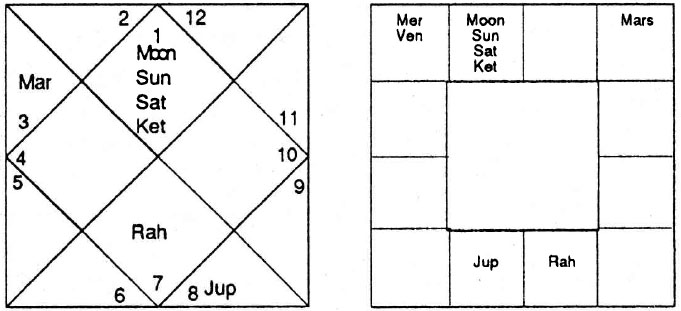
Ketu. The Moon is the strongest amongst them (other than the Sun who is the Dasa lord). Therefore, the Moon will be the lord of ½ part. There is no planet in the Trines from the Sun. (5th and 9th houses). Jupiter is in the 8th house from the Sun, hence will have 14th part in his Antardasa. Therefore, in the Sun Dasa; the Sun 1/1, the Moon 12th and Jupiter 14th parts as the period of their respective Antardasas. Now the process of equalising of the denominator will follow :
| Sun | Moon | Jupiter | Sun | Moon | Jupiter | ||||||
| 1 | , | 1 | , | 1 | = | 4 | , | 2 | , | 1 | |
| 1 | 2 | 4 | 4 | 4 | 4 |
By discarding the denominators, we get 4, 2, 1 respectively for the Sun, the Moon and Jupiter, totalling as 7. Suppose the longevity years (आयुर्दाय) of the Sun is 6 years 1 month and 22 days = 2212 days.
| Antardasa of the Sun | = | 2212 × 4 | = 1264 days |
| 7 | |||
| = | 3 years 6 months 4 days. | ||
| Antardasa of the Moon | = | 2212 × 2 | = 632 days |
| 7 | |||
| = | 1 year 9 months 2 days. | ||
| Antardasa of the Jupiter | = | 2212 × 1 | |
| 7 | |||
| = | 0 year 10 months 16 days |
| Year | Months | Days | |
| Antardasa of the Sun | 3 | 06 | 04 |
| Antardasa of the Moon | 1 | 09 | 02 |
| Antardasa of Jupiter | 0 | 10 | 16 |
| Dasa of the Sun | 6 | 01 | 22 |
These calculations are based on the following formula :
| Total Dasa year of the planet | × | Part of the individual planet |
| Sum Total of all parts |
Practice
State the Antardaśā calculation from verse 1.
Write your answer down before opening the explanation.
Show the answer and why
Answer: Multiply the Mahādaśā lord's years by the Antardaśā lord's years and divide by 120 — the total of all the periods.
A proportion, and nothing else. Each planet gets the same share of any Mahādaśā that it holds of the whole cycle. Venus, with 20 of 120 years, takes one sixth of every Mahādaśā. The Sun, with 6, takes one twentieth. Verse 1 adds that the same method continues downward: the Pratyantardaśā is computed from the Antardaśā the same way.
Source: BPHS 53.1
Compute the length of the Jupiter Antardaśā within a Saturn Mahādaśā.
Write your answer down before opening the explanation.
Show the answer and why
Answer: About two years and six months.
Saturn is 19 years; Jupiter is 16. So 19 × 16 ÷ 120 = 2.533 years, which is 2 years and about 6.4 months. Worth being able to do roughly in your head — a Jupiter Antardaśā is always about one seventh and a half of its Mahādaśā, since 16/120 is close to 1/7.5. Rough arithmetic like that is how you notice a printed table that has gone wrong.
What determines the order of the Antardaśās?
Write your answer down before opening the explanation.
Show the answer and why
Answer: The Mahādaśā lord's own Antardaśā comes first, and the rest follow in the standard cycle order from there.
So a Rahu Mahādaśā opens with Rahu/Rahu, then Rahu/Jupiter, Rahu/Saturn, Rahu/Mercury, Rahu/Ketu, Rahu/Venus, Rahu/Sun, Rahu/Moon, Rahu/Mars. The cycle order never changes; only the entry point does. Verse 2 states this and adds that Pratyantardaśās follow the same rule one level down.
Source: BPHS 53.2
What is self-similar about the subdivision structure?
Write your answer down before opening the explanation.
Show the answer and why
Answer: Every level uses the same nine lords in the same cyclic order, with the same proportional shares — only the total span changes.
A Mahādaśā is 1/120 of the cycle times the lord's years. An Antardaśā is the same fraction of the Mahādaśā. A Pratyantardaśā is the same fraction of the Antardaśā. The structure repeats identically at every scale, which is elegant and is also the source of the problem you meet in Week 10: because the structure repeats indefinitely, nothing in the arithmetic tells you where to stop. That limit has to come from outside the mathematics.
A chart's opening Mahādaśā is partial — say, four years of a twenty-year Venus period remaining. What happened to the earlier Antardaśās?
Write your answer down before opening the explanation.
Show the answer and why
Answer: They elapsed before birth. The sequence is joined part-way through, so the Antardaśās that would have run in the first sixteen years of that Venus period simply did not occur in this life.
This follows from the Week 8 point that the cycle was already running. With four years of Venus left, the person is in whichever Antardaśā that residue falls in — probably Venus/Mars or Venus/Rahu — and the earlier sub-periods are not part of their life at all. Software handles this correctly and it is worth understanding, because it explains why a chart's first listed Antardaśā is often not Venus/Venus.
Apply it to a chart
Chart C — Leonardo DiCaprio, the timing chart — Birth-certificate data and a well-dated public record — which is what makes timing work possible at all. · about 22 min
| Graha | Sign | House | Degree | Nakshatra | Condition |
|---|---|---|---|---|---|
| Sun | Libra | 2 | 25°09'44" | Vishakha 2 | debilitated |
| Moon | Virgo | 1 | 23°10'19" | Hasta 4 | neutral |
| Mars | Libra | 2 | 16°05'31" | Swati 3 | neutral |
| Mercury | Libra | 2 | 6°15'25" | Chitra 4 | neutral |
| Jupiter | Aquarius | 6 | 14°35'29" | Shatabhisha 3 | neutral |
| Venus | Libra | 2 | 26°23'27" | Vishakha 2 | own sign |
| Saturn | Gemini | 10 | 25°17'48" | Punarvasu 2 | neutral |
| Rahu | Scorpio | 3 | 17°46'00" | Jyeshtha 1 | not assigned in BPHS |
| Ketu | Taurus | 9 | 17°46'00" | Rohini 3 | not assigned in BPHS |
| Lagna | Virgo | 1 | 9°37'18" | Uttara Phalguni | lord Mercury |
Chart C's Rahu Mahādaśā ran from late 1981 to late 1999 — eighteen years covering the whole of the early career and the breakthrough. Dividing it is the point at which timing starts being able to answer a real question.
- Compute the Antardaśās of Chart C's Rahu Mahādaśā by hand. Rahu is 18 years; for each Antardaśā lord, the span is 18 × (that lord's years) ÷ 120.
- Check your figures: they should total 18 years, and the sequence should begin with Rahu itself and then run Jupiter, Saturn, Mercury, Ketu, Venus, Sun, Moon, Mars.
- Convert to dates from a Mahādaśā start of 25 December 1981. Then check against the Antardaśā table in the chart library.
- Now find which Antardaśā was running in December 1997. Write it down before looking at the timeline.
- Only then look at what is recorded for that date. Do not adjust anything. Note whether your Mahādaśā/Antardaśā pair looks like a plausible activator of what happened — and note what you would need to establish first, from the natal chart, before you could say so.
- Repeat for Chart B: divide the Sun Mahādaśā of 1916–1922 and find the Antardaśā running in November 1919.
Check your understanding
Answer from memory first. Looking back at the reading before you try turns a memory test into a copying exercise.
How long is a Venus Antardaśā within a Venus Mahādaśā?
Write your answer down before opening the explanation.
Show the answer and why
Answer: Three years and four months.
20 × 20 ÷ 120 = 3.333 years. The longest single Antardaśā in the whole system, and worth knowing as a landmark — nothing in Viṁśottarī at the Antardaśā level is longer than that.
And the shortest?
Write your answer down before opening the explanation.
Show the answer and why
Answer: The Sun's Antardaśā in a Sun Mahādaśā — about three and a half months.
6 × 6 ÷ 120 = 0.3 years, roughly 110 days. Having the extremes gives you a sense of scale: Antardaśās run from about three months to about forty months, which is why they are the level at which timing starts being able to answer real questions.
Why compute this by hand at all, when software does it instantly?
Write your answer down before opening the explanation.
Show the answer and why
Answer: To be able to sanity-check a table, and because the arithmetic makes the nested structure concrete.
A quick mental estimate catches errors: if a printed Jupiter Antardaśā in a Saturn Mahādaśā shows as four years, something is wrong, because 16/120 of 19 is about two and a half. That kind of check costs seconds and catches software configured with a different year length or a different system.
Where in BPHS is Antardaśā computation, and how much of the chapter is Viṁśottarī?
Write your answer down before opening the explanation.
Show the answer and why
Answer: Chapter 53. Verses 1 and 2; the rest applies the same logic to Chara and sign-based daśās.
Two verses out of sixteen, and they carry the whole method. This is now a familiar pattern — the Core content of a chapter is often a small fraction of its length, and knowing which fraction is most of what efficient reading of BPHS consists of.
Source: BPHS 53.1–2
What you carry forward
Two things grow across the whole course. This unit adds to both.
To your chart-analysis process
- **Step 12 (continued) — apply Viṁśottarī timing.** Narrow from Mahādaśā to Antardaśā. Both the Mahādaśā lord and the Antardaśā lord contribute, and both must be read through what they rule.
To your field manual
- Antardaśā length (53.1) = Mahādaśā years × Antardaśā lord's years ÷ 120.
- Sequence (53.2): the Mahādaśā lord's own Antardaśā comes first; the rest follow in standard cycle order.
- Longest Antardaśā: Venus in Venus, 3 years 4 months. Shortest: Sun in Sun, about 3½ months.
- The structure is self-similar — the same nine lords, same order, same proportions, at every level. Nothing in the arithmetic says where to stop; that limit comes from outside.
- An opening partial Mahādaśā has lost its earlier Antardaśās to the period before birth. The first listed sub-period is usually not the Mahādaśā lord's own.
- Sanity-check printed tables with rough mental arithmetic. Jupiter takes about 1/7.5 of any Mahādaśā; Venus about 1/6; the Sun about 1/20.
By now you should be able to
- Compute any Antardaśā by hand
- State the sequence rule and explain why the Mahādaśā lord comes first
- Explain the self-similar structure of the subdivision
- Say why the first Antardaśās of a partial opening Mahādaśā are absent