Brihat Parashara Hora Shastra · Volume 2
48. DASA SYSTEMS
सर्वज्ञोऽसि मर्हर्षे ! त्वं कृपया दीनवत्सल !।
दशाः कतिविधाः सन्ति ! तन्मे कथय तत्त्वतः ॥ १ ॥
1: Maitreya said, O Supreme Sage! You are ominiscient and have infinite knowledge. Kindly be merciful and enlighten me, in detail, about the prevalent “Planetary Dasas”(Periods).
साधु पृष्टं स्वया विप्र ! लोकानुग्रहकारिणा ।
कथयामि तवाग्रेऽहं दशाभेदाननेकशः ॥ २ ॥
दशाबहुविधास्तासु मुख्या विंशोत्तरी मता ।
कैश्चिदष्टोत्तरी कैश्चित् कथिता षोडशोत्तरी ॥ ३ ॥
द्वादशाब्दोत्तरी विप्र ! दशा पञ्चोत्तरी तथा ।
दशा शतसमा तद्वत् चतुराशीतिवत्सरा ॥ ४ ॥
द्विसप्ततिसमा षष्टि-समा षट् त्रिंशवत्सरा ।
नक्षत्राधारिकाश्चेताः कथिताः पूर्वसूरिभिः ॥ ५ ॥
2-5: Maharishi Parasara said, O Brahmin! You have asked a most appropriate question which will benefit one and all. I now unfold the secret of the prevailing Dasa systems.
There are various types of Dasas in vogue but for a common man, Vimshottari (विंशोत्तरी) Dasa is the predominant one. Some have mentioned particularly Astottari (अष्ठोत्तरी) and Shodsottari (षोडशोत्तरी) Dasas. O Brahmin! Ancients have also referred to Dwadasottari (द्वादशोत्तरी), Panchottari (पंचोत्तरी), Shatabdika (शताब्दिका) Dasas and in the same category there are also Chaturashiti-Sama (चितुरशीति समा), Dwisaptati-Sama (द्विसप्तत्ति समा), Shashtihayani (षष्टिहायनी), Shattrishanta-Sama (षिटत्रिंगतप्तमा) Dasas. All these Dasas are based on Nakshatras.
अथा कालदशा चक्रदशा प्रोक्ता मुनीश्वरैः ।
कालचक्रदशा चाऽन्या मान्या सर्वदशासु या ॥ ६ ॥
दशाऽथ चरपर्याया स्थिराख्या च दशा द्विज ! ।
केन्द्राद्या च दशा ज्ञेया कारकादिग्रहोद्भवा ॥ ७ ॥
ब्रह्मग्रहाश्रितर्क्षाया दशा प्रोक्ता तु केनचित् ।
माण्डूकी च दशा नाम तथा शूलदशा स्मृता ॥ ८ ॥
योगार्धजदशा विप्र ! दृग्दशा च ततः परम् ।
त्रिकोणाख्या दशा नाम तथा राशिदशा स्मृता ॥ ९ ॥
पल्चस्वरदशा विप्र ! विज्ञेया योगिनीदशा ।
दशा पैण्डी तथांशी च नैसर्गिकदशा तथा ॥ १० ॥
अष्टवर्गदशा सन्ध्या-दशा पाचकसंज्ञिका ।
अन्यास्तारादशाद्याश्च न सर्वाः सर्वसम्मताः ॥ ११ ॥
6-11: The Rishis have also made mention of Kala (काल) arid Chakara (चक्र)Dasas. But amongst the remaining Dasas, Kala Dasa has the greatest recognition. O Brahmin! Besides these Dasas, some have said about Chara, Sthir, Kendra, Karaka and Brahmagraha (ब्रह्मग्रह) Dasas. O Vipra! apart from these, Mandooki (माण्डूकी), Shoola (भूल), Yogardha (योगार्ध), Driga (दृग) followed by Trikona (त्रिकोण) and Rashi (राशी) Dasas are also there.
O Brahmin! Panchswara Dasa, Yogini Dasa, Pinda Dasa, Amsa Dasa, Naisargie Dasa, Ashtavarga Dasa, Sandhya Dasa, Pachaka Dasa and other Tara Dasa and the like are the different form of Dasas. However, out of these various Dasa forms, all are not acceptable by common consensus.
In some editions, Anshaja Dasa has not been mentioned but the word (तथांशी) figured in the 10th Shicka, gives aclear indication of this Dasa. As such Anshaja Dasa also needs to be considered.
In the foregoing stanzas, Maharishi Parasara has described about 32 types of Dasas. For the convenience and quick recapitulation of the esteemed readers, these Dasas are tabulated as per Table-1.
कृत्तिकातः समारभ्य त्रिरावृत्य दशाधिपाः ।
आ-चं-कु-रा-गु-श-बु.के-शुपूर्वा विहगाः क्रमात् ॥ १२ ॥
वहिभाज्जन्मभं यावद् या संख्या नवततष्टिता ।
शेषाद्दशाधिपो ज्ञेयस्तमारभ्य दशां नयेत् ॥ १३ ॥
विंशोत्तरशतं पूर्णमायु: पूर्वमुदाहृतम् ।
कलौ विंशोत्तरी तस्माद् दशा मुख्या द्विजोत्तम ! ॥ १४ ॥
12-14: Commencing from Kritika, the Dasa lords in succession would be Sun, Moon, Mars, Rahu, Jupiter, Saturn, Mercury, Ketu, Venus; in the three cycles of Nakshatras. The number of Nakshatras between Kritika and the birth Nakshatra be divided
| No. | Dasas | दशा | NO. | Dasas | दशा |
| 1 | Vimshottari | विमशोत्तरी | 17 | Yogardha | योगार्ध |
| 2 | Astottari | अष्टोत्तत्री | 18 | Kendradi | केन्द्र |
| 3 | Shadsottari | षाठशेत्तरी | 19 | Karaka | कारक |
| 4 | Dwadashoitari | द्वादशोत्तरी | 20 | Mandooka | माण्डूका |
| 5 | Panchsottari | पंचसोत्तरी | 21 | Shoola | शूल |
| 6 | Shatabdika | शताव्दिका | 22 | Trikona | त्रिकोण |
| 7 | Chalurashitisama | चालूरक्षितिसमा | 23 | Driga | दृग |
| 8 | Dwisapatatisama | द्विसपटातीसमा | 24 | Rashi | राशि |
| 9 | Shashtihayani | षष्टीहायानी | 25 | Panchswara | पंचसवार |
| 10 | Shatrimshat sama | षठत्रिम्हात समा | 26 | Yogini | योगिनी |
| 11 | Kala | काल | 27 | Pinda Amsa | पिंडा आशं |
| 12 | Chakra | चक्र | 28 | Naisargika | नैसर्गिक |
| 13 | Kalachakra | कालचक्र | 29 | Ashtakavarga | अष्टवर्ग |
| 14 | Chara | चर | 30 | Sandhya | सन्ध्या |
| 15 | Sthira | स्थिर | 31 | Pachaka | पाचक |
| 16 | Brahma-Graha | ब्रम्हा ग्रह | 32 | Tara | तारा |
by 9. The remainder will indicate the Dasa lord if counted from the Sun. (Let us suppose the remainder being 5, then the Dasa lord will be Jupiter at the time of birth. The subsequent Dasas will be in the same order i.e. after Jupiter comes the Dasa of Saturn, Mercury, Ketu and so on)
O Brahmin! The full span of life of man in ‘Kalayuga’ is said to be 120 years (Purna Ayu). Therefore, amongst the various Dasas, Vimshottari Dasa is the prime Dasa system.
दशासमाः क्रमादेषां षड् दशाऽश्वा गजेन्दवः ।
नृपाला नवचन्द्राश्च नगचन्द्रा नंगा नखाः ॥ १५ ॥
15: The number of years assigned to each planet (lord of the Dasa) the Sun, the Moon, Mars, Rahu, Jupiter, Saturn, Mercury, Ketu and Venus are 6, 10, 7, 18, 16, 19, 17, 7, 20 respectively. The Dasa at the time is determined from the Nakshatra in which Moon is in transit at the time of birth which is called birth (Janma) Nakshatra.
दशामानं भयातघ्नं भभोगेन हृतं फलम् ।
दशाया भुक्तवर्षाद्य भोग्यं मानाद् विशोधितम् ॥ १६ ॥
16 : Multiply the Dasa years of the planet, in whose Dasa the birth takes place by Bhayaata [The expired (elapsed) period ot the Nakshatra] and divide it by Bhabhoga [The full period to be traversed by the Nakshatra]. The resultant value will represent the period consumed in the Dasa of the planet till the time of birth. By deducting this figure from the full duration of the Dasa of the planet, the balance Dasa of the said planet is arrived at. (For terms Bhagyaata and Bhabhoga please refer to page 65 of volume 1).
लग्नेशात् केन्द्रकोणस्थे राहौ लग्नं विना स्थिते ।
अष्टोत्तरी दशा विप्र ! विज्ञेया रौद्रभादितः ॥ १७ ॥
चतुष्कं त्रितयं तस्मात् चतुष्कं त्रितयं पुनः ।
एवं स्वजन्मभं यावद् विगणय्य यथाक्रमम् ॥ १८ ॥
सूर्यश्चन्द्रः कुजः सौम्यः शनिर्जीवस्तमो भृगुः ।
एते दशाधिपा विप्र ! ज्ञेयाः केतुं विना ग्रहाः ॥ १९ ॥
रसा: पञ्चेन्दवो नागाः सप्तचन्द्राश्च खेंन्दवः ।
गोऽब्जाः सूर्याः कुनेत्राश्च रव्यादीनां दशासमाः ॥ २० ॥
17-20: Maharishi Parasara said, O Brahmin! If Rahu excepting in the Ascendant (Lagna) is posited in an Angle (Kendra) or a Trine (Trikona) from the lord of Ascendant (Lagna lord), some learneds adopt Astottari Dasa system.
The Astottari Dasa commences with the Sun Dasa covering four Nakshatras with Aridra being the first one. Three Nakshatras thereafter are assigned to the Moon. Next four go to Mars followed by three Nakshatras for Mercury Dasa. Again, next four Nakshatras are entrusted to Saturn Dasa which is succeeded by Jupiter Dasa with subsequent three Nakshatras. Rahu Dasa comes next with four and last is the Dasa of Venus with three left over Nakshatras. (These planets are the lord of the Nakshatras which are under their fold). The ruling Dasa lord is determined through counting in the above order upto the birth Nakshatra.
O Brahmin! Sun, Moon, Mars, Mercury, Saturn, Jupiter, Rahu and Venus are the Dasa lords. Excepting Ketu, all the other planets are covered in this system. The Dasa period starting from the Sun is 6, 15, 8, 17, 10, 19, 12 and 21 years respectively.
दशाब्दांघ्रिश्च पापानां शुभानां त्रयंश एव हि ।
एकैकभे दशामानं विज्ञेयं द्विजसत्तम ॥ २१ ॥
ततस्तद्यातभोगाभ्यां भुक्तं भोग्यं च साधयेत् ।
विंशोत्तरीवदेवात्र ततस्तत्फलमादिशेत् ॥ २२ ॥
21-22 : O Brahmin! "In the event of maletic planets, the span (period) of each Nakshatra is 1/4th of the prescribed period of the planet while in the case of benefic planets, each Nakshatra's spanis to the extent of 1/3rd period of the planet. The expired period of the birth Nakshatra is ascertained in the same manner as in Vimsottari Dasa system, that is the period traversed by the birth Nakshatra in Astottari Dasa be multiplied by Bhayaata and divided by Bhabhoga of the Nakshatra. The Dasa balance is also arrived at in the same fashion”.
कृष्णपक्षे दिवा जन्म शुक्लपक्षे तथा निशि ।
तदा ह्यष्टोत्तरी चिन्त्या फलार्थल्च विशेषतः ॥ २३ ॥
23 : O Brahamin! “If the birth is in the day time during Krishna Paksha or in the night in Shukla Paksha and in order to ascertain specific results, Astottari Dasa be adopted”.
चन्द्रहोरागते कृष्णे सूर्यहोरागते सिते ।
लग्ने नृणां फलज्ञप्त्यै विचिन्त्या षोडशोत्तरी ॥ २४ ॥
पुष्यभाज्जन्मभं यावद् या संख्या गजतष्टिता ।
रविर्भौमो गुरुर्मन्दः केतुश्चन्द्रो बुधो भृगुः ॥ २५ ॥
इति क्रमाद् दशाधीशाः ज्ञेया राहुं विना ग्रहाः ।
रुद्राद्ये कोत्तरा: संख्या धृत्यन्तं वत्सराः क्रमात् ॥ २६ ॥
24-26 : If Ascendant (Lagna) is in the Hora of the Moon in Krishna Paksha (waning Moon) or in the Sun’s Hora during Shukla Paksha (waxing Moon), Shodsottari Dasa be adopted for Prognoslication. Count the number of Nakshatras from Pushyami tothe birth Nakshatra and divide it by 8. The remainder will point out the Dasa of the planet barring Rahu, if counted in the order of the Sun, Mars, Jupiter, Saturn, Ketu, Moon, Mercury and Venus. The Dasa years are from 11 to 18 years with an accretion by one year for each planet in seriatim (i.e., Sun 11, Mars 12, Jupiter 13, Saturn 14, Ketu 15, Moon 16, Mercury 17 and Venus 18 Years).
शुक्रांशके प्रजातस्य विचिन्त्या द्वादशोत्तरी ।
जन्मभात् पौष्णभं यावत् संख्या हि वसुतष्टिता ॥ २७ ॥
सूर्यो गुरुः शिखी ज्ञोऽगुः कुजो मन्दो निशाकरः ।
विना शुक्रं दशाधीशा द्विचयात् सप्ततः समाः ॥ २८ ॥
27-28 : Dwadashottari Dasa be pursued for those natives whose Ascendant falls in the Navamsa of Venus. Number of the Nakshatras from the birth Nakshatra to Revati Nakashatra be reckoned and divided by eight. The remainder will indicate the planet as the lord of Dasa by serially counting from the Sun, Jupiter, Ketu, Mercury, Rahu, Mars, Saturn and the Moon having period 6, 7,9, 11, 13, 15, 17, 19 and 21 years respectively (An addition of 2 years in the successive Dasas). The Dasa of Venus is not in this scheme.
निजार्काशगते कर्कलग्ने पञ्चोत्तरी मता ।
मित्रर्क्षाज्जन्मभं यावत् संख्या सप्तविभाजिता ॥ २९ ॥
एकादिशेषे विज्ञेयाः क्रमात्सप्तदशाधिपाः ।
रविर्ज्ञोऽर्कसुतो भौमः शुक्रश्चन्द्रो वृहस्पतिः ॥ ३० ॥
एकोत्तराच्च विज्ञेया द्वादशाद्याः क्रमात्समाः ।
धृत्यन्ताः सप्तखेटानां राहु-केतू विना द्विज ! ॥ ३१ ॥
29-31 : When a native is born in the Cancer Ascendant (Lagna) and also having Cancer Dwadashamsa (1/12th Division), Panchattori Dasa be adopted. Divide the number of Nakshatras arrived at by counting from Anuradha to the birth Nakshatra by 7 digit and the remainder will indicate the planet of the ruling Dasa in the order of Sun, Mercury, Saturn, Mars, Venus, Moon and Jupiter having Dasa (years) of 12, 13, 14, 15, 16, 17 and 18 years respectively. O Brahmin! In this Dasa system there are seven planets, leaving aside Rahu and Ketu.
वर्गोत्तमगते लग्ने दशा चिन्त्या शताब्दिका ।
पौष्णभाज्जन्मपर्यन्तं गणयेत् सप्तभिर्भजेत् ॥ ३२ ॥
शेषांके रवितो ज्ञेया दशा शतसमाहुया ।
रविश्चन्द्रो भृगुर्ज्ञश्च जीवो भौमः शनिस्तथा ॥ ३३ ॥
क्रमादेते दशाधीशा बाणा बाणा दिशो दश ।
नखा नखाः खरामाश्च समाज्ञेया द्विजोत्तम ! ॥
३४ ॥
32-34 : in the event of Ascendent (Lagna) being Vargottama (वर्गोत्तम) i.e. having the some Ascendent in Navamsa (1/9th Division), the Shatabdika Dasa system will be suitable for prognostication. Count the number of Nakshatras from Revati to the birth Nakshatra and divide it by 7. The remainder will indicate the Dasa lord in the order of the Sun Moon, Venus Mercury, Jupiter, Mars, Saturn. The period of these Dasa lords are 5, 5, 10, 10, 20, 20 and 30 years respectively.
कर्मेशे कर्मगे ज्ञेया चतुराशीतिका दशा ।
पवनाज्जन्मभं यावद् या संख्या सप्तभाजिता ॥ ३५ ॥
शेषे रवीन्दु-भौम-ज्ञा गुरु-शुक्र-शनैश्चराः ।
दशाधीशाः क्रमादेषां ज्ञेया द्वादशवत्सराः ॥ ३६ ॥
35-36 : At the time of birth, if the 10th house is occupied by the 10th lord, Chaturashiti-Sama Dasa system will be useful. Number from Svati to the birth Nakshatra be counted and the figure is divided by 7. The remainder will indicate the Dasa order reckoned from the Sun, Moon, Mars, Mercury, Jupiter, Venus and Saturn in that order. Each planet has an identical Dasa of 12 years.
मूलाज्जन्मर्क्षपर्यन्तं गणयेदष्टभिर्भजेत् ।
शेषाद्दशाधिपा ज्ञेया अष्टी रव्यादयः क्रमात् ॥ ३७ ॥
नव वर्षाणि सर्वेषां विकेतूनां नभःसदाम् ।
लग्नेशे सप्तमे यस्य लग्ने वा सप्तमाधिपे ॥ ३८ ॥
चिन्तनीया दशा तस्य द्विसप्ततिसमाह्यया ।
विंशोत्तरीवदत्राऽपि भुक्तं भोग्यं च साधयेत् ॥ ३९ ॥
37-39 : In Dwisaptati-Sama Dasa system, counting is done from the Moola to the birth Nakshatra. The figure is divided by 8 and the remainder points out the planet-Dasa lord in that order starting from the Sun, the Moon, Mars, Mercury, Jupiter, Venus, Saturn and Rahu (Ketu is ignored). All the eight Dasas are of 9 years duration. Bhayaata and Bhaboga are considered in the same manner as in the Vimsottari Dasa system. This Dasa be gainfully applied in those cases where either the 7th lordis in the Ascendant or the Ascendant is posited in the 7th house.
यदार्को लागनराशिस्थश्चिन्तया षष्टिसमा तदा ।
दास्रात् त्रयं चतुष्कं च त्रयं चेति पुनः पुनः ॥ ४० ॥
गुर्वर्कभूसुतानां च दशा दश दशाब्दकाः ।
ततः शशिज्ञशुक्रार्कपुत्रागूनां रसाब्दकाः ॥ ४१ ॥
40-41: If the sun is located in the Ascendant Shasti Hayani Dasa will be most suitable for such natives. Commencing from Aswini Nakshatra, a cluster of 3 and 4 Nakshatras, taken alternatively would represent the Dasa lord in the order of Jupiter, the Sun, Mars, the Moon, Mercury, Venus, Saturn and Rahu. First three Dasas of the planets would each be of 10 years duration and the last five Dasas would have 6 years each.
श्रवणाज्जन्मभं यावत् संख्या वसुविभाजिता ।
शेषे चन्द्र-रवीज्यार-बुधा-किं-भृगु-राहवः ॥ ४२ ॥
क्रमाद्दशाधिपास्तेषामेकाद्ये कोत्तराः समा ।
लग्ने दिनेऽर्कहोरायां चन्द्रहोरागते निशि ॥ ४३ ॥
42-43: In the event of the birth being in the day time and also the Ascendant being in the Sun's Hora or in the night birth and Ascendant happened to be in the Hora of the Moon, Shat-Trimsha Sama Dasa be adopted. Count the number of Nakshatras from Shravana the birth Nakshatra and have it divided by digit 8. The remainder number would indicate the Dasa lord in seriatim Commencing from the Moon, the Sun, Jupiter, Mars, Mercury, Saturn, Venus and Rahu. The period of the Dasa would be in the natural order i.e. 1, 2, 3, 4, 5, 6, 7 and 8 years respectively.
सूर्यस्याऽर्धास्तयः पूर्वं परस्तादूदयादपि ।
पञ्च पञ्च घटी सन्ध्या दशनाडी प्रकीर्तिता ॥ ४४ ॥
सन्ध्याद्वयञ्च विंशत्या नाडिकाभिः प्रकीर्तितम् ।
दिनस्य विंशातिर्घट्यः पूर्णसंज्ञा उदाहृताः ॥ ४५ ॥
निशाया मुग्धसंज्ञाश्च घटिका विंशतिश्च या: ।
सूर्योदये च या सन्ध्या खण्डाख्या दशनाडिका ॥ ४६ ॥
अस्तकाले च या सन्ध्या सुधाख्या दशनाडिका ।
पूर्णमुग्धघटीमाने द्विगुणे तिथिभिर्भजेत् ॥ ४७ ॥
तथा खण्डसुधा-घदयो चतुर्घ्ने तिथिभिर्भजेत् ।
लब्धं वर्षादिकं मानं सूर्यादीनां खचारिणाम् ॥ ४८ ॥
एकादि-संख्यया निघ्नं दशामानं पृथक् क्रमात् ।
राहुकेतुयुतानां च नवानां कालसंज्ञकम् ॥ ४९ ॥
44-49 : The periods of 5 Ghatis (2 hrs.) astride the setting of the semi-disc of the sun and like wise, 5 Ghatis (2 hrs.) proceding and 5 Ghatis (2 hrs.) succeeding the Sun risei.e. aspanof 10 Ghatis (4 hrs.) each is termed as the twilight period (Sandhya) of evening and morning respectively. As such both these Sandhyas are constituted of 20 Ghatis (8 hrs.) the 20 Ghatis period (4 hrs.) of the day (i.e. the gap between morning and evening Sandhyas) is called POORNA (पूर्णा) and similarly, 20 Ghatis (8 hrs.) of the night is named as MUGDHA (मुग्धा). 10 Ghatis Sandhya of the sunrise and 10 Ghatis Sandhya of the sun set are called KHANDA (खण्ड) and SUDHA (सुधा) respectively.
lf the birth occurs in Poorna or Mugdha, multiply the period (Ghatis) consumed at birth in the said portion by 2 and divide it by 15. The product be expressed in years, months etc. and reckoned as a constant factor. Multiply this factor by 1 to 9 in natural order, the Kala Dasa of the corresponding planet starting from Sun to Rahu, again in normal planelary order is achieved. In case the birth is in the span of Khanda or Sudha, the expired period upto the birth be multiplied by 4 and then divided by 15. This product also be used as aconstant factor in calculating the Kala Dasa of the planets in the same manner.
(i)**Khanda (खण्डा) :** Day and night consist of 60 Ghatis (24 hrs). The period of 10 Ghatis i.e. 5 Ghatis (2 hrs.) prior and 5 Ghatis (2 hrs.) later to the Sun rise is called morning twilight (Sandhya). The Sandhya of the morning is called Khanda.
(ii)**Sudha (सुधा) :** In the identical fashion 10 Ghatis of the evening i.e. 5 Ghatis (2 hrs.) astride sun set time constitute the evening twilight (Sandhya).
(iii)**Poorna (पूर्णा) :**The period of 20 Ghatis (8 hrs.) between both the Sandhyas i.e. Khanda 10 Sudha is known by the name Poorna.
(iv)**Mugdha (मुग्धा) :** Similarly, the 20 Ghatis (8 hrs.) portion from Sudha to Khanda is termed as Mugdha.
The readers must have noticed from the text that the only intricacy in calculating the Kala Dasa is to first identify the segment (amongst the four above segments) in which the birth has taken place and then to figure out as to how much time has elapsed from the beginning of the said segment and the birth time.
The rest of the calculations and pin-pointing the ruling Dasa at the time of the birth is a simple affair. However, the principles set out for this purpose are reiterated as under :-
(i)It a native is born in the period between Poorna or Mugdha, it is first of all necessary to know as to how much time has been passed (in terms of Ghatis or hrs./minutes) in Poorna or Mugdha upto the birth. The said time be multipied by 2 and then divided by 15, The resultant value shall be multiplied by the numbers assigned to the planet (Sun-1; Moon-2; Mars-3; Mercury-4; Jupiter-5, Venus-6; Saturn-7; Rahu-8 and Ketu-9) to arrive at the Dasa of the respective planet.
(ii)The procedure for calculating Dasas of the planet if the birth is in the duration of Knanda or Sudha, except the elapsed period upto birth is multiplied by 4 instead of 2 and then divided by 15, rest ofthe steps remain unchanged.
(iii)It may also be understood that if the birthis on Sunday, the first Dasa will that be of the Sun and if Monday, the Dasa cycle will start from the Moon and so on. Since Dasa of Rahu and Ketu are also in the scheme, their Dasas will figure at 8th and 9th portion,
Example - 6:
Suppose the birth is at 2 Gh. 25 Pal. after the sunrise on Monday. Since it s less then 5 Gh., the birth is reckoned in ‘Khanda’(Sandhya). In order to find out the time elapsed from the commencement of Khanda, 5 Gh. (period prior to the sunrise) be added which comes to 7 Gh., 25 Pal.- period and since has been passed in Kanda segment.
Calculations :
7 Gh. - 25 Pal = 7.416 Gh. × 4 = 29.66 [25 +100/66]
29.66 + 15 = 1.977 = 1 yr. + 0.977
0.977 × 12 = 11.724 = 11 months + 0.724
0.724 × 30 = 21.72 = 22 days (Day)
= 1 yr, 11 months, 22 days call it factor "A" =
= Sun Dasa = A × 1 = 1 yr. months 22 days
= Moon Dasa = A × 2 = 3 yrs. 11 months 14 days
= Mars Dasa = A × 3 = 5 yrs. 11 months 6 days
Likewise, the Dasas of the other planets could be worked out. Since the birth being on Monday, the first Dasa would be of the Moon.
The method of calculating Kala Dasa enunciated in the similar books published by M/s. Khemchand Shrikrishan Das Publications (Bombay) and Thakur Prashad & Sons Booksellers (Varanasi) is at variance. According to them, if the native is born in Poorna segment, the elapsed period in Poorna [time from sunrise to birth-5 Gh.] shall be multiplied by 6 instead of 2. Similar treatment de given in the event of the birth being in part of Mugdha. Similarly, for Khanda and Sudha segments the elapsed period in their respective portions is to be multiplied by 12 rather by 4.
Further, the product in respect of all the above cases need to be divided by 45 (against 15). The resulting figure should be taken as a constant factor (Dhruanka). The procedure for calculating individual planetary Dasa remained the same i.e. the factor is to be multiplied by the serial number 1,2,3........... 8, 9 to ascertain the Dasas order of Sun, Moon, Mars, Rahu, Ketu respectively as illustrated in example-6.
Here the common feature is that the multiplieres are three times in both the cases and so is the division. Since multiplier and divisor are enhanced by the same denomination, the net result will remain the same. However, the reason for such divergent opinions could not possibly by figured out through any classical works known to this humble author.
रात्रौ लग्नाश्रिताद्राशेर्दिने लग्नेश्वराश्रितात् ।
सन्ध्यायां वित्तभावस्थान्नेया चक्रदशा बुधैः ॥ ५० ॥
दशा वर्षाणि राशीनामेकैकस्य दशामितिः ।
क्रमाच्चक्रस्थितानाञ्च विज्ञातव्या द्विजोत्तम ॥ ५१ ॥
50-51 : In the event of birth taking place in the night, the Dasa will originate from the sign of the Ascendant (Lagna Rasi). If the birth happened to be in the day, the Dasa will start from the sign which tenants the lord of the Ascendant (Lagna Lord). When the birth occurs in the period of twilight (Sandhya), the sign of the second house will initiate the Dasa. Each Dasa of the sign is of 10 years duration. Since the pattern of these Dasas is compatible with the twelve zodiacal signs, it is appropriately called as Chakra Dasa system.
अथाऽहं शङकरं नत्वा कालचक्रदशां ब्रुवे ।
पार्वत्यै कथिता पूर्वं सादरं या पिनाकिना ॥ ५२ ॥
तस्याः सारं सुमृदधृत्य तवाग्रे द्विजनन्दन ! ।
शुभाऽशुभं मनुष्याणां यथा जानन्ति पण्डिताः ॥ ५३ ॥
52-53: Maharishi Parasara asserted - O Vipra! Prostrating before Lord Shiva, I now perorate Kalachakra Dasa, as it was narrated to Goddess Parvati by Lord Shiva in the ancient time, for the savants to enable them to give righteous interpretations to the populace.
द्वादशारं लिखेच्चक्रं तिर्यगूर्ध्वसमानकम् ।
गृहा द्वादश जायन्ते सव्येऽसव्ये द्विधा द्विज! ॥ ५४ ॥
द्वितीयादिषु कोष्ठेषु राशीन् मेषादिकान् लिखेत् ।
एवं द्वादशराश्याख्यं कालचक्रमुदीरितम् ॥ ५५ ॥
54-55: Outline two charts of twelve compartments each by drawing vertical and horizontal lines for Savya (clockwise) and Apsavya (anti-clockwise). Affix sign Aries in the second compartment of each chart. This is called Dwadash-Rashiatmaka Kalachakra.
अश्विन्यादित्रयं सव्यमार्गे चक्रे व्ययस्थितम् ।
रोहिण्यादित्रयं चैवमपसव्ये व्यस्थितम् ॥ ५६ ॥
एवमृक्षविभागं हि कृत्वा चक्रं समुद्धरेत् ।
अश्विन्यदिति-हस्तर्क्ष-मलप्रोष्ठपदाभिधाः ॥ ५७ ॥
वहि-वाताहि-विश्वर्क्ष-रेवत्यः सव्यतारकाः ।
एतद्दशोडुपादानामश्विन्यादौ च वीक्षयेत् ॥ ५८ ॥
56-58: A group of first three Nakshatras viz., Aswini, Bharani and Kritika be placed in Savya Chakra (Chart) and the next group of these Nakshatras starting from Rohini in the Apsavya Chakra (Charts). Similarly, the next three nakshatras will go to the Savya Chakra followed by anotherthree Nakshatras in the Apsavya Chakra, and soon, With this pattern of distribution of the Nakshatras, the Savya Chakra will house 15 and the Apsavya Chakra 12 Nakshatras. The four quarters (Padas) of Aswini, Punarvasu, Hasta, Moola, Poorva Bhadra; Kritika, Ashelsha Swati, Uttara Bhadra and Revatibe identifiedin the same fashion as of 4 quarters (Padas) of Aswini Nakshatras.
Description of DEHA (Body), JEEVA (Life) etc.
देहजीवौ कथं वीक्ष्यौ नक्षत्राणां पदेषु च ।
विशदं तत्प्रकारं च मैत्रेय ! कथयाम्यहम् ॥ ५९ ॥
59: O Maitreya: now I enumerate how the quarters (Padas of the Nakshatras are made compatiable with Deha (body) and Jeeva (life).
TABLE-14A
DWADASHRASHIATMAKA KALACHAKRA
| Savya Naksh atras | Quarter | Sign | Deha | SAVYA KALACHAKRA | Jeeva | Dasa years | Amsas | ||||||||
| Sign | Lord | Sign | Lord | ||||||||||||
| yrs. | 1 | 2 | 3 | 4 | 5 | 6 | 7 | 8 | 9 | ||||||
| Aswini, Punarvasu, Hasta, Moola, P.Bhadra | 1st | Sign. yrs. | Ars. 7 | Mar | Tau. 16 | Gem. 9 | Can. 21 | Leo. 5 | Virg. 9 | Lib. 16 | Scor. 7 | Sagi. 10 | Jup | 100 | Ars. |
| 2nd | Sign. yrs. | Cap. 4 | Sat | Aqua. 4 | Pisc. 10 | Scor. 7 | Lib. 16 | Virg. 9 | Can. 21 | Leo. 5 | Gem. 9 | Mer | 85 | Tau. | |
| 3rd | Sign. yrs. | Tau. 16 | Ven | Ars. 7 | Pisc. 10 | Aqua. 4 | Cap. 4 | Sagi. 10 | Ars. 7 | Tau. 16 | Gem. 9 | Mer | 83 | Gem. | |
| 4th | Sign. yrs. | Can. 21 | Mon | Leo. 5 | Virg. 9 | Lib. 16 | Scor. 7 | Sagi. 10 | Cap. 4 | Aqua. 4 | Pisc. 10 | Jup | 86 | Can. | |
| Bharani, Pushyami, Chitra, P.Ashada, U.Bhadra | 1st | Sign. yrs. | Scor. 7 | Mar | Lib. 16 | Virg. 9 | Can. 21 | Leo. 5 | Gem. 9 | Tau. 16 | Ars. 7 | Pisc. 10 | Jup | 100 | Leo. |
| 2nd | Sign. yrs. | Aqu. 4 | Sat | Cap. 4 | Sagi. 10 | Ars. 7 | Tau. 16 | Gem. 9 | Can. 21 | Leo. 5 | Virg. 9 | Mer | 85 | Virg. | |
| 3rd | Sign. yrs. | Lib. 16 | Ven | Scro. 7 | Sagi. 10 | Cap. 4 | Aqua. 4 | Pisc. 10 | Scor. 7 | Lib. 16 | Virg. 9 | Mer | 83 | Lib. | |
| 4th | Sign. yrs. | Can. 21 | Mon | Leo. 5 | Gem. 9 | Tau. 16 | Ars. 7 | Pisc. 10 | Aqu. 4 | Cap. 4 | Sagi. 10 | Jup | 86 | Scor. | |
| kritika, Ashlesha, Swati, U.Ashada, Revati | 1st | Sign. yrs. | Ars. 7 | Mar | Tau. 16 | Gem. 9 | Can. 21 | Leo. 5 | Virg. 9 | Lib. 16 | Scor. 7 | Sagi. 10 | Jup | 100 | Sagi. |
| 2nd | Sign. yrs. | Cap. 4 | Sat | Aqua. 4 | Pisc. 10 | Scor. 7 | Lib. 16 | Virg. 9 | Can. 21 | Leo. 5 | Gem. 9 | Mer | 85 | Cap. | |
| 3rd | Sign. yrs. | Tau. 16 | Ven | Ars. 7 | Pisc. 10 | Aqua. 4 | Cap. 4 | Sagi. 10 | Ars. 7 | Tau. 16 | Gem. 9 | Mer | 83 | Aqu. | |
| 4th | Sign. yrs. | Can. 21 | Mon | Leo. 5 | Virg. 9 | Lib. 16 | Scor. 7 | Sagi. 10 | Cap. 4 | Aqua. 4 | Pisc. 10 | Jup | 86 | Pisc. |
TABLE-14B
DWADASHRASHIATMAKA KALACHAKRA
| Apsavya Naksh atras | Quarter | Sign | Jeeva | APSAVYA KALACHAKRA | Deha | Dasa years | Amsas | ||||||||
| Sign | Lord | Sign | Lord | ||||||||||||
| yrs. | 1 | 2 | 3 | 4 | 5 | 6 | 7 | 8 | 9 | ||||||
| Rohini, Megha, Vishakha, Sravana | 1st | Sign. yrs. | Sagi. 10 | Jup | Cap. 4 | Aqu. 4 | Pisc. 10 | Ars. 7 | Tau. 16 | Gem. 9 | Leo. 5 | Can. 21 | Mon | 86 | Scor. |
| 2nd | Sign. yrs. | Virg. 9 | Mer. | Lib. 16 | Scor. 7 | Pisc. 10 | Aqua. 4 | Cap. 4 | Sagi. 10 | Scro. 7 | Lib. 16 | Ven | 83 | Lib. | |
| 3rd | Sign. yrs. | Virg. 9 | Mer. | Leo. 5 | Can. 21 | Gem. 9 | Tau. 16 | Ars. 7 | Sagi. 10 | Cap. 4 | Aqu. 4 | Sat | 85 | Gem. | |
| 4th | Sign. yrs. | Pisc. 10 | Jup. | Ars. 7 | Tau. 16 | Gem. 9 | Leo. 5 | Can. 21 | Virg. 9 | Lib. 16 | Scor. 7 | Mar | 100 | Leo | |
| Mrigshira, P.Palguni, Anuradha, Dhanistha | 1st | Sign. yrs. | Pisc. 10 | Jup | Aqua. 4 | Cap. 4 | Sagi. 10 | Scor. 7 | Lib. 16 | Virg. 9 | Leo. 5 | Can. 21 | Mon | 86 | Can. |
| 2nd | Sign. yrs. | Gem. 9 | Mer. | Tau. 16 | Ars. 7 | Sagi. 10 | Cap. 4 | Aqua. 4 | Pisc. 10 | Ars. 7 | Tau. 16 | Ven | 83 | Gem. | |
| 3rd | Sign. yrs. | Gem. 9 | Mer. | Leo. 5 | Can. 21 | Virg. 9 | Lib. 16 | Scor. 7 | Pisc. 10 | Aqua. 4 | Cap. 4 | Sat | 85 | Tau. | |
| 4th | Sign. yrs. | Sagi. 10 | Jup. | Scor. 7 | Lib. 16 | Virg. 9 | Leo. 5 | Can. 21 | Gem. 9 | Tau. 16 | Ars. 7 | Mar | 100 | Ars. | |
| Aridra, U. Phalgunni, Jyestha, Shatbisha | 1st | Sign. yrs. | Pisc. 10 | Jup | Aqua. 4 | Cap. 4 | Sagi. 10 | Scor. 7 | Lib. 16 | Virg. 9 | Leo. 5 | Can. 21 | Mon | 86 | Pisc. |
| 2nd | Sign. yrs. | Gem. 9 | Mer. | Tau. 16 | Ars. 7 | Sagi. 10 | Cap. 4 | Aqua. 4 | Pisc. 10 | Ars. 7 | Tau. 16 | Ven | 83 | Aqua. | |
| 3rd | Sign. yrs. | Gem. 9 | Mer. | Leo. 5 | Can. 21 | Virg. 9 | Lib. 16 | Scor. 7 | Pisc. 10 | Aqua. 4 | Cap. 4 | Sat | 85 | Cap. | |
| 4th | Sign. yrs. | Sagi. 10 | Jup. | Scor. 7 | Lib. 16 | Virg. 9 | Leo. 5 | Can. 21 | Gem. 9 | Tau. 16 | Ars. 7 | Mar | 100 | Sagi. |
देहजीवौ मेषचापौ दासाद्यचरणस्य च ।
मेषाद्याश्चापपर्यन्तं राशिपाश्च दशाधिपाः ॥ ६० ॥
60: In the first quarter of the Aswini Nakshatra Aries represents Deha and Sagittarius Jeeva. The lords of each of signs from Aries to Sagittarius in seriatim would become lords of the nine Dasas.
मृगयुग्मे देहजीवौ द्वितीयचरणे स्मृतौ ।
क्रमात् मिधुनपर्यन्तं राशिपाश्च दशाधिपाः ॥ ६१ ॥
61: In the second quarter of Aswini Capricorn is Deha and Gemini signifies Jeeva. The lords of Capricorn to Gemini would act as Dasa lords in the natural order.
दास्त्रादिदशताराणां तृतीयचरणे द्विज ! ।
गौर्देहो मिथुनं जीवो द्वयेकार्केशदशाकंपाः ॥ ६२ ॥
क्वक्षिरामर्क्षनाथाश्च दशाधिपतयः क्रमात्।
Verse 62½62-62½ : In the third quarter of the Nakshatras commencing from Aswini, Tauras and Gemini will respectively represent Deha and Jeeva. Besides, lords of signs, namely, 2, 1, 12, 11, 10, 9,1, 2, 3 will be the Dasa lords in succession.
अश्विन्यादिदशौडूनां चतुर्थचरणे तथा ॥ ६३ ॥
कर्कमीनौ देहजीवौ कर्कादिनवराशिपाः ।
दशाधीशाश्च विज्ञेया नवैते द्विजसत्तम ! ॥ ६४ ॥
63-64: In the fourth quarter of the Nakshatra commencing from Aswini, Cancer and Pisces represent Deha and Jeeva respectively. And O Brahmin ! The lords of signs from Cancer to Pisces shall be the Dasa lords.
यमेज्यचित्रातोयर्क्षाऽहिर्बुध्न्याः सव्यतारकाः ।
एतत्पञ्चोडुपादानां भरण्यादौ विचिन्तयेत् ॥ ६५ ॥
65: Bharani, Pushyami, Chitra, Poorva Ashada and Uttara Bhadra Nakshatras, are in the Bharani cluster of Nakshatras (middle row of the Nakshatra under Savya) and Deha and Jeeva in this cluster of five Nakshatras should be determined like Bharni.
याम्यप्रथमपादस्य देहजीवावलिर्झाषः ।
नागागर्तु - पयोधीषुरामाक्षीन्द्वर्कभेश्वरा: ॥ ६६ ॥
66 : In the first quarter (Pada) of the Bharani Nakshatra, Scorpio and Pisces represent as Deha and Jeeva respectively. And the lords of the signs 8, 7, 6, 4, 5, 3, 2, 1 and 12 are serially be the Dasa lords.
याम्पद्वितीयपादस्य देहजीवौ घटांगने ।
रुद्रदिड्नन्द-चन्द्राक्षि-रामाब्धीष्वंगभेश्वरा: ॥ ६७ ॥
67: Aquarius and Virgo signs in the 2nd quarter (Pada) of Bharani Nakshatra respectively represent Deha and Jeeva and the lords of Aquarius to Virgo signs are the lords of the Dasas in their natural order.
याम्यतृतीयपादस्य देहजीवौ तुलांगने ।
सप्ताष्टांकदिगीशार्क-गजाद्रिरसभेश्वरा: ॥ ६८ ॥
68 : In the third quarter of Bharani, Libra represent, Deha and Virgo Jeeva. And the signs : Libra, Scarpio, Saggitamn. Capricorn, Aquarious, Pisces, Scorpio, Libra and Virgo, have their lords respectvely as Dasa lords.
कर्को देहो धनुर्जीवो याम्यतुर्यपदे द्विज ! ।
वेदबाणारिननेत्रेन्दु-सूर्येशशांकभेश्वराः ॥ ६९ ॥
सव्यमेवं विजानीयादसव्यं कथयाम्यहम् ।
द्वादशारं लिखेच्चक्रं पूर्ववद् द्विजसत्तम ! ॥ ७० ॥
69-70: Bharani's 4th quarter (Pada) goes to Cancer as Deha and Sagittarius as Jeeva and the lords of signs 4, 5, 3, 2, 1, 12, 11, 10, 9 (anti clockwise) would act as the lords of the Dasas.
O Brahmin ! I have since described Savya Chakra exhaustively. Now I explain the Apsavya Chakra. Sketch out the chart of 12 compartments as was done earlier (see Table 14-B).
द्वितीयादिषु कोष्ठेषु वृश्चिकाद् व्यस्तमालिखेत् ।
रोहिणी च मघा द्वीशः कर्णश्चेति चतुष्टयम् ॥ ७१ ॥
उक्तं चाऽसव्यनक्षत्रं पूर्वाचार्यैर्द्विजोत्तम ! ।
एतद् वेदोडुपादानां रोहिणीवन्निरीक्षयेत् ॥ ७२ ॥
71-72 : In the second compartment of the chart, write the signs from Scorpio in anti clockwise fashion i.e. Scorpio, Libra, Virgo and so on upto. O Brahmin ! The great Savants have called the four Nakshatras, Rohini, Magha, Vishakha and Shravana as ‘Apsavya’ The representation of Deha and Jeeva in these four Nakshatras are delineated in the same manner as was made out in case of Rohini Nakshatra.
रोहिण्यादिपदे देह-जीवौ कर्किधनुर्घरौ ।
नवदिग्रुद्रसूर्येन्दु-नेत्राग्नीष्वब्धिभेश्वराः ॥ ७३ ॥
धातुद्वितीयचरणे देहजीवौ तुलस्त्रियौ ।
अंगांगवसु -सूर्ये शदिगङ-वसुजूकपाः ॥ ७४ ॥
तृतीयचरणे ब्राह्म देहजीवौ घटाङगने ।
षड्बाणाब्धिगुणक्षीन्दु-नन्ददिग्रुद्रभेश्वराः ॥ ७५ ॥
रोहिण्यन्तपदे देह-जीवावलिजणौ स्मृतौ ।
सूर्येन्दुद्विगुणेष्वब्धितर्कशैलाष्ट भेश्वराः ॥ ७६ ॥
73-76 : In the first quarter of Rohini Nakshatra Cancer is assigned as Deha and Sagittarius as Jeeva. The lords of signs 9, 10,11, 12, 1, 2, 3, 5 and 7 will be the Dasa lords.
Similarly, in the second quarter of Rohini Nakshatra, Libra is Deha and Virgo, Jeeva. And the lords of signs 6, 7, 8, 12, 11, 10, 9, 8, and 7 are the Dasa lords.
Likewise, in third quarter of the Rohini, Aquarius becomes as Deha and Virgo Jeeva. And the lords of the signs 6, 5, 4, 3, 2, 1, 9, 10 and 11 will act as the Dasa lords.
Lastly, in the fourth quarter of Rohini, Scorpio acts as Deha and Pisces as Jeeva. The sign lords of signs 12, 1, 2,3, 5, 4, 6,7 and 8 would take on as Dasa lords.
चान्द्ररौद्र भगार्यम्ण-मित्रेन्द्र -वसुवारुणम् ।
एतत्ताराष्टकं विज्ञैर्विन्ञेयं चान्द्रवत् क्रमात् ॥ ७७ ॥
77: The Deha and Jeeva of the remaining Nakshatras under Apsavya viz. Mrigshira, Ardra, Poorva-Phalguni, Uttara Phalguni, Anuradha, Jyestha, Dhanishta and Satabhisa shall be ascertained on the basis of Mrigshira Nakshatra.
कर्को देहो झषो जीवो मृगाद्यचरणे द्विज ! ।
व्यस्तान्मीनादि-कर्कान्तराशिपाश्च दशाधिपाः ॥ ७८ ॥
गौर्देहो मिथुनं जीवो द्वितीयचरणे मृगे ।
त्रिद्वियेकांकदिशीशार्कचन्द्राक्षिमवनाधिपाः ॥ ७९ ॥
देहजीवौ नक्रयुग्मे तृतीयचरणे मृगे ।
त्रिबाणाब्धि-रसागाष्ट-सूर्येशदशमेश्वराः ॥ ८० ॥
मेषो देहो धनुर्जीवो चतुर्थचरणे मृगे ।
व्यस्ताच्चापादि-मेषान्त-राशिपाश्च दशाधिपाः ॥ ८१ ॥
78-81: In the first quarter (Pada) of Mrigshira Nakshatra Cancer is assigned to Deha and Pisces as Jeeva. The lord of the signs from Pisces sign to Cancer sign in the anticlockwise are the lords of the Dasas (Cancer and Pisces are Deha and Jeeva respectively in the 1st quarter of Mrigshira, counting the signs from Pisces in the reverse order i.e. Pisces, Aquarius, Capricorn, Sagittarius, Scorpio, Libra, Virgo, Leo and Cancer and the lords of these nine signs are nominated as the Dasa lords in seriatim).
Taurus represents Deha and Gemini Jeeva in the second quarter of the Mrigshira Nakshatra and the Dasa lords are the lords of the signs 3, 2, 1, 9, 10, 11, 12, 1 and 12 in that order.
The third quarter of the Mrigshira Nakshatra have Capricorn as DehaandGeminias Jeeva and 3, 5, 4, 6, 7, 8, 12, 11 and 10 signs lords are assigned the lordship of the Dasa in the respective order.
Aries as Dehaand Sagittarius as Jeeva are in the formation of the fourth quarter of Mrigshira Nakshatra. The lords of the signs in reverse order from Sagittarius to Aries i.e., 9, 8, 7, 6, 5, 4, 3, 2 and 1 would have the lordship of the Dasas.
अपसव्यगणे त्वेवं देहजीवदशादिकम् ।
पार्वत्यै शम्भुना प्रोक्तमिदानीं-कथितं मया ॥ ८२ ॥
82: Maharishi Parasara affirmed; "O Brahmin! I have since explained Deha and Jeeva and so also the lords of the Dasas of the various quarters (Padas) of the Nakshatras, in the manner, as it was narrated to Goddess Parvati by Lord Shiva”.
केषां च कति वर्षाणि दशेशानां महामुने ! ? ।
दशाया भुक्तभोग्याद्यं तदारम्भ प्रचक्ष्व मे ॥ ८३ ॥
83: Vipra submitted "O great Sage! kindly now apprise me about the periods (Span) of the Dasa-Signs-Lords you have since explained to me. Also kindly describe the method of calculating the beginning, the period consumed and balance period of the Dasa at birth".
भूतैकविंशगिरयो नवदिक्षोडशाब्धयः ।
सूर्यादीनां दशाब्दाः स्यू राशीनां स्वामिनो वशात् ॥ ८४ ॥
84: Maharishi Parasara said, "The span of the Dasas starting from that of the Sun are in the order of 5, 21, 7,9, 10, 16.and 4 years (for the Sun, that of the Moon, Mars, Mercury, Jupiter, Venus and Saturn respectively. The planets be reckoned as the lords of the respective signs of the Dasas.
TABLE-15
SIGN-DASA YEARS AND DASAS’ LORDS
| Sri. | Sign | Lord | Dasa yrs. | Sri. | Sign | Lord | Dasa yrs. | |
| 1 | Aries | Mars | 7 | 7 | Libra | Venus | 16 | |
| 2 | Taurus | Venus | 16 | a | Scorpio | Mars | 7 | |
| 3 | Gemini | Mercury | 9 | 9 | Sagittarius | Jupiter | 10 | |
| 4 | Cancer | Moon | 21 | 10 | Capricorn | Saturn | 4 | |
| 5 | Leo | Sun | 5 | 11 | Aquarius | Saturn | 4 | |
| 6 | Virgo | Mercury | 9 | 12 | Pisces | Jupiter | 10 |
नरस्य जन्मकाले वा प्रश्नकाले यदंशकः ।
तदादि-नवराशीनामब्दास्तस्यायु रुच्यते ॥ ८५ ॥
सम्पूर्णायुर्भवे दादावर्धमंशस्य मध्यके ।
अंशान्ते परमं कष्टमित्याहुरपरे बुधाः ॥ ८६ ॥
85-86: The life span of a native or a querist, is reckoned from the quarter (Pada) of the Nakshatra effective at birth time or atthe time the query is raised. Whatever number of years ascribed tothe signs (representing the said quarter) happened tobe the lite span ofthe individual. Many Astrological scholars opined that if the birth is in the first part (beginning) of the quarter, the native is bestowed fullife span (पूर्णायू) and ifin the middle of the quarter, the person wil! have half the span of his life. Ifthe birth is at the tag end of the quanter, the native may undergo deathlike sufferings.
ज्ञात्वैवं स्फुटसिद्धान्तं राश्यंशं गणयेद् बुधः ।
अनुपातेन वक्ष्यामि तदुपायमतः परम् ॥ ८७ ॥
गततारास्त्रिभिर्भक्ताः शेषं चैव चतुर्गुणम् ।
वर्तमानपदेनाढयं राशीनामंशको भवेत् ॥ ८८ ॥
87-88: The learneds may make themselves acquainted with the terms quarter (Pada) of the Nakshatras through these fundamentals. Now I describe the method of apportioning the quarters of the Nakshatras. Divide the number of Nakshatras Passed from Aswini by three. Ignoring the quotient, multiply the remainder by four and there after add the number of the quarters (Padas) of the operating Nakshatra. The resultant figure will indicate the Navamsa sign on counting it from the Aries sign,
मेषे शतं वृषेऽक्षाष्टौ मिधुने त्रिगजाः समाः ।
कर्कटेंऽगजाः प्रोक्तास्तावन्तस्तत्-त्रिकोणयोः ॥ ८९ ॥
89 : In the Kalachakra Dasa, the full life span (Poornayu) for the Aries-Amsa will be of 100 years, Taurus-Amsa 85, Gemini- Amsa 83 and Cancer-Amsa 86 years, The 5th and 9th signs from these signs will also have the same number of years.
जनो यत्रांशके जातो गतानाडीपलादिभिः ।
तदंशस्य हताः स्वाब्दाः पञ्चभूमिविभाजिता: ॥ ९० ॥
एवं महादशारम्भो भवेदंशाद्यथा क्रमात् ।
गणयेन्नवपर्यन्तं तत्त्दायुः प्रकीर्तितम् ॥ ९१ ॥
90-91: The elapsed period (in Gh, and Pal.) of the quarter (Pada) of the birth Nakshatra be multiplied by the Dasa period and then divided by 15. The resultant value represents the expired Period. After substracting if from the total number of years, the balance Dasa period is arrived at. Mahadasas be calculated commencing from this balance of Dasa period.
पदस्य भुक्तघट्याद्यैः स्वाब्दमानं हतं ततः ।
भभोगांध्रिहृतं भुक्तं, भोग्यं मानाद् विशोधितम् ॥ ९२ ॥
92:The consumed Ghatis and Palasof the current Nakshatra quarter (Pada) be multiplied by the total number of years of the said quarter (Pada) and the resultant value is divided by the 1/4th part of the Bhabhoga and this net product is deducted from the Dasa period and the Dasa balance could be obtained at birth.
Alternative method:
चन्द्राङकाशकला भुक्ताः स्वाब्दमानहताः हृताः ।
द्विशत्या भुक्तवर्षाद्यं ज्ञेयं भोग्यं ततो बुधैः ॥ ९३ ॥
93: The expired portion ofthe Moon's Navamsa be mu itiplied by the value (in terms of years) of the running quarter (Pada) of the Nakshatra and divide it by 200° (30°-20°) the consumed period (in year, months etc.) could be obtained. By deducting this value trom the full Dasa span, the balance Dasa al the time of birth is so ascertained.
सब्याख्ये प्रथमांशो य: स देह इति कथ्यते ।
अन्त्यांशो जीवसंज्ञः स्याद् विलोममपसव्यके ॥ ९४ ॥
देहादि गणयेत् सव्ये जीवादिमपसव्यके ।
एवं विज्ञाय दैवज्ञस्ततस्तत्फलमादिशेत् ॥ ९५ ॥
94-95 : In Savya Chakra (Chart) , the first Amsa(अंश) is named as Deha (दिह) and last one as Jeeva (जीव) Reverse is the pattern for Apsavya Chakra (i.e. last one is called Deha while the firstone as Jeeva). The counting in respect of Savya chakra should commence from Deha etc. and for Apsavya from Jeeva and predictions are made accordingly.
**Different types of motions of the sign (राशी गति) :**
कालचक्रगतिः प्रोक्ता त्रिधा पूर्वमहर्षिभिः ।
मण्डूकाख्या गतिश्चैका मर्कटीसंज्ञकाऽपरा ॥ ९६ ॥
सिंहावलोकनाख्या च तृतीया परिकीर्तिता ।
उत्प्लुत्य गमनं विज्ञा मण्डूकाल्यं प्रचक्षते ॥ ९७ ॥
पृष्ठतो गमनं नाम मकटीसंज्ञकं तथा ।
बाणाच्च नवपर्यन्तं गतिः सिंहावलोकनम् ॥ ९८ ॥
96-98: The ancient Sages have described three types of movements of the signs (राशी गती) in the Kalchakra Dasa system. There are known as Mandooki (मण्डूकी), Markati (मर्कटी) and Simhaviokan (सिंदवलोकन). Dasa-sign (Rasi) moving to next sign by leaping over asigniscalled Mandookimotion. A sign moving back tothe previous sign is known as Markati motion, The sign when jumps over the 5th or 9th sign (Trines) is termed as Simhaviokan motion.
कन्या-कर्कटयोः सिंहयुग्मयोर्मडूकी गति: ।
कर्किकेसरिणोरेवं कथ्यते मर्कटी गतिः ॥ ९९ ॥
मीन-वृश्चिकयोश्चापमेषयोः सैंहिकी गतिः ।
इति सञ्चिन्त्य विज्ञेयं कालचक्रदशाफलम् ॥ १०० ॥
99-100: The motion of Virgo’s Dasa to Cancer and Dasaof Leo sign to Gemini are the Mandooka types of movements. The motionof the Dasa of Leo sign to Cancer is Markatimovement. The Jumping of Pisces over to Scorpio and from Sagittarius to Aries are Simhavlokana movements.
After a proper acquaintence of these three kinds of motions, prognostication through Kalachakra Dasa could be attempted.
**Consequence of these motions (गती) during Dasas:**
मण्डूकगतिकाले हि सव्ये बन्धुजने भयम् ।
पित्रोर्वा विषशास्त्राग्ज्विरचोरादिजं भयम् ॥ १०१ ॥
केसरीयुग्ममण्डूके मातुर्मरणमादियेत् ।
स्वमृतिं राजभीतिं वा सन्निपातभ्यं वदेत् ॥ १०२ ॥
101-102:The sign-Dasa having Mandookimotions in Savya cycle, causes fear and mental pains amongst friends and acquaintances. Father will develop fear or feel distressed from poison, weapons, fire, fever, thieves etc. Mandooki formed in Leo and Gemini sign-Dasa, death of mother be predicted and besides, self-death, fear from the authorities and chances of dreaded disease be indicated.
मर्कटीगमने सब्ये धनधान्य-पशुक्षयः ।
पितुर्मरणमालस्यं तत्समानां च व मृतिः ॥ १०३ ॥
103: Dasas with Markati motion occurring in Savya cycle will bring about loss of wealth, prosperity and animals, death of father or elders and laziness.
सव्ये सिंहावलोके तु पशुभीतिर्भवेन्नृणाम् ।
सुहृत्स्नेहादिनाशश्च समानजनपीडनम् ॥ १०४ ॥
पतनं वापि कूपादौ विषशस्त्राग्निजं भयम् ।
वाहनात् पतनं वापि ज्वरार्तिः स्याननाशनम् ॥ १०५ ॥
104-105: During Simhavlokana Dasa in Savya-cycle; trouble to the animals, loss of affections or mockry amongst friends, pain from dear ones etc. Drowning in a well and possibility of harm through poison, weapon and fire and chances of falling from the moving objects (animals, chariot, vehicle etc.), pains from fever, and destruction of house, dwelling etc. will be caused.
मण्डूकगमने वामे स्त्री-सुतादि-प्रपीडनम् ।
ज्वरं च श्वापदाद् भीतिं वदेद् विज्ञः पदच्युतिम् ॥ १०६ ॥
मर्कटीगमने वाऽपि जलभीतिं पदच्युतिम् ।
पितुर्नाशं नृपक्रोघं दुर्गारण्याटनं वदेत् ॥ १०७ ॥
सिंहावलोकर्ने वामे पदभ्रंशः पितुर्मृतिः ।
तत्समानमृत्तिर्वाऽपि फलमेवं विचिन्तर्गत् ॥ १०८ ॥
106-108 : In the Apsavya cycle, Mandooka type of Movements will set in trouble to wife, children etc., possibility of fever and fall in status. Dasas of the signs in Markati motion produces; fear from water, loss of position, death of father, punishment from the authorities (Govt. etc.) and wandering in the forest be expected. In sign-Dasas with Simhaviokana motion in Apsavya cycle, service-loss or reduction in rank, death of father or near relation be considered.
**Special effects of the Motions (गति) :**
मीनात् हु वृश्चिके याते ज्वरो भवति निश्चितः ।
कन्यातः कर्कटे याते भ्रातृबन्धुविनाशनम् ॥ १०९ ॥
सिंहात्तु मिथुने याते स्त्रिया व्याधिर्भवेद् ध्रुवम् ।
कर्कटाच्च हरौ याते वधो भवति देहिनाम् ॥ ११० ॥
पितृबन्धुमृतिं विद्याच्चापान्मेषे गते पुनः ।
भयं पापखगैर्युक्ते शुभखेट्युते शुभम् ॥ १११ ॥
109-411: The movement of the sign-Dasa fram Pisces to Scorpio signs will definitely cause fever to the native. Succession of Virgo Dasa by Cancer Dasa will bring destruction of the brothers and friends. Shifting to Gemini Dasa from Leo Dasa brings illness to the wife. Movement frorn Cancer Dasa to Leo Dasa will cause death to the native. When Sagittarius Dasa precedes to Aries Dasa, death of the brother or the father occurs. Onthe basis of the Dasas of the signs occupied by the malefic planets or benetic planets, the auspicious or inauspicious results be predicted during the currency of the said Dasa.
शुभं वाऽप्यशुभं वापि कालचक्रदशाफलम् ।
राशिदिगभागतो वापि पूर्वादिदिग्नभश्चरात् ॥ ११२ ॥
तद्दिगावभागे वक्त्तव्यं तद्दशासमये नृणाम् ।
यथोपदेशमार्गेण सर्वेषां द्विजसत्तम ! ॥ ११३ ॥
112-113: In the Kalachakra Dasa system, the favourable or unfavourable results be predicted on the basis of the sign of the Dasa. O learned Brahmin ! During the pericd of the ruling Dasa of the sign, the predictions be made through the medium of the directional movements of the said Dasa sign.
कन्यातः कर्कटे याते पूर्वभागे महात्फलम् ।
उत्तरं देशमाश्रित्य शुभा यात्रा भविष्यति ॥ ११४ ॥
सिंहात्तु मिथुने याते पूर्वभागं विवर्जयेत् ।
कार्यान्तेऽपि च नैऋत्यां सुखं यात्रा भविष्यति ॥ ११५ ॥
कर्कटात् सिंहभे याते कार्यहानिश्च दक्षिणे ।
दक्षिणां दिशमाश्रित्य प्रत्यगागमनं भवेत् ॥ ११६ ॥
मीनात्तु वृश्चिके याते उदग् गच्छति संकटम् ।
चापाच्च मकरे याते संकटं जायते ध्रुवम् ॥ ११७ ॥
चापान्मेषे तु यात्रायां व्याधिर्बन्धो मतिर्भवेत् ।
वृश्चिके तु सुखं सम्पत् स्त्रीप्राप्तिश्च द्विजीत्तम ! ॥ ११८ ॥
सिंहाच्च कर्कटे याते पश्चिमां वर्जयेद्दिशम् ।
शुभयोगे शुभं ब्रूयादशुभे त्वशुभं फलम् ॥ ११९ ॥
114-119 : If the movements is from Virgo Dasa to Cancer travelling towards easternly direction be favourable and journey towards North at that time will also be beneficial.
Travelling to eastern direction is prohibited during the movement of Leo Dasa to Gemini Dasa. The journey to south- western direction willhoweverbe fruitful and the native returns after accomplishing the task. When Cancer Dasa moves to Leo Dasa and if the native undertakes the journey, the mission will not be accomplished and he will have to proceed to west instead of south. On the movement of Pisces Dasa to Scorpio Dasa, trouble be felt in the Norther side. The movement of Sagittarius Dasato Capricorn Dasa undoubtedly creates obstacles in north direction. When Sagittarius Dasa jumps over to Aries Dasa, it denotes illness, imprisonment, death etc., during the journey.
O Brahmin ! When the Dasa of the Sagittarius sign retreats to Scorpio Dasa, the native is bestowed with comforts, fame, woman (marriage). During the period when Dasa of Leo moves back to Cancer Dasa, journey to west be avoided. The combinations (Yogas) of the benefic planets render favourable results while malefics combinations denote unfavourable results
Results of the Navamsas of Kalachakra Dasa :
शूरश्चौरश्च मेषांशे लक्ष्मीवांश्च वृषांशके ।
मिथुनांशे भवेजूज्ञानी कर्काशे नृपतिर्भवेत् ॥ १२०॥
सिंहांशे राजमान्यश्च कन्यांशे पण्डितो भवेत् ।
तुलांशे राजमन्त्री स्याद् वृश्चिकांशे च निर्धनः ॥ १२१ ॥
चापांशे ज्ञानसम्पन्नो मकरांशे च पापकृत ।
कुम्मांशे च वणिक्कर्मा मीनांशे धनधान्यवान् ॥ १२२ ॥
120-122: According to the Kalachakra Dasa system, if the birth is in the Navamsa of Aries, the native will be brave but a thief. Ifthe birth be in the Taurus Navamsa, the native willbe wealthy and the Gemini Navamsa makes the native learned, The Cancer Navamsa’s birth, wil get him kingship. The native will be honoured by the king (authorities) if birth is in Leo Navamsa, If the birth bein the Navamsa of Virgo, the native becomes scholar. The birth in Libra Navamsa gets him ministership (a very high Government Position) while in Scorpio Navamsa makes him pauper. If birth is in Sagittarius Navamsa, the native willbe highly educated but birth in the Navamsa of Capricorn makes him commit sins. The native becomes businessman if born in the Aquarius Navamsa and if the birth be in the Pisces Navamsa, he becomes wealth.
देहो जीवोऽथवा युक्तो रविभौमार्किराहुभिः ।
एकैकयोगे मृत्युः स्याद् बहुयोगे तु का कथा ॥ १२३ ॥
क्रूरैर्युक्ते तनौ रोगं जीवे युक्ते महद् भयम् ।
आधी रोगो भवेद् द्वाभ्यामपमृत्युस्त्रिभिर्भवेत् ॥ १२४ ॥
चक्तुर्भिर्मृतिमापन्नो देहे जीवेऽशुभैर्युते ।
युगपद्देहजीवौ च क्रूरग्रहयुत्तौ तदा ॥ १२५ ॥
राजचोरादिभीतिश्च मृतिष्चापि न संशयः ।
वह्रिबाधा रवौ ज्ञेया क्षीणेन्दौ च जलाद भयम् ॥ १२६ ॥
कुजे शस्त्रकृता पीडा वायुबाधा बुधै भवेत ।
गुल्मबाधा शनौ ज्ञेया राहौ केतौ विषाद् भयम् ॥ १२७ ॥
देह-जीवगृहे यातो बुधो जीवोऽथवा भृगुः ।
सुखसम्पत्कराः सर्वे रोग-शोक-विनाशनाः ॥ १२८ ॥
मिश्रग्रहैशच संयुक्ते मिश्रं फलमवाप्नुयात्।
123-128 : If Deha and Jeeva signs are occupied by any of the planets, Sun, Mars, Saturn, Rahu death may be anticipated. If more than one of these planets are the occupant, the damages get beyond redemption (in otherwords the results will be disastrous). If Deha sign is afflicted by the malefic planets, disease will set in, and if Jeeva sign is tenanted by the maletics, sufferings through mental illness are predictable. Ifthe affliction is by the three malefic planets, early death will take place while if it is afflicted by the four maletic planets, the death is inevitable.
In case, both Deha and Jeeva signs are conjoined with the malefic planets, there will be lurking apprehension of persecution by the king (authorities), fear of theft, occurrence of death. If Deha or Jeeva signs are occupied by the Sun, tear from fire: if by the waning Moon, fear of drowning; if by Mars, injury from weapons; Mercury's occupation in these signs causes inflammatory diseases and Saturn's afflictions produces disease related to spleen. Rahu and Ketu it posited in the Deha or Jeeva will indicate fear of being poisoned.
In case, Deha or Jeeva signs are conjoined with Mercury, Jupiter or Venus (the benefic planets), these planets will afford comforts, good fortune, happiness etc. to the native and also redemption trom disease and sorrows. The occupation of mixed planets in Deha or Jeeva sign i.e. both benefic and malefic planets, mixture of good and bad events be anticipated.
पापक्षेत्रदशाकाले देहजीवौ तु दुःखित्तौ ।
शुभक्षेत्रदशाकाले शुभं भवति निश्चितम् ॥ १२९ ॥
शुभयुक्ताशु भक्षेत्रदशा मिश्रफला स्मृता ।
क्रूरयुक्तशुभक्षेत्रदशा मिश्रफला तथा ॥ १३० ॥
129-130 : During the Dasa period of the Deha and Jeeva signs having lordship of malefic planets, the native remains in distress and discomforts. The Dasa-sign of the benefic planets, undoubtedly, will be auspicious. If malefic Dasa-sign is posited with a benefic planet or benefic Dasa-sign is conjunct with malefic planet, mixed results be expected.
Interpretation of kalachakra Dasa-signs in relation to Ascendant and other houses
जनानां जन्मकाले तु यो राशिस्तनुभावगः ।
तस्य चक्रदशाकाले देहारोग्यं सुखं महत् ॥ १३१ ॥
शुभे पूर्णसुखं, पापे देहे रोगादिसम्भवः ।
स्वोच्चादिगतखेटाढये राज्य-मानधनाप्तयः ॥ १३२ ॥
131-132" The Kalachakra Dasa-sign being the Ascendant, the body remains healthy and the native enjoys the consequential comforts. If it happens to be a benefic sign, the results will be favourable and in the case of a malefic sign, the possibility of illness be anticipated. If it is exalted or in its own sign, honour, high status (through government) and accretion of wealth and property be expected.
धनभावे च यो राशिस्तस्प चक्रदशा यदा ।
तदा सुभोजनं पुत्रस्त्रीसुखं च घनाप्तयः ॥ १३३ ॥
विद्याप्तिर्वाक्पटुत्वं च सुगोष्ठ्या कालयापनम् ।
शुभर्क्षे फलमेवं स्यात् पापभे फलमन्यथा ॥ १३४ ॥
133-134: The Kalachakra Dasa-sign in the 2nd house indicates good meals, happiness of wife and children, accretion of wealth, education, enjoyment of the company of the respectable and decent persons. If the sign is benefic, favourable effects in full otherwise, mixed results be expected.
तृतीयभावराशेस्तु कालचक्रदशा यदा ।
तदा भ्रातृसुखं शौर्य धैर्य महत्सुखम् ॥ १३५ ॥
सवर्णा भरणवस्त्राप्तिः सम्मानं राजसंसदि ।
शुभर्क्षे फलमेवं स्यात् पापर्क्षे फलमन्यथा ॥ १३६ ॥
135-136: During the Dasa of the Kalachakra sign of the 3rd house, the native acquires comforts from his brothers (co-borns), valour,undaunted courage and tremendous happiness. He also gets ornaments, apparel and recognition from the king or authorities (Government etc.). The third house being a benefic sign, these results be perceived and in case of malefic sign, contrary results be denoted.
सुखभावगतर्क्षस्य कालचक्रदशा यदा ।
तदा बन्धुसुखं भूमि-गृहराज्य-सुखाप्तय: ॥ १३७ ॥
आरोग्यमर्थेलाभश्च वस्त्रवाहनर्ज सुखम् ।
शुभर्क्षे शोभनं जेयं पापभे फलमन्यथा ॥ १३८ ॥
137-138 : in the Kalachakra Dasa-sign of the 4th house, the native will receive affection from the relatives and acquire property, house, cloths, conveyance, authority, accretion of wealth etc. A benefic sign will render good results while if the sign be melefic, opposite results will be felt.
सुतभावगततर्क्षस्य कालचक्रदशा यदा ।
सुतस्त्रीराज्यसौख्याप्तिरारोग्यं मित्रसंगम: ॥ १३९ ॥
विद्याबुद्धियशोलाभो धैर्य च विक्रमोदयः ।
शुभराशौ शुभं पूर्ण पापर्क्षे फलमन्यथा ॥ १४० ॥
139-140: The Dasa-sign of the 5th house (Putra Bhava) of the Kalachakra Dasa will usher the birth of children, happiness from wife, sound health, success in the intellectual pursuits, appreciation from the authorities, spiritual contentment, patience, valor etc. The benefic Dasa-signs wil! give complete benefic results, while the maletic Dasa-signs, will produce opposite results.
रिपु भावगतर्क्षस्य कालचक्रदशा यदा ।
तदा चोरादिभूषाग्निविषशस्त्रमपयं महत् ॥ १४१ ॥
प्रमेह-गुल्मपाण्ड्वादि-रोगाणामपि संभवः ।
पापर्क्षे फलमेवं स्यात् शुभर्क्षे मिश्रमादिशेत् ॥ १४२ ॥
141-142: In the Kalachakra Dasa of the sign of the 6th house, the native will face wrath from the king (authority), danger from fire, poison, weapons and also suffer from diseases like Jaundice, diarrhoea etc. If the sign of the 6th house is maletic, full effects are expected and the sign being benefic, the results would be reversed.
जाया भावगतर्क्षस्य कालचक्रदशा यदा ।
तदा पाणिग्रहः पत्नी-पुत्रलाभादिकं सुखम् ॥ १४३ ॥
कृषि-गो-धन-वस्त्राप्तिर्नृपपूजा महद्यशः ।
शुभणशौ फलं पूर्ण पापराशौ च तद्दलम् ॥ १४४ ॥
143-144: In the Kalachakra Dasa, if the Dasa-sign is of 7th house, marriage (if the native is unmarried) comforts of wife, birth of children, gain of agricultural produce and cows, acquisition ot clothes commendation from the king (authorities), honour etc. are indicated. Benetic sign will give full effect while malefic sign will render partial results.
मृत्युभावस्थितर्क्षस्य कालचक्रदशा तदा ।
स्थाननाशं महद् दुःखं बन्धुनाशं धनक्षयम् ॥ १४५॥ दारिद्रयमन्नविद्वेषेपमरिभीतिं च निर्दिशेत् ।
पापराशी फलं पूर्ण शुभराशौ च तद्दलम् ॥ १४६ ॥
145-146: Ifthe sign of the 8th house having the ruling Dasa of the Kalachakra Dasa, change of residence (loss of house) lots of sorrow, deathof relatives, reductionin wealth, poverty, danger from enemies be expected. A malefic sign of 8th house will show full effects which may get mitigated if benetic sign owns the 8th house.
धर्म भावगतर्क्षस्य कालचक्रदशा यदा ।
तदा पुत्रकलत्रार्थकृषिगेहसुखं वदेत् ॥ १४७ ॥
सत्कर्म-धर्म-संसिद्धं महज्जनपरिग्रहम् ।
शुभराशौ शुभं पूर्ण पापराशौ च तद्दलम् ॥ १४८ ॥
147-148: During the Dasa of the sign of the 9th house in Kalachakra Dasa, the native will get married, have children, acquire wealth and comforts of house, agriculture etc. He also undertakes religious and charitable works and develops acquaintances with the intellectuals and leading personalities. Benefic sign will render full effects and malefic signs will give partial results.
कर्म भावगतर्क्षस्य कालचक्रदशा यदा ।
राज्याप्तिर्भूपसम्मानं पुत्रदारादिजं सुखम् ॥ १४९ ॥
सत्कर्मफलमैश्वर्य सद्गोष्ठ्या कालयापनम् ।
शुभणशौ फलं पूर्ण पापराशौ च मिश्रितम् ॥ १५० ॥
149-150: The Dasa of the sign of the 10th house in Kalachakra Dasa, produces recognition for the native, acquisition of authority, happiness from wife and children, inclination towards good deeds etc. and the native spends his time in altending noble pursuits and religious discourses and congregations. The benefic signs will denote full effects and maletic sign will render partial results.
लाभभावस्थितर्क्षस्य कालचक्रदशा यदा ।
पुत्रस्त्रीबन्धुसौख्याप्तिर्भृपप्रीतिर्महत्सुखम् ॥ १५१ ॥
धनवस्त्राप्तिरारोग्यं सतां संगश्च जायते ।
शुभराशौ फलं पूर्णं पापराशौ च खण्डितम् ॥ १५२ ॥
151-152: Kalachakra Dasa sign of 11th house ushers happiness from wife, children and friends, affection from the king, lots of comforts etc. Besides, acquisition of wealth, clothes, and good health, the native will have perpetual company of the noble friends. He gets full results if ihe sign occupied 10th house happened tobe a benefic one and the affects will get alteredincase of malefic sign.
व्ययभावगतर्क्षस्य कालचक्रदशा तदा ।
उद्योगभंगमालस्यं देहपीडां पदच्युतिम् ॥ १५३ ॥
दारिद्यं कर्मवैफल्यं तथा व्यर्थव्ययं वदैत् ।
पापराशौ फल त्वेवं शुभराशौ च तद्दलम् ॥ १५४ ॥
153-154: In the Dasa of the sign of the 12th house in Kalachakra Dasa, the native will face failure in ventures, loss of vitality, body pains, loss of occupation, poverty, reverses in pursuits and will spend time aimlessly, Malefic sign will bring full effects while the benefic sign will marginalise the adverse effects.
लग्नादिव्ययपर्यन्तं भानां चरदशां ब्रुवे ।
तस्मात् तदीशापर्यन्तं संख्यामत्र दशां विदुः ॥ १५५ ॥
मेषादि-त्रित्रिभैर्ज्ञेयं पदमोजपदे क्रमात् ।
दशाब्दानयने कार्या गणना व्युत्क्रमात् सभे ॥ १५६ ॥
155-156 : The methad of calculating Chara Dasa : Now | explain the Chara Dasas from the Ascendant to the 12th house. inthis Dasa system, the number of signs fromthe sign of the house upto the lord of the sign will denote the number of years of the Dasa ofthe said sign, Three signs put together in succession from Aries constitute one quarter (Pada). In order to ascertain the period (years) of Chara Dasa, the counting of the signs of odd quarters (1,3) be done in forward order, while for signs of even quarters (2, 4) it should be in the reverse order.
वृश्चिकाधिपती दौ च केतु-भौमौ स्मृतौ द्विज ! ।
शनि-राहु च कुम्भस्य स्वामिनौ परिकीर्तितो ॥ १५७ ॥
157 : Scorpio sign has the lordship of two planets viz., Mars and Ketu and Saturn and Rahu are the lords of Aquarius sign. O Brahmin! This aspect should be borne in mind.
Procedure of ascertaing Dasa in respect of signs of dual lordship :
द्विनाथक्षेत्रयोरत्र क्रियते तिर्णयोऽधुना ।
द्वावेवाधिपती विप्र ! युक्तौ स्तर्क्षे स्थितौ यदि ॥ १५८ ॥
वर्षद्वादशकं तत्र न चेदेकादि चिन्तयेत् ।
एकः स्वक्षेत्रगोऽन्यस्तु परत्र यदि संस्थितः ॥ १५९ ॥
तदाऽन्यत्र स्थितं नाथं परिगृह्य दशां नयेत् ।
ह्वावप्यन्यर्क्षेगौ तौ चेत् तमोर्मध्ये च यो बली ॥ १६० ॥
तत एव दशा ग्राह्या क्रमाद् वोत्क्रमतो दिजः ! ।
बलस्याऽत्र विचारे स्यादग्रहात् सग्रहो बली ॥ १६१ ॥
द्वावेव स-ग्रहौ तौ चेद् बली तत्राधिकग्रह: ।
ग्रहयोगसमानत्वे ज्ञेयं रणशिबलाद् बलम् ॥ १६२ ॥
ज्ञेयाश्चरस्थिरद्वन्द्वाः क्रमतो बलशालिनः! ।
रशशिसत्त्वसमानत्वे बहुवर्षो बली भवेद् ॥ १६३ ॥
एकः स्वोच्चगतश्चाऽन्यः परत्र यदि संस्थित: ।
गृहीयादुच्चखेटस्थं राशिमन्यं विहाय वै ॥ १६४ ॥
उच्चखेटस्य सद्भावे वर्षमेकं च निक्षिपेत् ।
तथैव नीचखेटस्य वर्षमेकं विशोधयेत् ॥ १६५ ॥
एवं सर्वं समालोच्य जातकस्य फलं वदेत् ॥ १६६ ॥
158-166 : Now I explain how to decide the Dasa-years of the signs having the dual lordship. O Brahmin! If both the lords are conjunct and located in their own signs, 12 years be assigned, otherwise Dasa-years be ascertained on the basis of single lord- ship. Incase, one lord is in its own sign and other one is ina different sign, the counting of years be restricted upto the latter one (if the lords are posited in different signs). in the event of both the lords being located in different signs, O-Brahmin, the forward or reverse counting should be in respect of the planet which is stronger. The concept of relative strength over here means that the lord which is accompanying a planet is stronger than the one without it. If both have equal number of planets, the decision will rest on the basis of the strength of the signs. The sequence is that the fixed sign from the movable sign and the dual sign from the fixed sign is more powerful. If the signs also be of the same type, the sign rendering higher number of years be considered for Chara Dasa. Here, if one planet is in the exaltation sign and the other one is contributing higher number of years, the former (the one of exaltation sign) be considered. Besides, one year be added for the planet in the exallation and one yearbe deducted if it is in the state of debilitation.
The results of the Chara Dasa be analysed after due deliberation on these lines.
क्रमादुत्क्रमतो वाऽपि घर्मभावपदक्रमात् ! ।
लग्नणशिं समारभ्य विज्ञश्चरदशां नयेत् ॥ १६७ ॥
167: Depending upon the sign of the 9th house being in the odd or even group, the Dasa of the sign is fixed by counting in forward or reverse order respectively from the Ascendant.
**तस्मात् तदीशपर्यन्तं संख्यामत्र दशां बिन्दुः**
It deciphers like this; from the logitudinal difference of Dasa sign andits lord, the years of the Dasa will be denoted by the resultant sign, months, days ete. be ascertained in decifraction i.e. to express in propor- tionto the fraction ofthe sign. However, the dictum ofthe ancient scholars, to find Dasa years by counting from sign to the lard of the sign is ever since being followed.
अथाऽहं संप्रवक्ष्यामि स्थिरसंज्ञां दशां द्विज ! ।
चरे सप्त स्थिरे चाऽष्टौ द्वन्द्वे तत्र समाः स्मृताः ॥ १६८ ॥
स्थिरत्वाच्च दशाब्दानां स्थिराख्येति निगद्यते ।
ब्रह्मखेटाश्रितर्क्षादिर्दशेयं परिवर्त्तते ॥ १६९ ॥
168-169 : Maharishi Parasara said : O Brahmin! Now I divulge Sthira type of Dasa. The movable signs are ascribed 7 years, fixed signs 8 years and dual signs 9 years of Dasas. Since the Dasa years are of fixed nature, this systemis called Sthira Dasa system. The sequence of twelve sign Dasas commences from Brahma-Graha Sign. The order of counting for odd signs is forward and for even signs is backward
योऽसौ ब्रह्मग्रहः प्रोक्तः कथं ल ज्ञायते मुने ! ।
इति स्पष्टतरं ब्रूहि कृपाऽस्ति यदि ते मयि ॥ १७० ॥
170 : Maitreya said, O Supreme Sage! You have just mentioned about Brahma-Graha, be kind and shed some more tight on this subject.
चष्ठाष्टव्ययनाथेषु यो बली विषमर्क्षगः ।
पृष्ठस्थितो भवेद् ब्रह्मा बलिनो लग्नजाययोः ॥ १७१ ॥
कारकादष्टमेशो वा ब्रह्माऽप्यष्टभावगः ।
शनौ पाते च ब्रह्मत्वे ब्रह्मा तत्षष्ठखेचरः ॥ १७२ ॥
बहवो लक्षणाक्रान्ता ज्ञेयस्तेष्वधिकांशकः ।
अंशसाम्ये बलाधिक्याद् विज्ञेयो ब्रह्मखेचरः ॥ १७३ ॥
171-173 : Maharishi Parasara replied; “The strongest lord amongst 6th, 8th or 12th house reckoned from the Ascendant or 7th house (the house holding more strength) and posited in an odd sign and also located within 6 signs from the Ascendant or 7th house (the one being considered) is called Brahma-Graha. The lord of the 8th house from Karaka (Atmakarka) and posited in 8th house is also taken as Bramha. Amongst the Saturn, Rahu or Ketu which ever is being picked up as Brahma-Graha and 6th lord there from is also called Brahma. If more than one planets is getting approved as Bramha, the one with greater longitude be reckoned as Bramha- Graha. in the event of longitude being identical, the stronger one be considered.
योगार्घे च दशामानं द्वयोर्योगार्धसम्मितम् ।
लग्नसचप्तमप्राण्यादिर्दशेयं च प्रवर्तते ॥ १७४ ॥
174 : Half the sum total periods of Chara and Sthira Dasas constitute the span of Yogardha Dasa. The Dasas of the twelve signs are commenced from the Ascendant or 7th house whichever is the stronger and with the forward counting for the odd signs and backward counting for the even signs.
लग्नसप्तमयोर्मध्यो यो राशिर्बलवान् भवेत्त् ।
त्ततः केन्द्रादि-संस्थानां राशीनाञ्च बलक्रमात् ॥ १७५ ॥
कारकादपि राशीनां खेटानां चैवमेव हि ।
दशाब्दाश्चरवज्ज्ञेयाः खेटानां च स्वभावधि ॥ १७६ ॥
175-176 : From the Ascendant or 7th house whichever is stronger, the Dasa of the signs of Angles (Kendra) etc., in their relative strength order are reckoned. [If the sign of the Ascendant or 7th house (what ever will be the case) is ocd, the sequence of the Dasas will be in progression and if it is an even sign, the 08585 sequence will be ina reverse manner forthe signs locatedin Kendra (Angles), Panapharas (Succedent), Apoklimas (Cadent) houses. The Dasa order will be in accordance to the comparative strength of the sign.] in the same manner, the Dasa of the signs and planets be considered from Atmakarka also. The scheme of fixing the span of Dasa in Chara Dasa system as weil be adopted in this case. The Dasa period (years) of the planets is ascertained through counting upto their respective signs.
This Dasa is of two kinds (i) Kendradi Dasa (iI) Karka-Kendraci Dasa. Eveninthis, some kind of ditfarence exists between Kendradi-Sign Dasa and Kendra-Planet Dasa. Appropos procedure relates to Kendra sign Dasa. The pattern of Kendra-Planat Dasais also near about the same as planets instead of signs are taken into consideration over here. For fixing the period (years) of the Dasas, Maharishi Parasara described it by saying “दशाब्दाश्चरवज्हेयाः” which means that the Dasa period (years) be identical to Chara Dasa years.
Example : 13
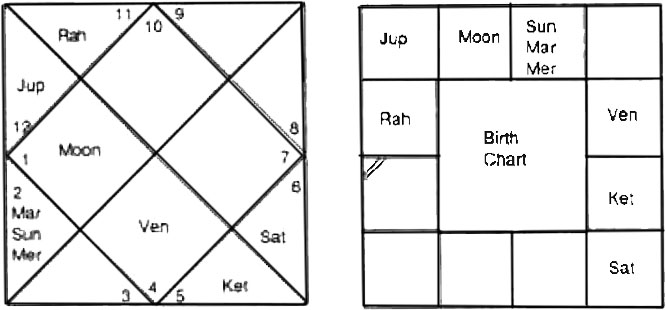
In the illustrated horoscope, the 7th house is stronger than the Ascendant (for logic, please see example 11). Consequently, the serial of Dasas will begin from the 7th house and in reverse order, as the 7th sign is even sign. In that order, the first Angle sign is Aries then Capricorn and lastly Libra sign. Since, 7th lord Moon is located in Aries, the Dasa will commence from Aries. Between Capricorn and Libra signs, the Dasa of the sign will come next whose lord has higher longitude.
The signs of the Panaphara houses from the 7th house are (in severse arder) Gemini, Pisces, Sagittarius and Virgo. The Dasas of these signs will be serlaled on the basis of these comparative strength. It comes to Pisces, Virgo, Sagittarius and Gemini. The sign Dasas of the Apoklima houses with respect to the 7th house are Taurus, Aquarius, Scorpio and Leo and in the sequence of Taurus, Aquarius, Leo, Scoprio Dasas.
The total number of years in respect of each Dasa shoutd be determined on the basis of Chara Dasa system. The Cancer sign being of even group, the total years will be 3 (4-1) i.e. by counting in the reverse _ order from the 7th house to the sign in which the 7th lord Moon is posited. Similarly, the Dasa periods (years) of the other signs may be determined.
In the same manner, amongst Atmakarka, the Moon, lord of Aries and the 7th sign, the Aries sign is more powerful. This is an odd sign, hance, the Dasa will start from Aries sign itself. Thereafter, the Dasas of the signs of Kendra, Panaphara and Apoklima houses be determined.
Karaka-Kendradi Graha (Planet) Dasa :
Atmakaraka Moon is posited in Aries sign which is an odd sign. Therefore, forward sequence will start from Aries in the context of Kendra, Panaphara and Apoklima houses and the Dasas of the planets located in these houses will follow the sequence depending upon their comparative strength.
Like, the Moon is in Aries, hence first Dasa will be that of the Moon and next planet in Angle from Aries, is only Venus and the Dasa of Venus will come next. The planets located in the Panaphara houses from the Moon (in the direct order) are Sun, Mercury, Mars, Ketu and Rahu. Since first three planets are together, the determination of three order will be on the longitudinal basis and the sequence will be Sun, Mars and Mercury. This will be followed by Ketu and Rahu Dasas.
The planets in Apoklima house from the Moon are only Saturn and Jupiter. On the basis of their strength, Jupiter comes first succeeded by Saturn.
The span of the Dasas of these planets is equal to the number (in terms of years) between the planets and their respective signs. Hence, the Dasa-span of Moon is 3 (4-1) years when counted in the reverse order upto Cancer (even sign). On the same lines, the Dasa-span in respect of planets may be measured. However, the sequence of the Dasas will remain the same.
As stated earlier, in the determination of the Dasa ofa planet, the counting should always commence from the planet to its respective sign. However, some astrological scholars are of the opinion that the counting should be from the sign to its planet (lords). This concept does not seem to hold water because the exposition of Kendradi-Dasa over here is purely in context with the maxim of Maharishi Parasara which is at variance with the Jaimini's aphorism.
दिराश्यधिप-खेटस्य गर्णयेदुभयादधि ।
उभयोरधिका संख्या कारकस्य दशा समा: ॥ ९७७ ॥
177 : The counting of the Dasa period (years) in respect of planets having lordship over two signs should be done upto both the signs and which ever sign attributes longer period shall be reckoned as the Dasa-span of the planet.
आत्मकारकमारभ्य कारकाख्यदशा क्रमात् ।
लग्नात् कारकपर्यन्तं संख्यामत्र दशां विदुः ॥ १७८ ॥
178 : Karaka Dasa commences from Atmakaraka and has the same sequence as that of the Karakas (eight Karakas). In this Dasa system, the span of each Dasa is equal the number (years) between the Ascendant and the respective Karaka.
मण्डूकापरपर्याया त्रिकूटाल्यदशा द्विज ! ।
लग्नसप्तमयोर्मध्ये यो राशिर्बलवान् भवेत् ॥ १७९ ॥
ततः क्रमेणौजरशो समे नेया सथोत्क्रमात् ।
त्रिकूटानां च विज्ञेयाः स्थिरवच्च दशा समाः ॥ १८० ॥
179-180 : O Brahmin! The ancient Astrologers used the name of Trikoota Dasa for Mandooka Dasa. Dasa in this system, emanates from the strongest amongst the Ascendant and the 7th house and sequence of the Dasas is in the forward or in the reverse order depending upon the sign being of odd or even nature. The period (years) of the Dasa are in line with the Sthira Dasa system (i.e., for movable signs-7 years, fixed signs 8 years and for dual signs 9 years). In this Dasa scheme, the counting pattern is to relinquish two signs in between every time (i.e. Jumping over two signs) and for this very reason it is called Mandooka Dasa.
निर्याणस्य विचारार्थं कैश्चिच्छूलदशा स्मृत्ता ।
लग्नसप्तमतो मृत्युभयोर्यो बलवान् भवेत् ॥ १८१ ॥
तदादिर्विषमे विप्र ! क्रमादुत्क्रमतः समे ।
दशाब्दाः स्थिरवत्तत्र बलिमारकभे मृतिः ॥ १८२ ॥
181-182 : Some astrological Savants consider Shoola Dasa for ascertaining the timing of death. The eighth house fromthe Ascendant or the 7th house i.e. the 2nd house, which ever is stronger will lead the Dasa order into motion. The sequence of the twelve signs will be in the forward or in the reverse order depending upon the leading sign being odd or even. The Dasas years are identical to those in the Sthira Dasa system. Death possibly occurs in the Dasa of strong Capricorn sign.
जन्मलग्नत्रिकोणेषु यो राशिर्बलवान् भवेत् ।
तमारभ्य नयेद् धीमान् चरपर्यायवद् दशाम् ॥ १८३ ॥
क्रमादुतक्रमतो ग्राह्यं त्रिकोणं विषमे समे ।
त्रिकोणाख्यदशा प्रोक्ता समा नाथावसानका: ॥ १८४ ॥
183-184; Trikona Dasa emanates from the Ascendant or from of the Trinal houses (5th or 9th) which ever is the stronger one and is like Chara Dasa. Forward count for odd and reverse count for the even sign, be adopted. The Dasa years equals to the difference of the number of signs between the concernd Trinal house to the lord of its sign. This Dasa-system since confined tothe Trinal houses (1,5,9) it is called Trikona-Dasa system.
लग्नाद् धर्मस्य तद्दृष्टराशीनां च दशास्ततः ।
दशमस्य च तद्दृष्टरशीनां च नयेत् पुनः ॥ १८५ ॥
एकादशस्य तद्दृष्टराशीनां स्थिरवतु समाः ।
प्रवृत्ता दृग् वशाद्यस्माद् दुगुदशेयं ततः स्सूता ॥ १८६ ॥
चरे व्युत्क्रमतो ग्राह्या दुगयोग्याः स्थिरभे क्रमात्त् ।
विषमे क्रमतो द्वन्दे राशयो व्युत्क्रमात् समे ॥ १८७ ॥
185-187 : First, the 9th sign from the Ascendant, and then signs aspected by the 9th sign followed by the 10th sign and the signs aspected by 10th sign and thereafter 11th sign, the signs aspected by the 11th sign are the Dasas of the signs under Driga Dasa system. The sequence of the Dasa are decided on the basis of aspects and that is why it is called Driga-Dasa system.
The signs 9th, 10th, 11th from the Ascendant are respectively movable, fixed and dual. In the event of movable signs the count toward aspected signs be forward and in that of fixed signs, the counting upto the aspected sign be in the reverse order. Incase of dual sign, if it is odd sign, forward counting and even sign backward counting, upto the aspected signs be resorted to.
ऋक्षे लनादिराशीनां दशा राशिदशा स्मृता ।
भयातं रविभिर्निघ्नं भभोगविहृतं फलम् ॥ १८८ ॥
राश्याद्यं लग्नराश्यादौ योज्यं द्वादशशेषितम् ।
तदारभ्य क्रमादोजे दशा जेयोत्क्रमात् समे ॥ १८९ ॥
188-189 : Every Nakshatra consists of Dasas of 12 signs including the Ascendant in Lagnadi-Rasi Dasa system. Multiply Bhayaata at birth by 12 and divide it by the Bhabhoga and the remainder sign degree etc., be added to the Ascendant’s longitude and the sum be divided by 12 and Rasi-Dasa is thus obtained. The Dasa sequence will commence there from upto the 12 signs. For odd sign forward and for even sign reverse counting will be resorted to.
Example : 15
The Bhagaata of the birth Nakshatra Kritika is 0 Ghati, 36 Palas, 20 Vipalas (432 Pallas) [Vipala be ignored as being inconsequential] and Bhaghoga 65 Gh. 22 Pal. (3922 Pal.)
Bhayaata + Bhabhoga = 432 Pal. + 3922 Pal.
= 0 Sign, 3 Deg., 18 Mts. and 16 Sec.
| Sign. | Deg. | Mts. | Sec. | |
| Bhayaata + Bhabhoga = | 0 | 3 | 18 | 16 |
| Long. of Ascendant = | 9 | 19 | 4 | 42 |
| Expired period = | 9 | 22 | 22 | 53 |
[It the sum of the signs is more the 12 signs, dispense with 12 signs and balance signs be reckoned]. In the instant case, the resultant sign is lass than 12 signs and henca Capricorn Dasa will be the first Dasa and the sequence of the Dasaswillbe in the reverse order (Capricorn being even sign). The period (years) of the Dasa will be inline with the SthiraDasa system,
Method to find out the Balance of Dasa:
दशाब्दा भुक्तभागघ्ता त्रिंशता विहृताः फलम् ।
भुक्तं वर्षादिकं ज्ञेयं भोग्यं मानाद् विशोधितम् ॥ १९०॥
190 : The expired longitude of the Dasa (so obtained) be multiplied by the total year of the said Dasa and then divided by 30. The product will indicate the expired period. By deducting the Product from Dasa (years), the balance of Dasa be obtained.
अकाण्दीन् स्वणन् पञ्च प्रथमं विन्यसेत् क्रमात् ।
कादिहान्तांल्लिखेद् वर्णान् स्वराघो डज्जणोज्झितान् ॥ १९१ ॥
तिर्यक् पंक्तिक्रमेणैव पञ्च-पञ्च-विभागतः ।
न प्रोक्ता डञणा वर्णा नामादौ सन्ति ते न हि ॥ १९२ ॥
चेद् भवन्ति तदा ज्ञेया गजडास्ते यथाक्रमात् ।
यत्र स्वरे स्वनामाद्यवर्णः स्यात् तत्स्वरादयः ॥ १९३ ॥
क्रमात् पंच दशाधीशाः द्वादशद्वादशाब्दकाः ।
स्वराणां च क्रमाज्ज्ञयाः दशास्वन्तर्दशादयः ॥ १९४ ॥
191-194 : Write the sequence of Akaradi (अकारादि) 5 Swaras (अ, इ, उ, ए, औ) and beneath, write the Varana (वर्ण) in natural seriatim. The words ‘ड’, 'ञ', 'ण' are to be ignored as there Varana are not put to use in any individual name. The Varana are written in six rows and five
coloumns. However, if these Varanas are figured in any name, the same may be replaced by another Varana such as ड by ग, ञ,by च and ण by ड्. Identify the “Swara’from the column in which Varana of the name of the individual is placed. Commencing from that Swara, the Dasas are determined. All the five Dasas are of 12 years duration. Every Swara Dasa contains Antardasa of the five Swara in the same sequence.
पूर्वमेव मया प्रोक्ता वर्णदास्या दशा द्विज ! ।
इदानीं शम्भुना प्रोक्ता कथ्यते योगनी दशा ॥ १९५ ॥
मंगला पिंगला धन्या भ्रामरी भद्रिका तथा ।
उल्का सिद्धा संकटा च योगिन्योऽष्टौ प्रकीर्तिताः ॥ १९६ ॥
मंगलातोऽभवच्चन्द्रः पिडगंलातो दिवाकरः ।
घन्यातो देवपूज्योऽभूद् भ्रामरीतोऽभवत् कुज: ॥ १९७ ॥
भद्रिकातो बुधो जातस्तथोल्कातः शनैश्चरः ।
सिद्धातो भार्गवी जातः संकटातस्तमोऽभवत् ॥ १९८ ॥
जन्मर्क्ष च त्रिभिर्युक्तं वसुभिर्भागमाहरेत् ।
एकादिशेषे विज्ञेया योगिन्यो मंगलादिका: ॥ १९९ ॥
195-199 : Maharsh Parasara said; O learned Savant, I have already described Varana Dasa, now | explain to you Yogini Dasa an enunciated be Lord Mahadeva. There are eight Yogini Dasas viz., 1. Mangla, 2. Pingala, 3. Dhanya, 4. Bhramari, 5. Bhadrika 6. Uika, 7. Sidha and 8. Sankata. The Moon, the Sun, Jupiter, Mars, Mercury, Saturn, Venus, Rahu have been evolved from Mangla, Pingla, Dhanya, Bharamari, Bhadrika, Ulka, Sidha, Sankata respectively. Add 3 in the birth Nakshatra and divide it by 8. The remainder represents Yogini Dasa, in sequence commencing from Mangla Dasa, operating at the time of the birth. The Dasa years is in the seriatim of the natural Dasa order of 1, 2, 3, 4, 5, 6, 7 and 8 years. From Bhayaata, Bhabhoga, the expired period and bal- ance Dasa at the time of the birth be calculated.
एकाद्येकोत्तरा ज्ञेया: क्रमादापां दशासमा: ।
नक्षत्रयातभोगाभ्यां भुक्तं भोग्यं च साधयेत् ॥ २०० ॥
येषां यदायुः संप्रोक्तं पैण्डमांशं निसर्गजम् ।
तत्तत् तेषां दशा ज्ञेया पैण्डी, चांशी निसर्गजा ॥ २०१ ॥
बली लग्नार्कचन्द्राणां यस्तस्य प्रथमा दशा ।
तत्केन्द्रादिगतानां च ज्ञेया बलवशात्ततः ॥ २०२ ॥
200-202 : The Pinda, Amsa, Naisargika Dasas will correspond to Pindaya, Amsayu, Nisargayika of the planet as ascertained on the basis of earlier narrations. The sequence of Dasa will commence from the strongest amongstthe Ascendant, the Sun and the Moon and then the Dasa order of the planets located in Kendras, Panaphara and Apoklima houses will follow and the eight Dasas (the Ascendant and the 7 planets) will run in the natural order starting from the Ascendant.
अष्टवर्गबलेनैषां फलानि परिचिन्तयेत् ।
अष्टवर्गदशाश्चैताः कथिताः पूर्वसूरिभिः ॥ २०३ ॥
203 : The analysis of these Dasas be done on the basis of Ashtakavarga Balas which are explained in the later part. The ancient scholars have described these Dasas as Ashtakavarga Dasas.
परायुर्दादशो भागस्तस्य सन्ध्या प्रकीर्तिता ।
तन्मिता लग्नभादीनां क्रमात् सन्ध्यादशा स्मृता ॥ २०४ ॥
204 : The Dwadasamsa (1/12th) of the Paramayu (120 years) is equal to Sandhya. The sequence of the Ascendant and other signs constitute Sandhya Dasa; each being of 10 years. (1/ 12th of 120 years = 10 years).
सन्ध्या रसगुणा कार्या चन्द्रवहनिता फलम् ।
संस्थाप्यं प्रथमे कोष्ठे तदर्धं त्रिषु विन्यसेत् ॥ २०५ ॥
विभागं वसुकोष्ठेषु विन्यस्य तत्फलं वदेत् ।
एवं द्वादशभावेषु पाचकानि प्रकल्पयेत् ॥ २०६ ॥
205-206 : Multiple Sandhya Dasa by 6 and divide it by 31, The resultant value (in terms of year etc.) be keptin first column and ½ part of it be entered in the nextthree columns. The restofthe eight columns be filled with the figure 1/3rd of the resultant value. In this manner, the Pachaka in Sandhya Dasa be conceptulised.
विंशोत्तरीदशेवाऽत्र कैश्चिद् तारादशा स्मृता ।
आचंकुरागुशबुकेश्वादिस्यानेषु तारकाः ॥ २०७ ॥
जन्म-सम्पत्-विपत्-क्षेम-प्रत्यरिः साधको वधः ।
मैत्रं परममैत्रं च केन्द्रस्थवलिमी ग्रहात् ॥ २०८ ॥
ज्ञेया तारादशा विप्र ! नामतुल्यफलप्रदा ।
यस्य केन्द्रे स्थितः खेटो दशेयं तस्य कीर्तिता ॥ २०९ ॥
207-209 : Some exponents of the astrology have been considering Tara Dasa like Vimshottari Dasa. tn place of the Sun, the Moon, Mars etc., Tara Dasa of Janma, Sampat etc. are reckoned. Commencing from the strongest planet amongst the planets tenanted in the Angles, the sequence of Janma, Sampat, Vipat, Kshema, Pratyak, Sadhana, Naidhara, Mitra and Param- Mitra Dasas are adopted. O Vipra ! The effect of Tara Dasas will be in accordance to their nomenciature. This Dasa system will be applicable only to those nativities where the planets are posited in the Angles. In the event of more than one planets in the Angles, the commencement of Dasa sequence will be from the strongest amongst them.
इति ते कथिता विप्र ! दशाभेदा अनेकधा ।
एतदन्तर्दशाभेदान् कथयिष्यामि चाग्रतः ॥ २१० ॥
210 : O Brahmin ! I have since acquainted you with the intricacies of the various type of Dasa systems. I would explain the effects of their Antradasas at a later stage.