Brihat Parashara Hora Shastra · Volume 2
53. COMPUTATION OF ANTARDASAS UNDER VIMSHOTTARI DASA SYSTEM
दशाब्दाः स्वस्वमानघ्ना सर्वायुर्योगभाजिताः ।
पृथगन्तर्दशा एवं प्रत्यन्तरदशादिकाः ॥ १ ॥
1 : For computing the Antardasa of a planet, multiply the Mahadasa years of that planet with the Mahadasa years of other planets separately and then divide the product by the total Mahadasa years of all the planets, the resultant figure in years etc. will represent the Antardasa of each planet. In the same way, from the Antardasa, the Pratyantar Dasas can be calculated.
आदावन्तदशा पाकपतेस्तत्क्रमतोऽपराः ।
एवं प्रत्यन्तरादौ च क्रमो ज्ञयो विचक्षणैः ॥ २ ॥
2 : The first Antardasa will belong to the planet whose Mahadasa being reckoned and the normal sequence of the Antardasas of the other planets follow therefrom. In the same way, the sequence of the Pratyantar Dasas be adopted. (Here the first Pratyantar Dasa will that be of the Antardasa).
भुक्तिर्नवानां तुल्या स्याद् विभाज्या नवधा दशा ।
आदौ दशापतेर्भुक्तिस्तत्केन्द्रादियुजां ततः ॥ ३ ॥
विद्यात् क्रमेण भुक्त्यंशानेव सूक्ष्मदशादिकम् ।
बलक्रमात् फलं विज्ञैर्वक्तव्यं पूर्वरीतितः ॥ ४ ॥
3-4: To compute the Chara Dasas of the planets, multiply the Dasa-span by 9 and the product thereafter is equally divided amidst all the planets and that will be the Antardasa span of each planet. In this, the first Dasa belongs to the lord of the Dasa followed by the Dasas of the planets posited in the Angles (Kendras), then Dasas of planets in Panaphara and lastly the Dasas of the planets in Apoklima houses. Likewise, the Sookshma Dasas of the nine Antardasas be ascertained and their results be predicted by the learned Astrologers on the basis of the strength etc., and other maxims enunciated earlier.
Antardasas of the signs.
कृत्वाऽर्कधा राशिदशां राशेर्भुक्तिं क्रमाद् वदेत् ।
प्रत्यन्तर्दशाद्येवं कृत्वा तत्तत्फलं वदेत् ॥ ५ ॥
5 : The Dasa years of the signs be divided by 12 the resultant will be the Antardasa of each sign. Similarly division of the Antardasas of the sign, the Pratyantar Dasas of the signs are obtained.
The sequence of Antardasas of the signs.
आद्यसप्तमयोर्मध्ये यो राशिर्बलवांस्ततः ।
ओजे दशाश्रये गण्याः क्रमादुत्क्रमतः समे ॥ ६ ॥
6: The first sign of Antardasa or the 7th sign of Antardasa which ever is stronger, the sequence of Antardasa will commence therefrom. In the event of first Antardasa sign being odd, the Dasa sequence will be in the forward order and for even sign, it will be in the reverse order.
अत्राऽपरो विशेषोऽस्ति ब्रविमि तमहं द्विज ! ।
चरेऽनुज्झितमार्गः स्यात् षष्ठषष्ठादिकाः स्थिरे ॥ ७ ॥
उभये कण्टकाज् ज्ञेया लग्नपञ्चमभाग्यतः ।
चरस्थिरद्विस्वभावेष्वोजेषु प्राक् क्रमो मतः ॥ ८ ॥
तेष्वेव त्रिषु युग्मेषु ग्राह्यं व्युत्क्रमतोऽखिलम् ।
एवमुल्लिखितो राशिः पाकराशिरुदीर्यते ॥ ९ ॥
स एव भोगराशि: स्यात् पर्याये प्रथमे स्मृतः ।
आद्याद् यावतिथ: पाकः पर्याये यत्र दृश्यते ॥ १० ॥
तस्मात् तावतिथो भोगः पर्याये तत्र गृह्यताम् ।
तदिदं चरपर्याय - स्थिरपर्याययोर्द्वयोः ॥ ११ ॥
त्रिकोणाख्यदशायां च पाकभोगप्रकल्पनम् ।
पाके भोगे च पापाढ्ये देपपीडा मनोव्यथा ॥ १२ ॥
7-12: O-Vipra : I now narrate the special dimensions of the sequence of the Antardasas of the signs. If the apex Dasa sign is of a movable sign, the sequence of twelve Antardasas of the signs will be in forward or reverse orders. If the apex Dasa is of a fixed sign, the Antardasa sequence will commence there itself followed by the Antardasa df every 6th sign thérefrom. Should the apex Dasa-sign be a dual sign, the first Antardasa will be of the apex Dasa-sign, then the Antardasas of the signs in Angles (Kendras) to the apex Dasa-sign, followed by the Antardasas of the signs in Angles from the 9th to the apex sign; will be the sequence of the twelve Antardasas of the signs. Ifthe apex Dasa-sign of allthe three kinds of signs viz., movable, fixed and dual, is an odd sign, the order of the Dasas will be forward-wise, and in the case of even sign, it would be in the reverse order.
The apex Dasa (दशाश्रय) is called Paaka sign (पाक राशि). The first Dasa-sign is known as and if it belongs to Bhoga sign (भोग राशि). The next Dasa-sign i.e.. Dasa Prada (दशा प्रद) and if it belongs to an even sign, then as much distance the apex Dasa (दशाश्रय) is ahead of it (दशा प्रद) at that much distance, the Bhoga sign (भोग राशि) will be located. In this manner Paaka and Bhoga signs be assumed for Chara, Sthera and Trikona Dasas. If Paaka and Bhoga signs are conjunct with the malefic planets, it will produce oppressive bodily pain and mental distress.
Computation of Antardasas of Pinda etc.
पिण्डत्रिकदशायां तु ब्रवीम्यन्तर्दशाविधिम् ।
पूर्ण दशापतिर्दद्यात् तदर्धं तेन संयुतः ॥ १३ ॥
त्रिकोणगस्तृतीयांशं तुर्यांशश्चतुरस्त्रगः ।
स्मरगः सप्तमं भागं बहुष्वेको बली ग्रहः ॥१४ ॥
एवं स - लग्नका: खेटा: पाचयन्ति मिथः स्थिताः ।
समच्छेदीकृताः प्राप्ता अंशाश्छेदविवर्जिताः ॥ १५ ॥
दशाब्दाः पृथगंशघ्ना अंशयोगविभाजिताः ।
अन्तर्दशा भवन्त्येवं तत्प्रत्यन्तर्दशादिकाः ॥ १६ ॥
13-16: Now I explain the procedure for working out the Antardasas of Pinda etc., which are of three types (Pinda, Amsa, Naisargika).
The lord of the operating Dasa will have full part (1) and planet in conjunction with it will have half part (½), the planet in Trines from it will have one-third part (1/3), the planet in 4th and 8th from it will have one fourth part (¼), the plant located at 7th house from it will have one seventh part (1/7) of the span of the Dasa span lord. In this manner, the eight planets, including the Ascendant, mutually located are the Antardasa lords (Pachaka - पाचक) of the Dasa. If there are more than one planets in these houses, the stronger amongst them will be the Antardasa lord (पाचक). The parts (proportion) of all the Antardasas of the Dasa be coverted with a common denomination and by omitting this denominator, the numerators will indicate non-fractional digits of each planet.
By multiplying the figure of a particular planet with the Dasa years and then dividing it by the sum total of the digits of all the planets, it will give the Antardasa of each planet. Like Antardasa, the Pratyantar Dasas be worked out.
"एकर्मोपगतानां यो भवति बलाधिको विशेषेण ।
एक: स एव हर्ता नान्ये तत्र स्थिता विहगा:"
Meaning thereby that if many planets are at one place, only the strongest amongst them will be the planet who will have the Antardasa. course of his part.
This goes to prove that in any horoscope, if there are no planet in the Ascendant, 4th, 5th, 7th, 8th and 9th, from the Dasa-lord planet, such Dasa-lord will not have any Antardasas in his Dasa and this planet himself will be the lord of a lone Antardasa.
Whatever parts of the lord of Antardasas are obtained (i.e. 1/2, 1/3 etc.), after equalising the denominator of all the parts, only the numerator's figures of each planet (denominators duly discarded) be multiplied individually by the Dasa years and then divided by the sum total of the numerator's figures of all the planets. The resultant will represent. the Antardasa of the planet in terms of years and months.
Example - 17 : To find out of the Antardasa in the Sun Dasa.
The Sun is in the Ascendant alongwith the Moon, Saturn and
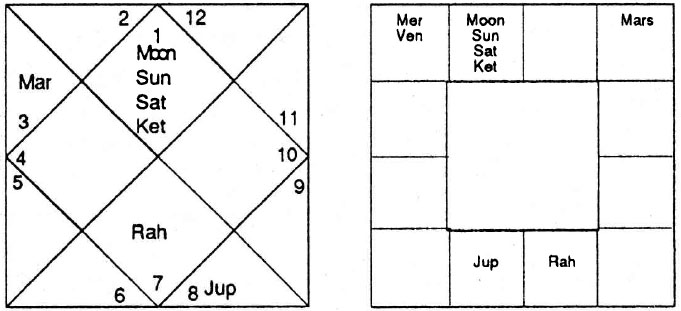
Ketu. The Moon is the strongest amongst them (other than the Sun who is the Dasa lord). Therefore, the Moon will be the lord of ½ part. There is no planet in the Trines from the Sun. (5th and 9th houses). Jupiter is in the 8th house from the Sun, hence will have 14th part in his Antardasa. Therefore, in the Sun Dasa; the Sun 1/1, the Moon 12th and Jupiter 14th parts as the period of their respective Antardasas. Now the process of equalising of the denominator will follow :
| Sun | Moon | Jupiter | Sun | Moon | Jupiter | ||||||
| 1 | , | 1 | , | 1 | = | 4 | , | 2 | , | 1 | |
| 1 | 2 | 4 | 4 | 4 | 4 |
By discarding the denominators, we get 4, 2, 1 respectively for the Sun, the Moon and Jupiter, totalling as 7. Suppose the longevity years (आयुर्दाय) of the Sun is 6 years 1 month and 22 days = 2212 days.
| Antardasa of the Sun | = | 2212 × 4 | = 1264 days |
| 7 | |||
| = | 3 years 6 months 4 days. | ||
| Antardasa of the Moon | = | 2212 × 2 | = 632 days |
| 7 | |||
| = | 1 year 9 months 2 days. | ||
| Antardasa of the Jupiter | = | 2212 × 1 | |
| 7 | |||
| = | 0 year 10 months 16 days |
| Year | Months | Days | |
| Antardasa of the Sun | 3 | 06 | 04 |
| Antardasa of the Moon | 1 | 09 | 02 |
| Antardasa of Jupiter | 0 | 10 | 16 |
| Dasa of the Sun | 6 | 01 | 22 |
These calculations are based on the following formula :
| Total Dasa year of the planet | × | Part of the individual planet |
| Sum Total of all parts |